


Greece / Crete / Food and wine · 13 min read
Stop asking for a menu. Ask what is in the pot.
Crete holds the 2026 European Region of Gastronomy title — and the food that earned it is mostly inland, at lunch, with no printed menu at all.
Crete Gastronomy 2026: The Short Answer
A whole-island food culture that was already there, now with a title attached.
Crete gastronomy 2026 is not about one famous restaurant or a new tasting-menu scene. It is a practical food guide to the island's best local meals: where to eat, what dishes to order, when to leave the coast, how much to budget, and why the 2026 title matters on an actual plate.
In October 2024, an international jury spent five days on Crete, met with more than sixty chefs, farmers, academics, and local officials, and came away recommending the island for a title most travelers have never heard of: European Region of Gastronomy. Crete officially holds it in 2026. The jury's report didn't praise fireworks or fusion cuisine — it praised eleven million olive trees, over three hundred edible wild greens growing on the hillsides, and a food culture built on simplicity that scientists have spent decades studying as a model for human longevity.
That's the real headline here, and it's worth sitting with before you book a single restaurant: Crete didn't win this title by inventing something new. It won it by never stopping doing what it's always done. This guide is about where that's most visible on the plate.
The title is built on olive oil, wild greens, mountain tavernas, small producers and Cretan wine — not on one famous restaurant.
Split your meals between Chania, Heraklion, Rethymno and at least one inland village.
The dishes to hold out for: dakos, horta, antikristo, fava and Sfakiani pita.
At least one meal should be at a taverna with no fixed menu at all.
Three dishes worth seeking out at any taverna on the island
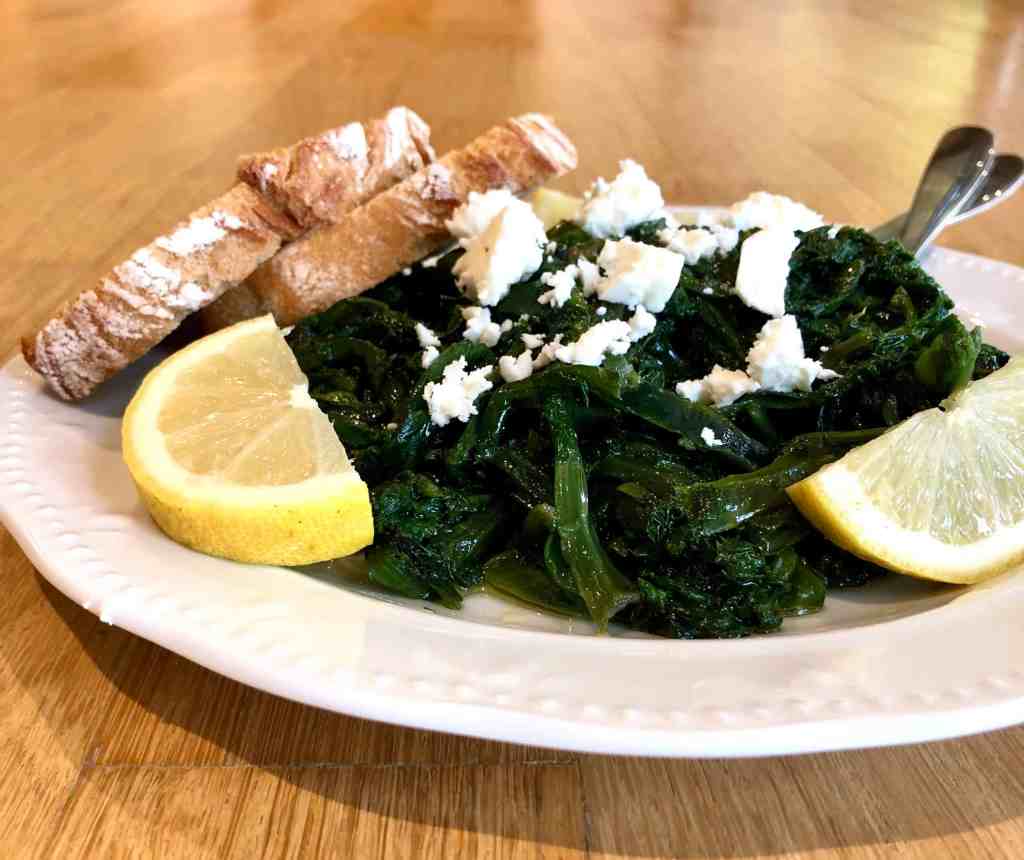 Horta — wild greens, olive oil, lemon


What Crete’s 2026 Gastronomy Title Actually Means
Awarded through IGCAT, after a jury spent five days meeting more than sixty chefs and producers.
The title is awarded through the European Region of Gastronomy platform, coordinated by IGCAT, and it is designed to spotlight food heritage, biodiversity, sustainable tourism, local producers, and regional identity. That matters on Crete because the island's strongest food experiences are rarely isolated from the landscape: olive groves, vineyards, beehives, sheep farms, wild greens, village ovens, and family-run tavernas all feed the same story.
For travelers, the useful takeaway is simple: treat Crete as a food region, not just a beach island with good dinners. The Greek National Tourism Organisation's gastronomy guide is a useful official primer on the wider Greek food context, while the World Region of Gastronomy platform explains why these titles focus on culture, education, sustainability, and local food systems rather than only restaurants.
Every theme, sortable
| Theme | What it means in Crete | How to experience it |
|---|---|---|
| Olive oil | Everyday ingredient, not garnish | Taste Kolymvari, Messara, or Sitia oil at the source |
| Wild greens | Seasonal biodiversity on the plate | Order horta and ask what was gathered that week |
| Mountain tavernas | Slow cooking, short supply chains | Drive inland for lunch, not late dinner |
| Cretan wine | Local varieties like Vidiano, Liatiko, and Kotsifali | Pair one winery visit with a taverna meal |
Forget the Word “Authentic” — Just Ask What’s in the Pot
Outside the resort towns, most tavernas do not bother with a printed menu.
Cretan tavernas, especially outside the resort towns, often don't bother with a printed menu. The honest version of eating well here means walking into the kitchen, looking at what's simmering in the clay pots, and pointing. If a place hands you a glossy laminated menu with photos, that's usually your signal you've found the version built for someone who won't ask questions — not the version built for someone who actually wants to eat like Crete eats.
Ntounias: No Menu, No Electricity in the Kitchen, No Compromise
Taverna Drakona, near Chania, and the clearest statement of what this island does.
If there's one taverna that captures what this island's food culture is actually about, it's this one, tucked into the mountain village of Drakona about thirty minutes from Chania. Owner-chef Stelios Trilirakis runs it alongside his family's adjacent organic farm, and everything — genuinely everything — is cooked over wood fire in clay pots, with no modern electrical appliances anywhere near the kitchen. There's no printed menu; you're invited in to see what's cooking that day and choose from there.
The setting alone — olive groves, mountain breezes, a building that feels more like someone's home than a restaurant — does half the work. But it's the food that makes people drive thirty minutes up a winding mountain road specifically for this: thick-cut fried potatoes dusted in Cretan oregano, slow-cooked meats, vegetables that came from the field outside that morning. Reservations are essential, especially on weekends, when locals show up alongside the visitors who've heard about it.
Salis: Where Chania’s Harbour Scene Actually Delivers
Most of the waterfront sells the view. This one cooks.
The Venetian harbor in Chania has the views, but not always the food — most of what lines the water is built for foot traffic rather than flavor. Salis is the consistent exception, a restaurant that takes traditional Cretan dishes and gives them a modern, creative twist without losing the thread back to where they came from. The octopus carpaccio gets singled out repeatedly by people who actually cook Cretan food for a living, and the pasta program here is strong enough that visitors find themselves ordering the same dish on repeat trips. It's proof that "harbor restaurant" and "actually good" aren't mutually exclusive in Chania — you just have to know which one.
Salis, Chania — the harbour restaurant that earns its view
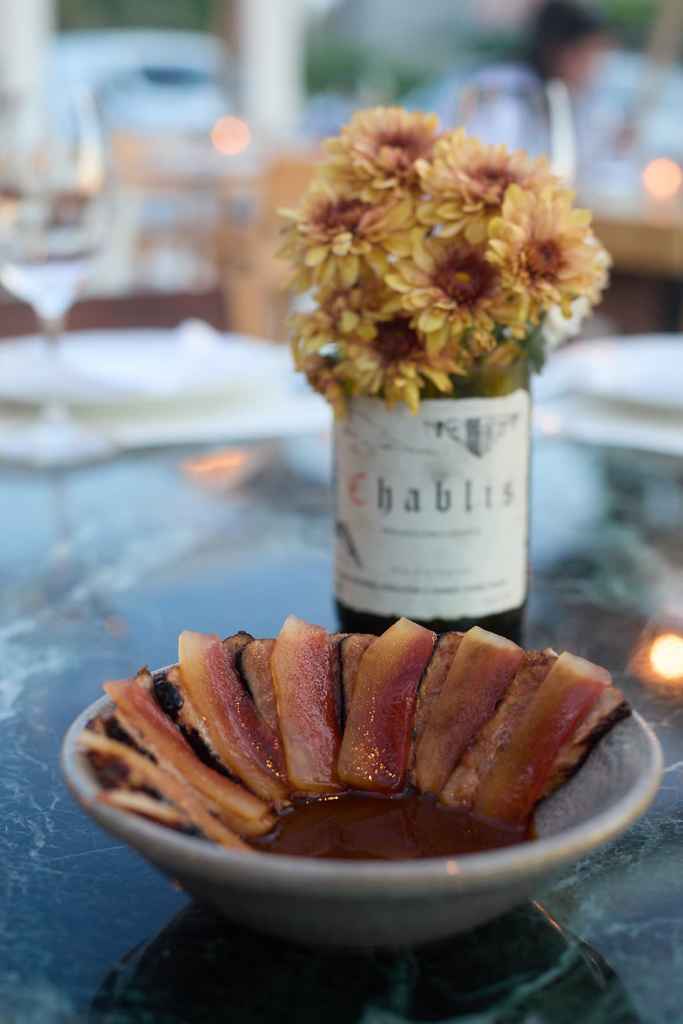 The plate
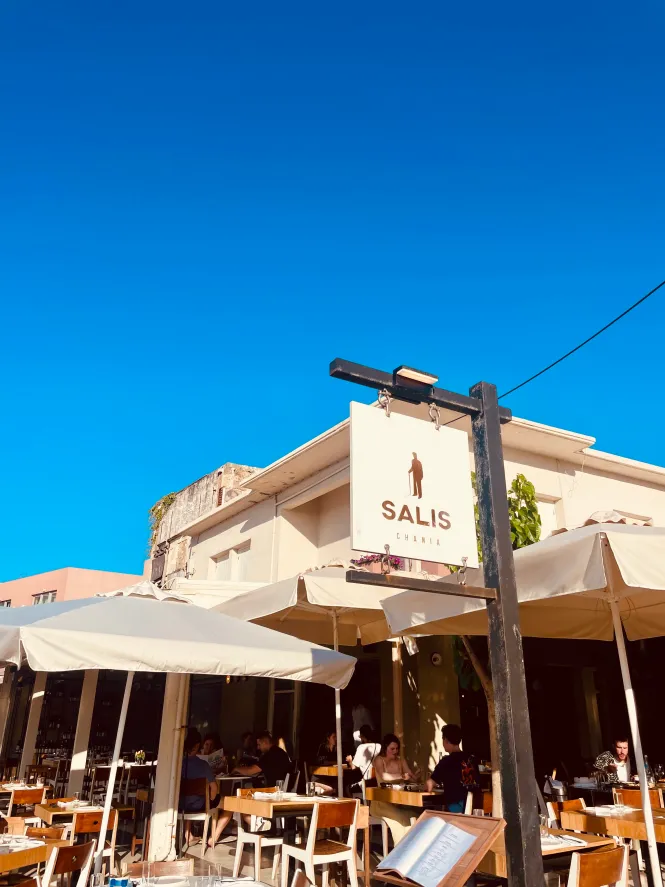 Octopus carpaccio
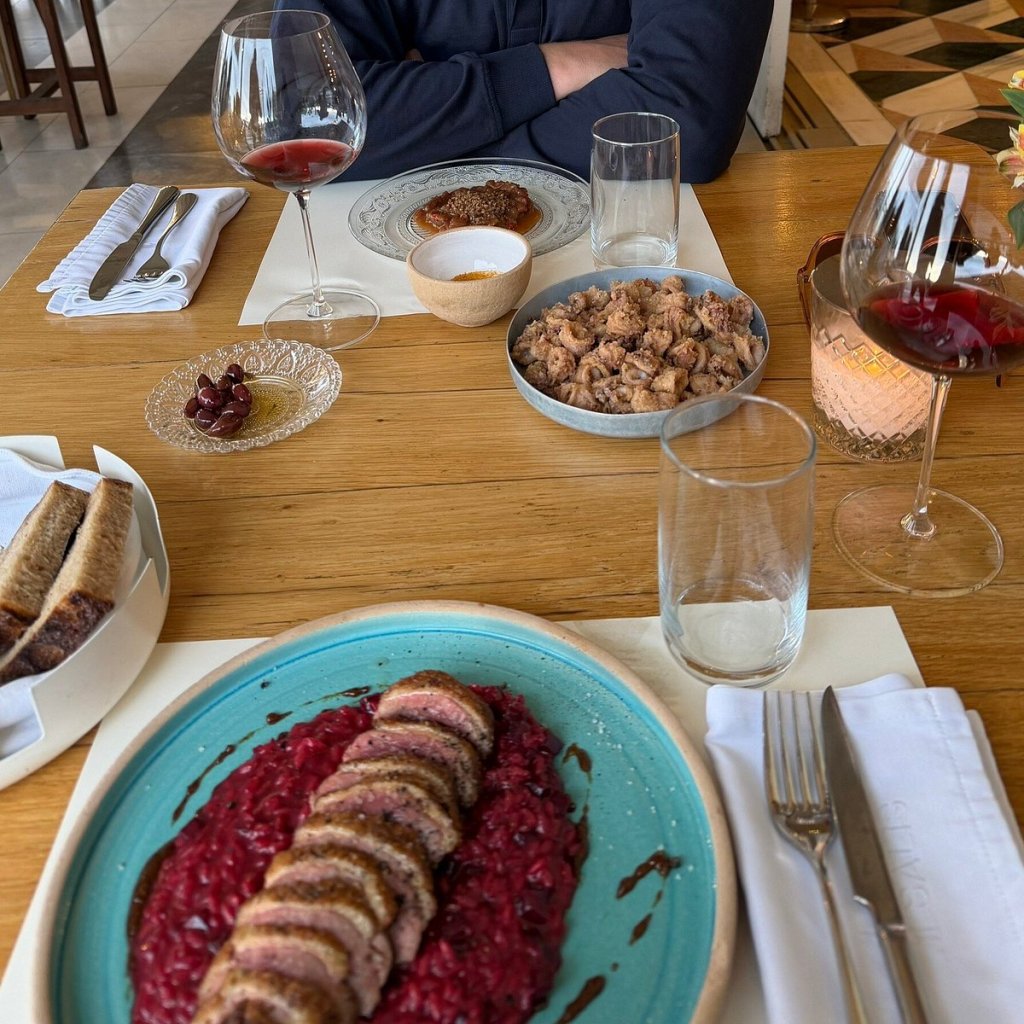 And the pasta, which is the sleeper order
Peskesi: The Farm-to-Table Pioneer in Heraklion
Sourcing almost everything from its own farm, a decade before that was a position.
When dietician Panagiotis Magganas opened this restaurant over a decade ago, sourcing nearly everything from his own 60-acre biodynamic farm, locals reportedly thought he was making a mistake. He wasn't. Peskesi is now one of the most consistently recommended restaurants on the island, set in a huddle of stone houses that once belonged to a Byzantine church.
The menu reaches back further than most Cretan kitchens are willing to go: avronies (wild asparagus) in broth, creokakkavo — pork slow-cooked with honey and herbs in a recipe dating back to Minoan times — and katsikaki stamnagathi, kid goat served with Crete's wild chicory "superfood." This is farm-to-table done with actual historical depth behind it, not as a marketing label borrowed from somewhere else.
Avli: Rethymno’s Romantic Case for Olive Oil Pairing
A Venetian mansion courtyard, and a chef who is also a certified olive oil sommelier.
Tucked into a Venetian mansion with a flower-filled courtyard in Rethymno, Avli runs on a detail almost no other restaurant on the island can claim: its chef, Vassilis Leonidou, is also a certified olive oil sommelier. Ask him to pair each course with a different extra virgin olive oil, and you'll come away understanding the island's defining ingredient in a way no bottle label could teach you. Cretans only half-jokingly say their olive oil is the best in Greece, and a meal here is the closest thing to a guided argument for why they might be right.
Avli, Rethymno — the courtyard, the plate, the room
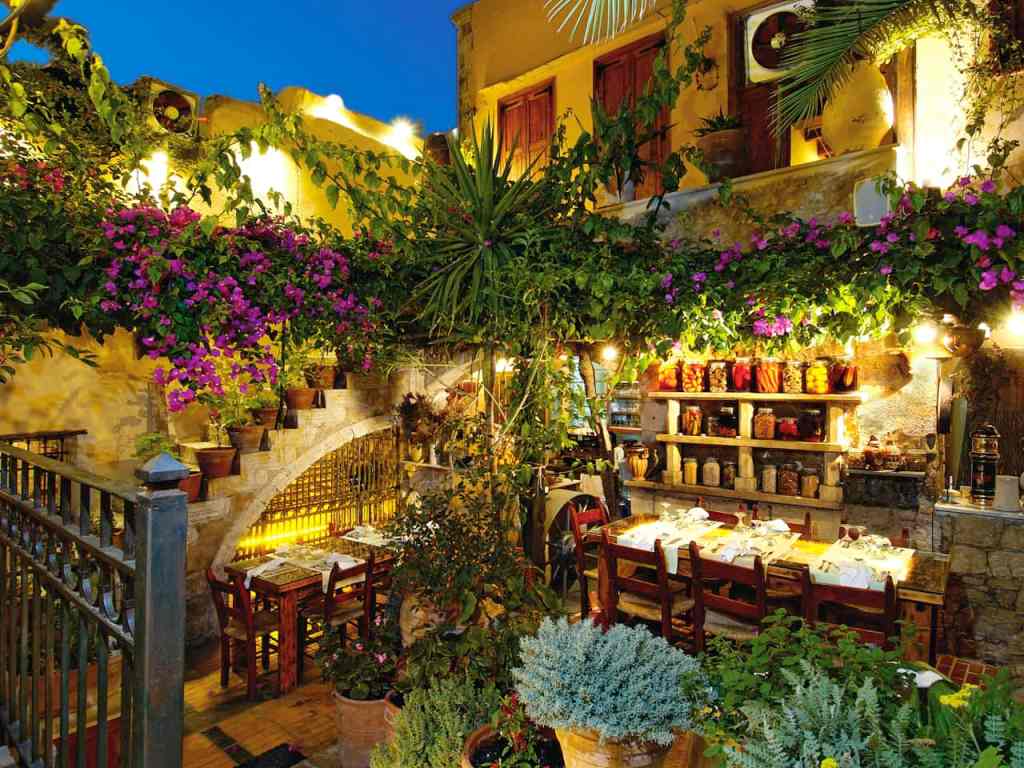 The flower-filled courtyard
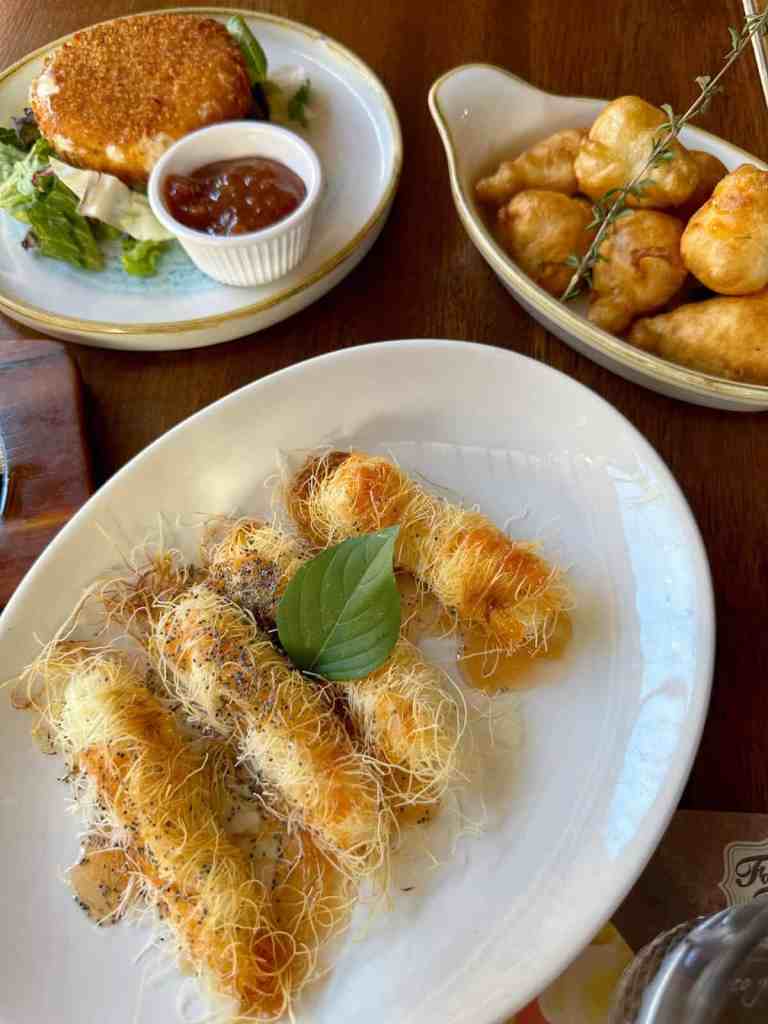 A dish from the pairing menu
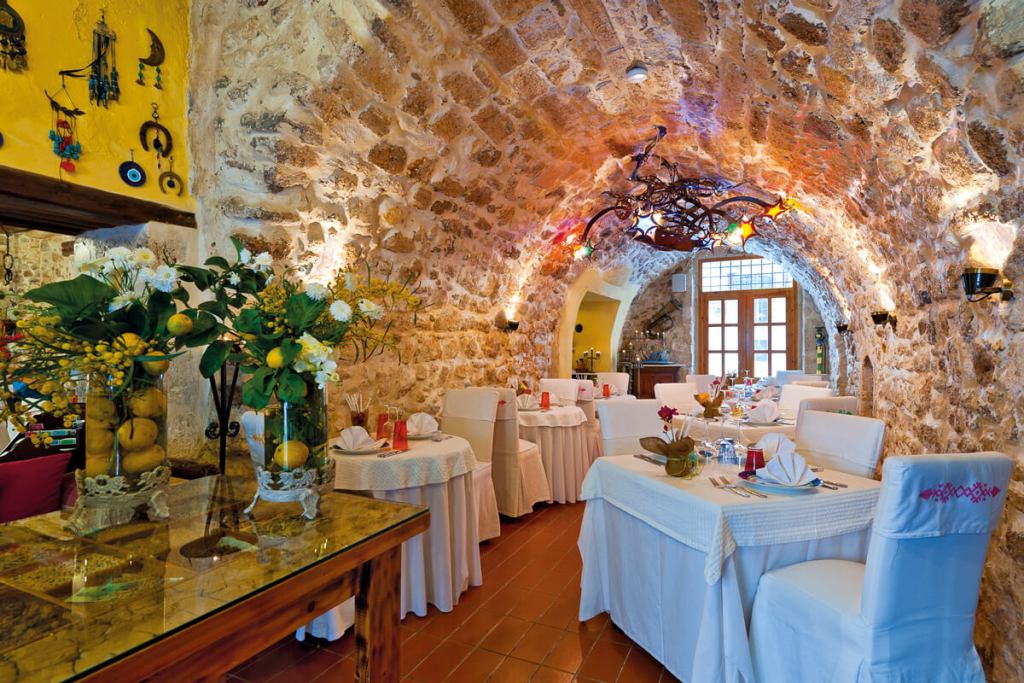 And the Venetian mansion interior
The Mountain Detour Is Not Optional
The single most important piece of advice in this guide.
This is the single most important piece of advice in this entire guide: some of the best food on Crete simply isn't on the coast, and skipping the drive inland means skipping the meal locals would actually pick for themselves.
Three detours, none of which need planning
From Chania
the villages of Therisso and Meskla sit within thirty to forty minutes and serve lamb, pies, and wild greens at what's widely considered their purest.
From Rethymno
the Amari Valley — a lush, lightly visited agricultural region surrounded by mountains — has tavernas where the goat came from the yard out back and a three-course meal with wine for two costs less than a single main course would in a tourist-zone restaurant elsewhere.
From Heraklion
Archanes and the Peza wine country offer the same principle applied to a different landscape — vineyards instead of orchards, but the same farm-table directness.
None of these detours require advance planning beyond a car and an appetite. The food doesn't get more honest than this anywhere else on the island.
Antikristo, the East, and the Kafeneion
Lamb staked around an open fire, fish tavernas nobody writes about, and a stop that is not about food.
If you want to understand Cretan meat cookery in a single dish, it's antikristo — lamb or pork slow-roasted over an open wood fire, the meat angled to face the flame rather than sit directly over it. A taverna outside Chania built specifically around this technique sources everything from olive oil to wine locally, treating the whole meal as an extension of the cooking method rather than a backdrop for it. The result is meat that's tender and smoky in a way that no oven replicates, and watching it roast is most of the entertainment for the evening.
The eastern part of the island sees far fewer visitors than Chania or Heraklion, and the fish tavernas there reflect that. At a family-run spot by the sea in this less-touristed stretch, the convention is simple and unpretentious: if you ask, they'll open the fridge and show you the actual catch of the day, ready to be grilled or fried à la minute. There's no performance to it — it's just the most direct way to guarantee what's seasonal and fresh, and it's a convention worth looking for anywhere on the coast, not just in the east.
Scattered through inland villages — particularly along the routes connecting major sites like the Minoan palace of Festos — are kafeneia: small, old-fashioned cafés where time genuinely seems to slow down. Stopping for a coffee, a shot of raki, or a simple plate of olives, cheese, and bread drizzled in olive oil isn't really about the food itself. It's about sitting inside the actual rhythm of village life for half an hour, surrounded by people for whom this stop is a daily ritual rather than a tourist detour. If you're driving between inland sites, building in one of these stops does more for understanding the island than most paid attractions will.
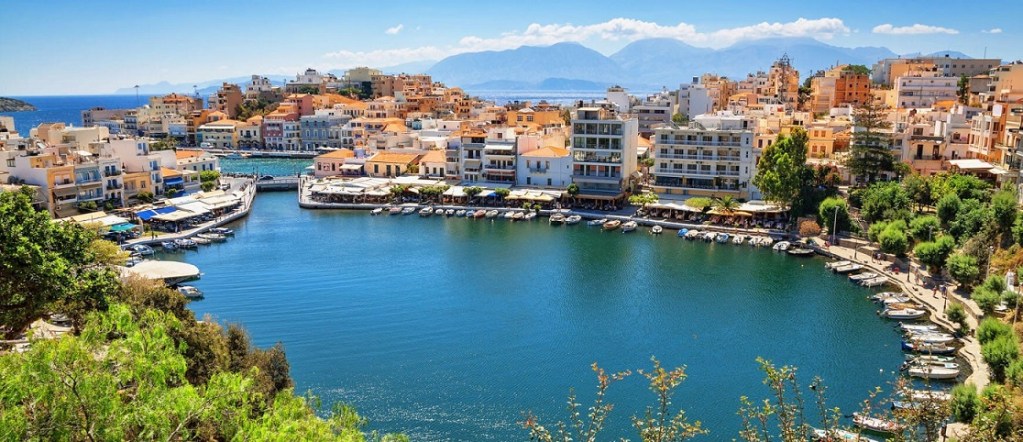 Eastern Crete, where the fish tavernas get quietly better.
The Dishes to Hold Out For
Five things worth ordering regardless of which taverna you end up in.
A handful of dishes worth specifically seeking out, regardless of which taverna you end up at:
What to order, and why
Dakos
A barley rusk topped with chopped tomato, mizithra cheese, and a generous pour of olive oil. It's Crete's answer to bruschetta, except it predates the comparison by centuries and doesn't need the comparison to make its case.
Fava
A silky split pea purée, often finished with raw or caramelized onion, sometimes capers. A close cousin, koukofava, uses dried broad beans instead and is worth trying side by side if a menu offers both.
Horta
Foraged wild greens, simply boiled and dressed with olive oil and lemon. With over three hundred edible wild species growing across the island, this dish changes by season and by region, and it's the clearest single expression of why Crete's biodiversity matters to its food culture, not just its scenery.
Sfakiani Pita
A thin, cheese-filled flatbread from the Sfakia region, traditionally drizzled with honey. Myzithropitakia are the same basic idea reshaped into small individual pies rather than one large flatbread.
Raki
The local spirit, and almost always brought to your table for free at the end of a meal, whether you ordered it or not. Declining it is allowed. Drinking it is the more honest choice.
Coast or Mountain: A Few Honest Trade-Offs
The difference matters more here than in most places.
Every meal decision on Crete comes down to a real trade-off, and the difference matters more here than in most places.
Eat on the coast and you get views, convenience, and consistency, at the cost of paying resort-adjacent prices for food that's good but rarely the island's best version of itself. Drive into the mountains and you'll pay less for better food, at the cost of a winding road, a menu that might not exist in any written form, and a meal that runs on the kitchen's schedule rather than yours.
Coast against mountain, sortable
| Coast | Mountain | |
|---|---|---|
| Price | Resort-adjacent, higher | Lower, often cash-only |
| Food quality | Good, rarely the island's best | Often the island's best version |
| Menu | Printed, sometimes photo menus | Often none — you point at the pot |
| Pace | Runs on your schedule | Runs on the kitchen's schedule |
Eat in Chania and you get the most atmospheric backdrop and the most ambitious creative restaurants. Eat in Heraklion and you get the Central Market, sharper prices, and arguably more adventurous new-wave kitchens willing to dig into Minoan-era recipes. Rethymno sits in between on both counts. None of these is the wrong base — they're just different versions of the same island's food culture, and the complete picture requires more than one of them.
All three cities, sortable
| Chania | Heraklion | Rethymno | |
|---|---|---|---|
| Best for | Atmosphere | Value & ambition | A middle ground |
| Vibe | Venetian harbor, romantic | Central Market, working city | Venetian mansions, quieter |
| Kitchens | Most creative, ambitious | Digging into Minoan-era recipes | Both traditional and modern |
How to Actually Eat Well Here
Four things that matter more than any single restaurant name.
A few practical things that matter more than any single restaurant name:
The rules that actually help
Lunch, Not Dinner
Mountain tavernas are at their best at midday. Daily specials run on what was cooked that morning, and they run out — showing up at 1pm rather than 8pm at a village taverna gets you the full range of what's actually in the pots.
Carry Cash
Still genuinely useful at smaller village tavernas, even in 2026 — not all of them prioritize card readers, and the ones that don't tend to be exactly the ones worth visiting.
Buy Olive Oil at the Source
The best regions — Kolymvari near Chania, Messara near Heraklion, Sitia in the east — each produce a genuinely distinct character. Buying direct from a producer gets you both a better product and a fairer price than a souvenir shop.
Don't Expect a Wine List
Many village tavernas pour their own house wine from the barrel, unlabeled and unbranded — and it's frequently better than anything you'd find on a printed list elsewhere.
If food is the point of the trip, do not try to cover the entire island in one heroic loop. Build the route around three different eating contexts: one city, one mountain village, and one quieter coastal stretch.
A practical three-day food itinerary
Day 1: Chania
Start with the market, a simple lunch, and a proper dinner at Salis or another serious kitchen that earns its harbor setting. Order dakos, horta, local cheese, seafood, and one Cretan white wine.
Day 2: Mountain Villages
Leave the coast before lunch and aim for a village taverna such as Ntounias. This is the day for wood fire, clay pots, antikristo if available, house wine, and whatever vegetables came out of the garden.
Day 3: Heraklion or Rethymno
Use Heraklion for Peskesi, the market, and more ambitious cooking, or Rethymno for Avli and a slower Venetian old-town meal. Add an olive oil tasting or winery if you have a car.
Costs, Booking and the Bottom Line
Still good value, as long as you move away from the obvious waterfront tables.
Crete can still be good value if you move away from the obvious waterfront tables. For a realistic 2026 food trip, budget more for transport and fewer glossy dinners: the meals that explain the island best are often simpler, slower, and inland.
Every food experience, sortable
| Food experience | Typical spend | Best move |
|---|---|---|
| Village taverna lunch | EUR 15-25 pp | Arrive early and ask what is cooked today |
| Creative city dinner | EUR 35-70 pp | Book ahead in Chania, Heraklion, and Rethymno |
| Olive oil tasting | EUR 15-40 pp | Buy direct from a producer if you like it |
| Winery visit | EUR 20-45 pp | Look for Vidiano, Liatiko, and Kotsifali |
The most common mistake is treating Crete like a reservation-only restaurant destination. Book the famous places, yes, but leave room for the meal you find because someone points you toward a village, a wood oven, or a kitchen with three pots and no written menu.
A video helps with the part a written guide cannot quite capture: the pace of the meal, the size of the dishes, and how often the best food on Crete happens outside the polished restaurant setting.
Watch a Crete food tour before you go
Crete's European Region of Gastronomy title isn't a marketing campaign dressed up as an award — it's an acknowledgment of a food culture that's been doing the same thing, well, for longer than most countries have existed. The island's best meals aren't hiding in a Michelin-chasing kitchen; they're in a mountain village with no menu, a harbor restaurant that earned its reputation honestly, and a clay pot that's been cooking the same way since before anyone thought to write the recipe down.
Go inland at least once. Ask what's in the pot instead of asking for a menu. And don't turn down the raki.
Before you go
Why is Crete a European Region of Gastronomy in 2026?
Crete holds the title because its food culture connects local agriculture, olive oil, wild greens, wine, mountain villages, small producers, and sustainable tourism. The award recognizes a living food system, not just restaurant quality.
What food is Crete best known for?
Crete is best known for dakos, horta, antikristo lamb, fresh seafood, Cretan cheeses, olive oil, fava, snails, Sfakiani pita, raki, and local wines made from varieties such as Vidiano, Liatiko, and Kotsifali.
Where should first-time visitors eat in Crete?
First-time visitors should combine Chania for atmosphere, Heraklion for markets and farm-to-table cooking, Rethymno for a slower old-town meal, and at least one inland mountain taverna where the menu may simply be what is cooking that day.
Do you need a car for a Crete food trip?
A car is strongly recommended if food is a priority. Buses can connect the main cities, but the best mountain tavernas, olive oil producers, wineries, and smaller coastal villages are much easier to reach independently.
How expensive is eating out in Crete?
Village taverna meals are often around EUR 15-25 per person, while creative city restaurants can run EUR 35-70 per person depending on wine and seafood. Waterfront tourist spots usually cost more without guaranteeing better food.
What is the biggest mistake visitors make with Cretan food?
The biggest mistake is staying only on the coast and choosing restaurants by view. Crete's most memorable meals are often inland, at lunch, in places with short menus, seasonal dishes, and food cooked slowly in pots or over fire.
How many days do you need for a Crete food itinerary?
Three days is enough for a focused introduction if you choose one base and add a mountain taverna day. Five to seven days is better if you want to compare Chania, Heraklion, Rethymno, eastern Crete, wineries, and olive oil producers.
Keep going


Sources
Checked against official and institutional sources · IGCAT: European Region of Gastronomy · Visit Greece (GNTO) · Incredible Crete (Region of Crete) · UK FCDO Greece travel advice · US State Dept Greece · Greek Ministry of Culture · UNESCO: Mediterranean diet · Heraklion airport · Minoan Lines ferries · Wine Roads of Crete
We will tell you whether we can help and send a written quote before any paid work begins.