

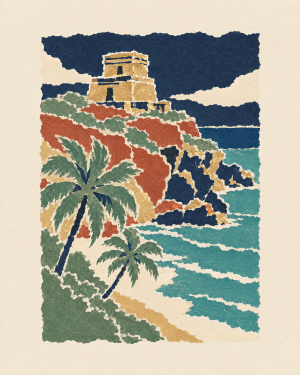
 TULUM
Latin America / Mexico / Travel guide · 12 min read
The empty cenote was photographed at six in the morning.
This Tulum travel guide helps you choose a town or beach base, plan four days and check the details that matter before booking: transport, ruins access, cenote rules and beach conditions.
Jump to what you came for
Tulum travel guide: quick answer
Allow four days for the ruins, cenotes, one beach day and a separate Sian Ka’an excursion. Town is our value-focused starting point; a beach base suits travellers willing to pay for proximity to the sand. Check the exact address, transfers and access rules before booking.
Pick your day
7 of 7 things shown · 0 done
TULUMTulum is two places that share a name
And almost every guide fails to say so
Tulum’s photographs rarely show the whole trip. A beachfront room can be far from town services, a cenote can be busy, and the beach road can be slow. Check the location and total cost of the stay you are actually booking.
What is actually here, without the filter


Tulum town and the beach zone are separate bases. The distance depends on your hotel and beach entrance; compare door-to-door routes rather than assuming every journey is three kilometres.
Tulum town, the pueblo, is a real place: grocery shops, pharmacies, taquerías, people going to work. It is where the good cheap food is, where the practical services are, and where accommodation costs a fraction of the beach road.
The beach zone is a fifteen-kilometre road running parallel to the sand, lined end to end with boutique eco-hotels, beach clubs and restaurants. This is the Tulum that went viral — natural wood, jungle backdrop, turquoise water. It is genuinely beautiful, fully commercialised, expensive by any Mexican standard, and increasingly crowded.
How four days here should run
The organising trick that saves real money: lunch at the beach club, dinner back in town. The gap between the two price worlds is wide enough to be worth structuring around.
The practical consequence is a single road doing the work of an entire street grid. Everything in the beach zone — every hotel, every club, every restaurant — hangs off one strip, and so does everyone trying to get between them.
That is why the journey times people quote each other are so unreliable. The same trip can take ten minutes or forty depending on the hour, the season and where exactly along the fifteen kilometres you are going, and a hotel described as being on the beach can still leave you negotiating that road twice a day.
None of which is an argument against the beach zone. It is an argument for knowing which Tulum you have booked before you arrive, rather than working it out from the back of a taxi on the first evening.
Town, or the beach road
| Compare | Tulum town | The beach road |
|---|---|---|
| Accommodation | A fraction of the beach road | Expensive by any Mexican standard |
| Food | The good cheap food — taquerías, fondas, cochinita pibil | Resort-level; dinner for two reaches $150–200 without difficulty |
| Services | Grocery shops, pharmacies, people going to work | Boutique eco-hotels, clubs and restaurants end to end |
| Getting to the sand | A journey — compare door-to-door routes | Walk out, subject to current access arrangements |
| Who it suits | Value and everyday services | A sand-focused stay with a larger budget |
TULUMThe ruins: do this first, and do it early
A walled Mayan port on a cliff, and the reason the name exists

The Tulum archaeological site is a walled Mayan city on a clifftop above the Caribbean, occupied from roughly 1200 to 1500 AD and one of the last still functioning when the Spanish arrived. White stone against turquoise water, with a small beach directly below the main temple: it is the most photogenic archaeological site in Mexico and it has the visitor numbers to match.
Plan an early visit. Check INAH’s official Tulum visitor page for the current opening hours, last entry and fees. Allow time for the wider Parque del Jaguar access arrangements as well as the archaeological site.
Allow roughly two hours for the archaeological visit, plus access and waiting time. Do not plan around guaranteed access to the beach below the ruins: follow current park signs and closures. Bring shade protection and drinking water.
What makes the site unusual is not the architecture, which is modest by Maya standards, but the position. This was a port: a walled town facing the sea on a stretch of coast with a reef offshore, built where boats could be brought in.
The wall is the other clue. Most Maya cities did not have one, and this one was closed on three sides with the cliff doing the work of the fourth — which tells you the place was holding something worth protecting, and that it mattered enough to defend.
Go at opening and you get the version worth the trip: low sun on pale stone, the sea doing its colour trick below, and iguanas on the walls that have not yet decided to move. By mid-morning you are in a queue photographing the same stones as four hundred other people.
Quick facts
The site
A walled Mayan city on a clifftop, occupied from roughly 1200 to 1500 AD and one of the last still functioning when the Spanish arrived.
How long
Allow roughly two hours for the archaeological visit, plus access and waiting time.
Hours and fees
Check INAH’s official Tulum visitor page for current opening hours, last entry and fees.
Access
Allow time for the wider Parque del Jaguar arrangements, and follow current park signs and closures.
TULUMCenotes: the actual highlight
Better than the beach, and nobody books the trip for them

The cenote se-NO-tay system of the Yucatán is one of the genuine natural wonders of the hemisphere: hundreds of sinkholes in the limestone, connected by flooded cave passages, holding freshwater so clear that depth perception stops working. The Maya treated them as sacred entrances to the underworld, which makes more sense once you are floating in one.
Gran Cenote is a popular option near town. Confirm current admission, opening hours, equipment charges and swimming rules directly before setting off. Arrive with enough time before last entry.
Dos Ojos offers cenote and cavern experiences north of Tulum, towards Playa del Carmen. Choose a visit appropriate to your swimming or diving experience and confirm what the operator includes.
Cenote Calavera has several openings and a different atmosphere from Gran Cenote. Check access, depth and current rules before entering; do not treat jumping as a requirement.
The reason they exist at all is that the Yucatán has almost no rivers. Rain falls on limestone, drains straight through it, and collects in a vast network of flooded passages underneath, which is the entire water story of the peninsula in one sentence.
A cenote is simply a place where the roof of one of those passages has given way and the water below is exposed. That is why they turn up in the middle of nowhere, beside a road, and occasionally in the middle of somebody’s garden.
It also explains the reverence. If you are farming this landscape with no river and no lake, the holes in the ground are not scenery — they are the only drinking water for miles, which is a very short step from treating them as sacred.
TULUMBeach clubs: how they actually work
And the thing about Mexican beaches nobody mentions

Beach clubs set their own day-pass charges, minimum spends and reservation rules. Ask whether the quoted price includes a lounger, food credit, tax and service, and whether an unused credit is refundable.
The approach that works: pick one, go on a weekday, arrive early for a good position, and stay. Moving between clubs saves nothing and spends the day you came for in transit.
The rhythm that makes a club day work is the opposite of what most people do. Arrive early enough to choose where you sit, order properly once rather than constantly, and treat the place as somewhere to spend six hours instead of ninety minutes.
Clubs are built for exactly that. The loungers, the unhurried service, the way the music climbs through the afternoon — all of it assumes you are staying, and the people who drift in at two for a drink and a photograph get the worst version of somewhere that works perfectly well if you commit to it.
Use designated public beach access and check current Parque del Jaguar entry arrangements where relevant. A hotel or club charge for facilities is not the same thing as a charge for every beach. Do not assume you can cross a private property to reach the sand.
TULUMFood: town and beach-road budgets
And the gap is wide enough to plan around
On the beach road, prices are resort-level. Dinner for two at a beach restaurant reaches $150–200 without difficulty. The quality is generally good — the international chef scene that arrived over the last decade brought real cooking with it — but you are paying for the location at least as much as the plate.
In town, compare taquerías and fondas serving regional dishes such as cochinita pibil. Check the actual restaurant address and current menu before travelling; names and locations can change.
It is worth eating the Yucatecan food on its own terms rather than as the budget option. This is a distinct regional cuisine, not a cheaper version of what is on the beach road — achiote and sour orange rather than chilli heat, and a slow, buried style of cooking that predates every restaurant in town.
Cochinita pibil is the one to start with, and the clue is in the name: pib is the pit it was traditionally cooked in. Pork, marinated red, cooked long enough to fall apart, eaten with pickled onion and as much habanero as you can defend.
Organising around the gap — lunch at the club you are already paying for, dinner back in town — saves meaningful money across a trip without giving up a single good meal. And the Yucatecan food in town, cochinita pibil above all, is a regional cuisine worth eating on its own terms rather than as the cheap option.
TULUMSian Ka’an: the part that is actually wild
A UNESCO biosphere, and most visitors never go
Sian Ka’an is a UNESCO World Heritage biosphere reserve immediately south of Tulum: tropical forest, mangrove, coastal lagoon, and both Caribbean reef and cenote water systems in one protected block. It holds over three hundred and fifty bird species, along with jaguars, crocodiles, manatees and sea turtles.
Choose the Sian Ka’an excursion carefully. The operator’s route guide distinguishes Muyil’s inland lagoons and channels from Punta Allen’s coastal and marine trips. Do not assume one half-day outing includes both. Confirm access, transport, reserve fees, weather alternatives and the return time.
It is the best nature experience reachable from Tulum and it is the one most visitors skip, because it requires organising rather than walking out of a hotel. Organise it.
The coast the reserve protects


Tulum travel guide: everything in this guide, on one map
TULUMThe new airport, and why you may still fly to Cancún
This is the part every older guide gets wrong
Tulum International (TQO) and Cancún (CUN) are both options to compare. Search the airline’s live schedule for your dates and add the full cost of reaching your accommodation; TQO is outside town and still requires a transfer.
Route availability and operating days change seasonally. Check the airline’s booking system for both directions rather than relying on a fixed list of international routes.
TULUMSargassum: the thing that ruins trips
Use current beach reports

Sargassum is the brown seaweed that drifts across the Atlantic and lands on this coast in mats, and when it arrives in volume it turns a turquoise beach into something that smells of sulphur. Nobody who books a Riviera Maya trip plans for it and it is the single most common way one is ruined.
Sargassum conditions change by year, beach and day. Seasonal patterns can help planning, but no winter window guarantees clear water.
Use the University of South Florida Sargassum Watch System for regional observations and outlooks, then check recent reports from your specific beach. Regional bloom forecasts cannot predict one hotel frontage on a future date.
It helps to know what the stuff actually is. Sargassum is a brown seaweed that floats: it has no roots, spends its whole life drifting, and forms mats out in the open Atlantic that are genuinely important habitat for turtles and juvenile fish.
The problem is entirely about where it lands. Offshore it is an ecosystem; piled deep on a hotel frontage in the heat it rots, and rotting sargassum is what produces the sulphur smell that no amount of raking clears quickly.
Which is why the honest advice is unsatisfying. Nobody can promise you a clear beach on a date months away, and anyone who does is guessing — so the useful move is to book somewhere with a decent inland plan B rather than to hunt for a guaranteed week.
Check recent beach reports before travelling and again locally. Ask the hotel what happens when the beach is affected, including cleanup arrangements and alternative activities.
Tulum travel guide: arrival and booking checklist
- Reserve the first airport transfer and confirm the final drop-off address.
- Separate archaeological-site admission, park access and any transport charges in your budget.
- Confirm cenote opening hours, last entry, lockers and life-jacket rules.
- Ask for the beach club’s minimum spend and cancellation terms in writing.
- Keep a flexible day for weather and arrange your return airport journey before the final evening.
TULUMIf you only do one thing
It is not on the beach road
A cenote visit is worth making time for. Choose an opening time published by the operator, confirm the current price and follow the site’s swimming and conservation rules.
What the coast looks like on a good day


 TULUM
The bottom line
Know which Tulum you booked
Stay in town and visit the beach, or stay on the beach road and accept what it costs — but decide deliberately rather than discovering the difference on arrival. Ruins at eight. Two cenotes rather than five. One beach club for a whole day. Sian Ka’an organised in advance. Dinner in town every night.
If you are building a wider Mexico trip, our Mexico beaches comparison helps you choose the right coast before committing to a hotel.
Before you go
Should I stay in Tulum town or the beach zone?
Town is our starting point for value and everyday services; the beach zone suits a sand-focused stay with a larger budget. Check your exact hotel location and transfer costs.
When is the best time to visit Tulum?
Choose dates around your budget and activities, then check weather and beach reports. Winter is popular, but no month guarantees clear water or an empty beach.
Are the Tulum cenotes worth it?
Yes if swimming and limestone landscapes appeal. Compare access rules, facilities and current prices, and choose activities suited to your ability.
Can you fly directly into Tulum?
Tulum International uses code TQO. Check live airline schedules for your departure city and dates, then compare the total journey with Cancún, code CUN.
Do you have to pay to go to the beach in Tulum?
Costs depend on your access route and whether you use park transport or club facilities. Check designated public access and current park arrangements separately from hotel or club charges.
How many days should I spend in Tulum?
Four days allow separate time for ruins, cenotes, a beach day and a Sian Ka’an excursion. Add arrival and departure time if your connections take most of a day.
Keep going
Sources
Practical information reviewed 14 October 2026. Confirm current operating details with the linked authorities and providers before booking.
Tulum · Cenote · Sian Ka’an · Tulum airport routes 2026–27 · Sargassum tracker and forecast · Visit Mexico
We will tell you whether we can help and send a written quote before any paid work begins.