

Europe / Spain / City guide · 13 min read
2026 is the Gaudí centenary, and the city knows it.
Which of the architecture is worth booking, which hill to climb, and the market that is not La Boqueria.
Things to Do in Barcelona: The Short Answer
The best things to do in Barcelona in 2026 are Sagrada Família, Park Güell, Casa Batlló, Casa Milà, Palau Güell, Montjuïc, Bunkers del Carmel, El Born, Mercat de Sant Antoni, Poblenou, and the city’s World Capital of Architecture events. Book Sagrada Família and Park Güell ahead, use free museum windows for budget days, and save one sunset for the Bunkers.
Things to do in Barcelona in 2026 start with Gaudí and architecture, but the better trip balances Sagrada Família, Park Güell, Montjuïc, El Born, Sant Antoni, Poblenou, festival dates, free museum windows, and enough unscheduled neighborhood time to let the city breathe.
This is not a normal year to visit Barcelona. June 10, 2026 marks the centenary of Antoni Gaudí's death — he stepped out of the way of one tram and was hit by another, was mistaken for a destitute man due to his appearance, and by the time anyone recognized him, it was too late. The city has spent years preparing for this anniversary, and the result is a full year of exhibitions, events, and architectural programming unlike anything Barcelona has done before. On top of that, UNESCO and the International Union of Architects awarded Barcelona the title of World Capital of Architecture 2026, generating over 1,500 events across the city through December — the majority of them free.
If you're visiting this year, that context changes what you should prioritize. Architecture that would normally require ticket queues is offering special openings. Buildings that normally stay closed to the public have scheduled open days. The city is, for once, actively leaning into letting you see it.
The main sights, priced and timed
| Sight / Area | Type | Price | Booking | Best Time |
|---|---|---|---|---|
| Sagrada Família | Basilica | €26–40 | Required | Morning |
| Park Güell | Park | €10 / free zone | Required (peak) | Early/late |
| Casa Batlló / Milà | House-museum | €29–35 | Recommended | Early morning |
| Palau Güell | House-museum | €12 | Usually walk-in | Any time |
| Montjuïc (MNAC + Castle) | Hill / museum | Free Sat/Sun pm | None | Afternoon |
| Bunkers del Carmel | Viewpoint | Free | None | Sunset |
| El Born | Neighborhood | Free (Born CC ~€4.40) | None | Afternoon |
| Mercat de Sant Antoni | Market | Free to browse | None | Weekday morning |
| Poblenou | Neighborhood / beach | Free | None | Half-day |

The Sagrada Família: Go, But Know What You Are Doing
Still unfinished, and that is the point
Yes, you've seen the photos. Yes, it's still worth it. The distinction worth understanding before you book is that 2026 is categorically different from a normal year: the centenary celebrations include a solemn mass, special cultural and musical programming, and symbolic milestones tied to the construction progress. The interior, particularly the stained glass on the nave, changes completely depending on the time of day — morning light from the east produces entirely different colors than late afternoon from the west. Go in the morning, book in advance (queues without pre-booking are brutal even on good days), and climb at least one tower for the aerial view of the city.
The construction has been ongoing since 1882 and continues. By most current projections, completion is expected around 2026-2028. The fact that it's still being built is not a detraction — it means you're watching a living project rather than a finished museum piece.
Gaudí’s basilica, outside and up


Park Güell: Timing Is Everything
Half of it is free, and the half that is not sells out
Park Güell is divided into two sections, and understanding the split saves time and money. The Monumental Zone — the famous terrace with mosaic bench, dragon staircase, and hypostyle room — requires a ticket and a timed entry. The Forest Zone is free and offers viewpoints over the city that many visitors skip entirely by heading straight for the main terrace.
The local tip that keeps appearing in guides written by people who actually live here: arrive before or after peak hours. The park opens at 9:30am for ticketholders. Early morning or late afternoon light changes how the mosaics look significantly. June through September, the timed entry slots sell out days or weeks in advance online — book before you arrive.

The Gaudí Route Beyond the Famous Two
Four more, and the centenary has funded them properly
Gaudí Year means Barcelona has put additional resources into its lesser-visited Modernista architecture, and 2026's free open days through the World Capital of Architecture program are the best opportunity to see buildings that are normally difficult to access.
Casa Batlló and Casa Milà (La Pedrera) on Passeig de Gràcia are the two most visited after Sagrada Família, and both justify their queues. The interior of Casa Batlló — bone-white walls, undulating ceilings, rooms designed to feel like the inside of a marine creature — is the most disorienting interior in the city, in the best possible way.
Palau Güell, in El Raval near La Rambla, is the underrated Gaudí property: the first major commission he received from his patron Eusebi Güell, built in the 1880s, and now far less crowded than his more famous works. The rooftop chimneys alone — each one covered in a different pattern of broken tile — are worth the detour.
Colònia Güell and the crypt at Santa Coloma de Cervelló, about twenty minutes outside the city, is the experimental structure Gaudí used to test the hanging chain models that informed Sagrada Família's structural design. An extraordinary piece of architectural history that barely registers on most tourist itineraries.
The rest of the Gaudí list
Casa Batlló
Passeig de Gràcia · bone-white walls, marine-creature interior. Book ahead.
Casa Milà (La Pedrera)
Passeig de Gràcia · undulating stone facade, iconic rooftop chimneys.
Palau Güell
El Raval · first major Gaudí commission, patterned rooftop chimneys, far fewer crowds.
Colònia Güell
20 min outside the city · the crypt that shaped Sagrada Família's structural design.
A short Gaudí walk
Montjuïc: The Hill Nobody Talks About Enough
A museum, a castle and the better view
Barcelona has two hills. The Tibidabo gets the funicular and the amusement park; Montjuïc gets the castle, the MNAC, the Olympic stadium, and one of the city's best-hidden viewpoints. It's also where the Magic Fountain sits — a combination of water, music, and light built in 1929 and restored in 1992. The fountain runs free performances on weekend evenings in spring and summer; check current schedules since timings shift seasonally.
The MNAC (National Art Museum of Catalonia) holds one of Europe's finest collections of Romanesque art, much of it rescued from rural Catalan churches in the early 20th century. Free on the first Sunday of each month and every Saturday after 3pm. The building's views over the city from the terrace are worth the climb even on closed days.
Montjuïc Castle, at the summit, has a complicated history — it served as a political prison for much of the 20th century — but the views are exceptional in every direction and the walk or cable car ride up is more interesting than most of the city's equivalent ascents.

The Bunkers del Carmel: The Sunset Spot
No longer hidden, still the best view in the city
Every guidebook calls it a "hidden gem," which it no longer is, but that doesn't make it less worth doing. The anti-aircraft battery ruins on the Turó de la Rovira hill in the Carmel neighborhood give a 360-degree view of the city — the Sagrada Família, the sea, the mountains behind — that's more complete than any single viewpoint from the main tourist circuit. Go at sunset with a drink. The crowds are part of it; a mix of locals and visitors in the specific way that Barcelona handles at its best — everyone just there for the light.
Getting there requires a bus or a twenty-minute walk uphill from the nearest metro. The absence of a cable car is why it stays manageable.

El Born: The Neighbourhood to Wander
For the afternoon with no plan in it
For unstructured afternoon time, El Born consistently ranks as the neighborhood that delivers the best combination of architecture, bars, independent shops, and hidden corners without being entirely overrun. The Basílica de Santa Maria del Mar, built between 1329 and 1384 entirely by the donations and labor of the city's waterfront workers, is Barcelona's last remaining Catalan Gothic church — plainer and more honest than the cathedral, and for many people more moving for it.
The El Born Cultural and Memory Centre (Born CC) is built inside an 1876 cast-iron market hall, around an archaeological site that was excavated in the 1990s revealing Barcelona as it existed in 1714. You can see from raised walkways the actual streets, houses, and cellars of the city as it was before a significant portion was demolished to build a military citadel. There's nowhere quite like it in Europe.
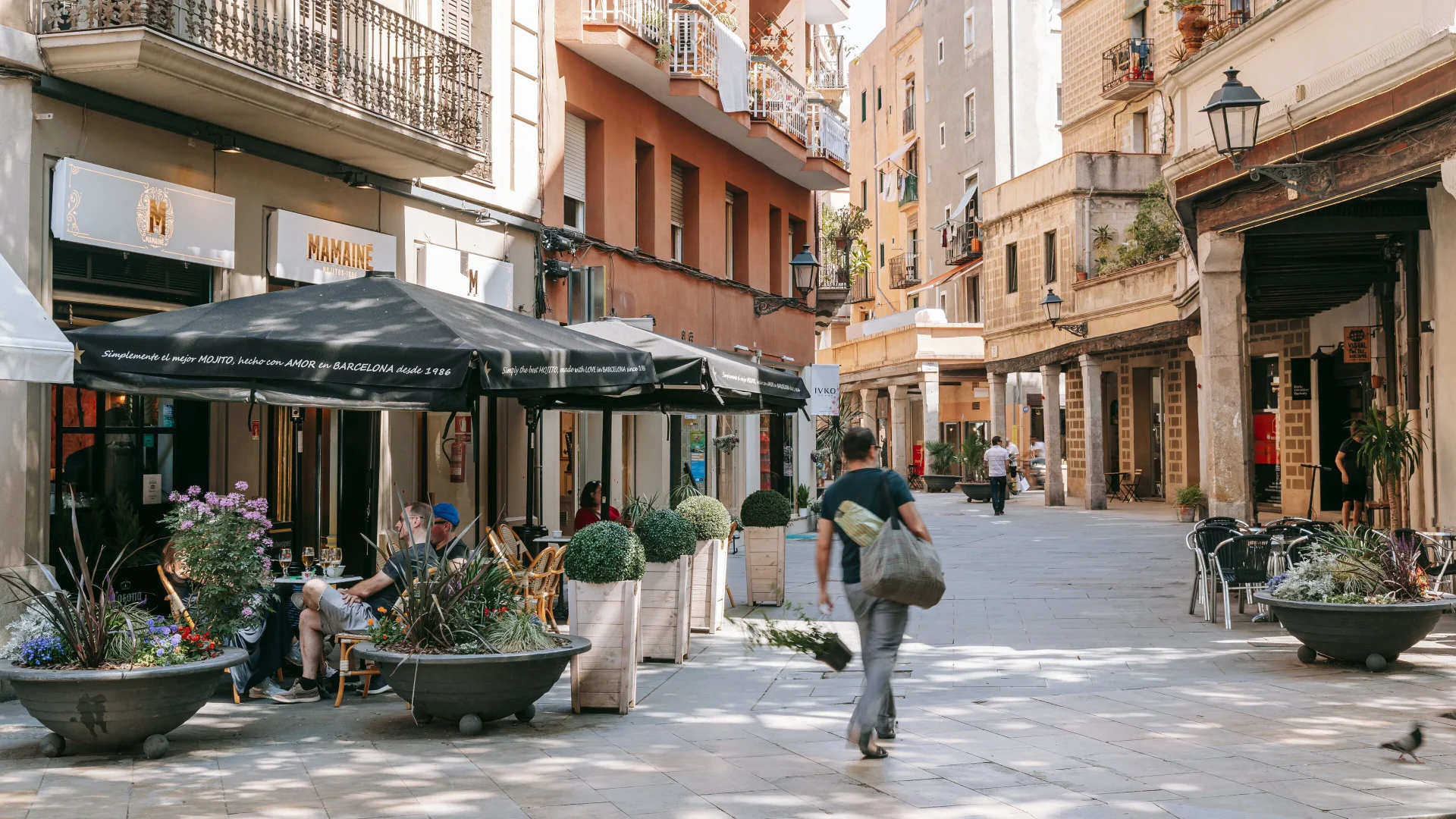 El Born rewards having nowhere in particular to be.
Mercat de Sant Antoni: La Boqueria’s Better Alternative
A working market rather than a photographed one
La Boqueria is, at this point, almost entirely an experience for visitors. The vendors know it, the prices reflect it. The better market experience in Barcelona is Mercat de Sant Antoni, in the Sant Antoni neighborhood, which reopened after a decade of renovations in 2018 and has become a genuine daily market for residents — food vendors during the week, a Sunday book and record market, and a restored ironwork building that's architecturally as impressive as La Boqueria without the selfie density.
Time Out Barcelona's local editors explicitly list it as a top Barcelona experience for 2026. That's not a meaningless endorsement — it's the editors who live here choosing this over the famous alternative.
Sant Antoni, still shopping


Poblenou: Barcelona’s Creative Shift
Old factories, a quieter beach, and almost no queues
The former industrial district to the north of Barceloneta has been transforming for over a decade, and in 2026 it's worth dedicating a half-day specifically to see what's happened. Workshops, galleries, design studios, and food spots have colonized the old factory buildings in a way that feels less curated than the tourist-facing neighborhoods. The Rambla del Poblenou is the residential spine — a narrow boulevard with local shops and cafés and a traditional horchata stand in warmer months that operates as a neighborhood institution.
The beach end of Poblenou also provides a stretch of coast that's noticeably less crowded than the Barceloneta beaches closer to the city center, while still being accessible by metro or on foot.
Poblenou, the industrial quarter


Getting Around
Three clusters, one metro, and two hills that are not on it
Barcelona is a walking city with a metro that actually helps, which is the opposite of Rome. The sights in this guide fall into three clusters — the Gothic Quarter and El Born, the Eixample along Passeig de Gràcia, and the high ground at Park Güell, Montjuïc and the Bunkers — and the metro links all three in under twenty minutes.
Single tickets are poor value. The multi-journey travel cards sold at every station are the obvious choice for a short trip, and some of them can be shared between travellers, which changes the maths for a couple. Card names, zones and prices change more often than the network does, so check the current ones with the city transport operator rather than trusting a figure from a guide.
The hills are the exception to all of this. Park Güell’s main gate is a steep climb from the nearest station, and the Bunkers need a bus or a twenty-minute walk uphill. Montjuïc has a funicular that connects to the metro and a cable car above that. None of it is difficult, but it is worth knowing before you plan a day with two hilltop sights back to back.
A Practical Three-Day Itinerary
Do not stack every ticketed Gaudí site into one day
If this is your first visit, don’t stack every ticketed Gaudí site into one exhausting day. Barcelona works better when the big architecture is paired with a neighborhood, a market, or a view.
Three days, morning to evening
| Day | Morning | Afternoon | Evening |
|---|---|---|---|
| Day 1 | Sagrada Família | Hospital de Sant Pau or Eixample walk | El Born tapas and Santa Maria del Mar |
| Day 2 | Park Güell timed entry | Casa Batlló or La Pedrera | Bunkers del Carmel sunset |
| Day 3 | Sant Antoni Market | Montjuïc, MNAC, or castle | Poblenou dinner or beach walk |
Costs and Booking Priorities
What to book first, and what can wait
For a culture-heavy Barcelona trip, assume the main paid decisions are Sagrada Família, Park Güell, and one or two Gaudí house museums. Everything else can be shaped around free viewpoints, markets, neighborhoods, and museum free-entry windows.
Book in this order
Book first
Sagrada Família, especially if you want tower access or morning light.
Book second
Park Güell, particularly from June through September.
Book if it matters
Casa Batlló or Casa Milà, ideally early morning.
Leave flexible
Montjuïc, El Born, Sant Antoni, Poblenou, and the Bunkers.
Common Mistakes to Avoid
Peak summer, and a phone on a café table
Barcelona in peak summer (July-August) is hot, crowded, and expensive. The city is making genuine efforts in 2026 to distribute tourist activity away from the most saturated spots — the World Capital of Architecture programming is partly designed to pull people into neighborhoods and buildings they wouldn't otherwise visit — but June, September, and October remain the more manageable options for anyone with flexible dates.
Leaving your phone visible on a café table in the Gothic Quarter or La Rambla
Carrying your bag on your back instead of across your body in crowds
Keeping your phone in a back or open front pocket
The pickpocketing reality in the Gothic Quarter and La Rambla is consistent and well-documented. It's not a violent problem; it's a practical one — twenty seconds of habit prevents most of it.
Book Sagrada Família tickets for a morning slot
Reserve Park Güell's timed entry (June–Sept sells out fast)
Book Casa Batlló / Casa Milà ahead if you're visiting either
Check the World Capital of Architecture free open-day schedule
Get a T-Casual metro card for Montjuïc, Bunkers, and Poblenou
Keep valuables zipped and front-facing in the Gothic Quarter & La Rambla
Festivals Worth Planning Around
Two of them will decide your dates for you
Barcelona's festival calendar has two unmissable entries in 2026. Primavera Sound (June 4-7) brings The Cure, Gorillaz, Massive Attack, and Doja Cat to Parc del Fòrum — one of the most genuinely excellent lineups in recent festival memory, in a setting that combines the outdoor stage energy with easy access to the beach. Sónar (June 19-21) is the other fixture: the world-renowned electronic music and digital arts festival that's been happening here since 1994, still among the most conceptually interesting music events in Europe.
La Mercè in September (Barcelona's main city festival, free, across multiple outdoor stages throughout the city) and Sant Jordi in April (a Catalan Valentine's Day where couples exchange books and roses, and the whole city turns into a street market) are both worth knowing about if your dates are flexible — both transform the city in ways that a normal visit doesn't access.
The 2026 calendar
Primavera Sound
The Cure, Gorillaz, Massive Attack, Doja Cat at Parc del Fòrum, steps from the beach.
Sónar
Electronic music and digital arts festival running since 1994.
La Mercè
Barcelona's main city festival, outdoor stages across the whole city.
Sant Jordi
Catalan Valentine's Day — books, roses, and a street market across the city.

The Free Admission Days Worth Knowing
First Sunday of the month, and it adds up
Most of Barcelona's major public museums offer free admission on the first Sunday of each month and every Sunday after 3pm. The MNAC (National Art Museum of Catalonia) is free on Saturdays after 3pm as well. The El Born Cultural Centre is free for the archaeological ruins section. Planning one or two days around these windows saves meaningfully on a budget-conscious trip without sacrificing the quality of what you see.
The Bottom Line
The city is leaning into itself this year
2026 is the year to visit Barcelona if you care about architecture and culture, specifically because the centenary programming means access and programming that won't exist in this form again. Book Sagrada Família, Park Güell, and any ticketed Gaudí sites in advance. Use the free open days for the lesser-known buildings. Find your way up to the Bunkers at sunset. And spend at least one morning in El Born or Sant Antoni rather than fighting the Boqueria crowd.
The city is leaning into itself this year in a way that's worth meeting halfway.
Before you go
Things to Do in Barcelona FAQ
What are the best things to do in Barcelona in 2026?
Start with Sagrada Família, Park Güell, Casa Batlló or Casa Milà, Montjuïc, Bunkers del Carmel, El Born, Sant Antoni Market, Poblenou, and the World Capital of Architecture events happening across the city.
Is 2026 a good year to visit Barcelona?
Yes, especially if you care about architecture. Barcelona is marking Gaudí’s centenary and its World Capital of Architecture year, which means more exhibitions, open days, and citywide programming than usual.
How many days do you need in Barcelona?
Three full days is the practical minimum for a first visit. It gives you time for Sagrada Família, Park Güell, one Gaudí house, Montjuïc, El Born, a market, and one sunset viewpoint without rushing everything.
Do you need to book Sagrada Família and Park Güell ahead?
Yes. Sagrada Família should be booked ahead year-round, and Park Güell timed entries become unreliable as walk-ups during peak months. Book both before you arrive if your dates are fixed.
What can you do in Barcelona for free?
Free options include Montjuïc viewpoints, Bunkers del Carmel, El Born wandering, Sant Antoni Market, Poblenou, beach walks, many architecture events in 2026, and museum free-entry windows on selected Sundays.
Where should first-time visitors stay in Barcelona?
Eixample is the easiest base for Gaudí sights and transport. El Born is better for atmosphere and evening wandering, while Sant Antoni and Poblenou work well if you want a slightly more local rhythm.
What should you skip in Barcelona?
Skip trying to see every famous sight in one day, avoid La Rambla as a dining area, and don’t treat La Boqueria as your only market stop. Sant Antoni is a better everyday market experience.
Keep going


Sources
Opening hours, ticketing and festival dates checked against the official sites below · Sagrada Família · Park Güell · Casa Batlló · Casa Milà · MNAC · Ajuntament de Barcelona · Barcelona Turisme · TMB transport · Primavera Sound · Sónar · UNESCO World Heritage Centre · Turespaña
We will tell you whether we can help and send a written quote before any paid work begins.
Frequently asked questions
How many days do you need in Barcelona?
Three full days covers the main Modernisme sights, the old city, a market and one neighborhood beyond the center. Four or five days gives you room for beaches, museums or a day trip.
Which Barcelona attractions need advance booking?
Book major Gaudí sites and timed museums when your dates are fixed. Neighborhood walks, markets, viewpoints and beaches can remain flexible.
What is the best way to organize a first Barcelona visit?
Group sights by neighborhood and avoid crossing the city repeatedly. Pair Sagrada Família with nearby Modernisme, and keep the Gothic Quarter and waterfront for a separate day.