


Europe / Portugal / Food guide · 11 min read
The bifana window is open until two, and there is always a queue.
Nine things to order at a counter, what each costs, and the hours Lisbon actually eats them.
Jump to what you came for
Street Food in Lisbon: The Short Answer
Street food Lisbon is best understood through counter snacks, late-night sandwiches, petiscos, ginjinha, and June sardines rather than one formal meal. Use this guide to decide what to order first, what it should cost, where to eat it, and when the city actually eats.
The bifana window near Rossio is open until 2am. There's always a queue. The people in it are locals coming home from a night out, shift workers finishing late, and the occasional tourist who stumbled across it and is currently making the best accidental food decision of their trip. A bifana costs €2.50 to €3.50. You eat it standing up, or sitting on the stone steps across the street, or walking. You drink a cold Super Bock. You don't need to have planned this.
That's the entry point to Lisbon's casual food culture: not a curated street food market designed for visitors, not a "food tour" through neighborhoods with a guide doing all the work, but a city that has always fed itself quickly, cheaply, and well, and whose traditions you can access without any particular effort if you know what to look for. Pair your food stops with these Lisbon walks, sights and viewpoints to build a day around the same neighbourhoods.
What to order, and what it costs
| Dish | Price | Best For |
|---|---|---|
| Bifana | €2.50–3.50 | First bite, any hour |
| Prego | €3–5 | After seafood, late night |
| Petiscos spread | €3–8 per plate | Sharing, early evening |
| Pastel de bacalhau | €1–2 | Café-counter snack |
| Caldo verde | €3–5 | Late-night soup |
| Ginjinha | €1–2 | Three-minute ritual |
| Chamuças | €2–3 | Café counter, any hour |

Best Areas for a Street Food Crawl
Rossio to start, Alfama after dark, Alcântara for a table
For a first Lisbon street food crawl, start around Rossio and Baixa for bifanas, ginjinha counters, and old-school cafés, then walk into Mouraria or Alfama when you want cheaper tascas and less polished rooms. Cais do Sodré works when you want the controlled version at Time Out Market Lisboa, while Chiado is useful for a quick prego, coffee, or pastel de bacalhau between sights.
The counter, the sandwich and the spread


 Petiscos are not tapas, and the difference matters here.
Where to go, and when
| Area | Go For | Best Moment |
|---|---|---|
| Rossio & Baixa | Bifana, ginjinha, café-counter snacks | First day, late afternoon, late night |
| Mouraria & Alfama | Tascas, sardines in June, cheap plates | Dinner and festival evenings |
| Chiado | Prego, bifana, quick coffee breaks | Between sightseeing stops |
| Cais do Sodré | Time Out Market, seafood snacks, drinks | One controlled intro meal |
The Bifana: Start Here
Portugal’s greatest contribution to the sandwich
Portugal's greatest contribution to the sandwich canon and the first thing every serious visitor should eat. Thin pork slices — marinated overnight in white wine, garlic, and paprika, then stewed until tender — stuffed into a crusty papo-seco roll. Add yellow mustard. Add piri-piri oil if you want heat. Eat it in three bites or, if you're doing it right, four.
The bifana originated in Vendas Novas in the Alentejo, roughly an hour from Lisbon, and the pork is often Alentejo breed — the same black Iberian pigs responsible for the region's prized hams. In Lisbon, the style runs larger than the northern version (which is smaller, slower-cooked in broth), and the mustard is the correct condiment, not a suggestion.
The Prego: The Bifana’s Beef Cousin
Thin steak, garlic, a crusty roll
The prego is a thin beef steak grilled with garlic, tucked into a crusty roll with butter. It's simpler than the bifana in concept and slightly more expensive, and it has one unusual tradition: it's the standard "dessert" at seafood restaurants (cervejarias), specifically at Ramiro, where ordering a prego after a spread of shellfish is not eccentric but expected.
The prego developed near Sintra in the 19th century as an affordable meal for working-class Lisboetas. O Prego da Peixaria, near Alvalade subway station, runs creative variations on the classic — including several non-standard versions for people who want the format with different fillings — but the original remains the benchmark.
Petiscos: Portugal’s Answer to Tapas
Related to tapas, and not the same thing
Petiscos are not tapas. The word gets used interchangeably in tourist contexts, but the traditions are distinct: petiscos are Portuguese sharing plates that developed independently, built around different ingredients and a different dining pace than the Spanish version. The confusion is understandable and slightly annoying to anyone who knows both.
A good spread includes
A Good Petiscos Spread Includes
Pataniscas
cod fritters, lighter and more egg-heavy than a standard fritter
Grilled prawns in garlic butter
Octopus salad and fried chouriço
Pica-pau
chopped steak with pickles and mustard, one of the great bar snacks
Tremoços (lupini beans)
small, briny, yellow, arriving automatically with a beer
O Lutador, in Alcântara, is a well-sourced local recommendation: a massive terrace where you can eat a bifana and drink an imperial (a small draft beer) in the fading afternoon sun, or order proper plates of pica-pau, octopus salad, and tiny snails in summer. It's genuinely a neighborhood bar with a terrace — the kind of place a Lisbon resident describes as "my local" and recommends in the same breath.
How to Order at a Lisbon Counter
Five words and one gesture, and you are through
Counter service in Lisbon has its own grammar, and knowing four phrases turns the whole thing from intimidating into quick.
Com ela. This is the one that matters. A bifana is served either plain or with the garlicky, slightly spicy cooking juices spooned over it. Com ela means with the sauce. Ask for it. Nobody will offer, and the plain version is a different and lesser sandwich.
Uma imperial. A small draught beer, about 20cl, which is the default size at a counter and the right partner for almost everything in this guide. A larger glass is uma caneca. Ordering a pint-sized beer with a bifana marks you out more than your accent does.
Um café. In Lisbon this means an espresso, drunk standing, in about ninety seconds. If you want it longer ask for um abatanado; if you want milk, um galão comes in a glass and belongs to the morning.
A conta, por favor. You pay at the end, not when you order, and usually at the counter rather than the table. At a busy window you simply say what you want, eat standing at the ledge, and settle up before you leave.
Two habits worth copying. Order one thing at a time rather than assembling a whole meal at once, because the point of a counter is turnover. And when something arrives that you did not order — a saucer of olives, a dish of lupin beans — it is not a gift. It goes on the bill, it costs very little, and refusing it is the only genuinely awkward move available to you.

Com ela — with the sauce. Always ask; it is never offered.
Uma imperial — a small draught beer, the default counter size.
Um café — an espresso, drunk standing in ninety seconds.
A conta, por favor — the bill, settled at the counter on the way out.
Olives and lupin beans that arrive unasked go on the bill. Accept them.
Pastel de Bacalhau: The Counter Snack
The honest mid-afternoon stop
At every traditional café counter and most tascas, you'll find pastel de bacalhau — a golden fried cod cake made from salted cod, mashed potato, onion, parsley, and egg, shaped into a roughly oval form and deep-fried until the outside crisps. Best eaten warm, as a mid-morning or mid-afternoon snack, standing at the bar with an espresso. They cost €1-2 each.
This is the honest Lisbon mid-afternoon snack: not a scheduled lunch, not a sit-down meal, just a warm codfish cake and a coffee at a zinc counter, the same way the neighborhood has been doing it for decades. It's available everywhere. It's almost always good. It will cost you almost nothing.
What sits on the counter all day
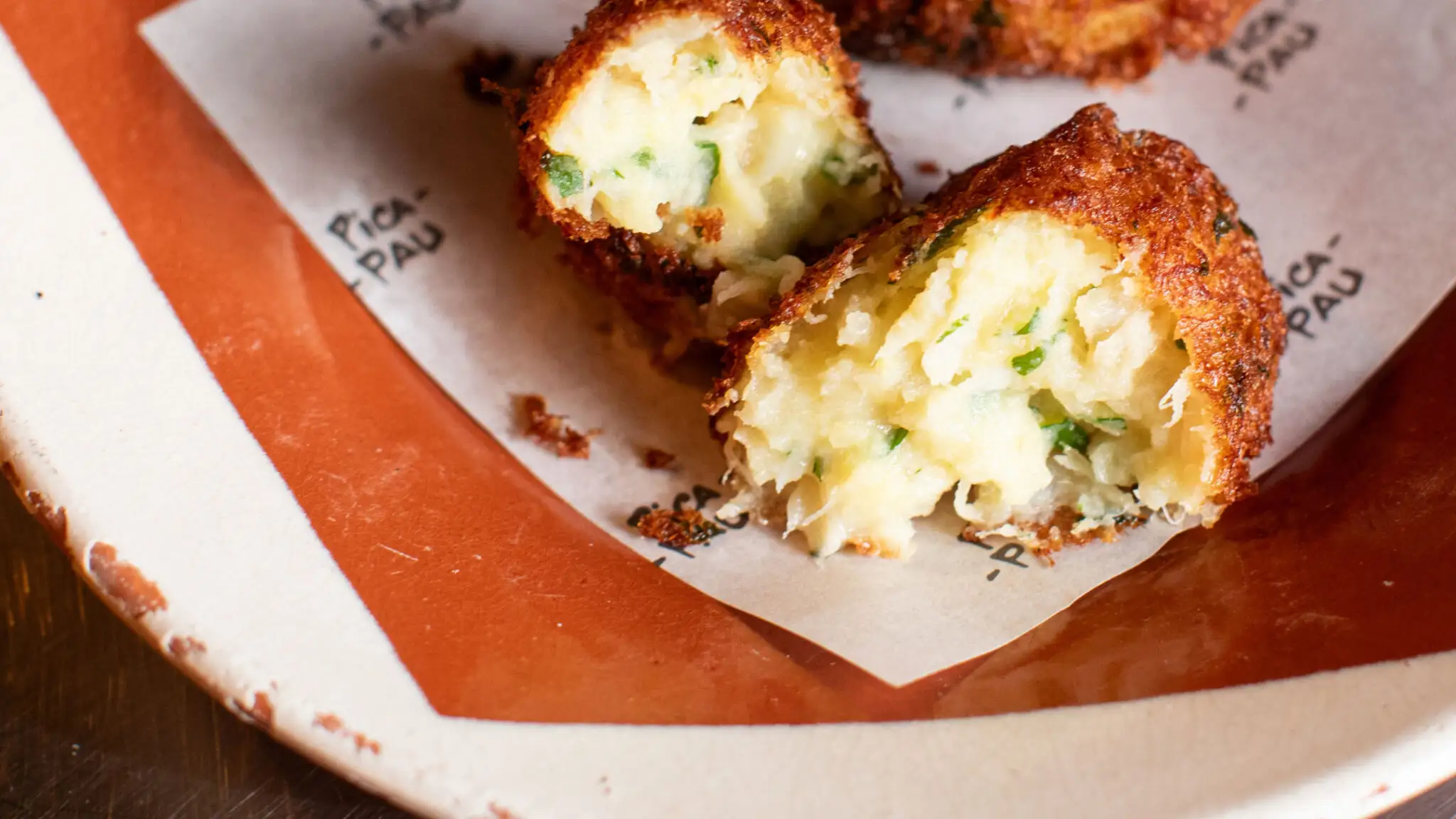 Pastel de bacalhau: cod and potato, fried, eaten standing.

Caldo Verde and the Late-Night Soup
A bowl at one in the morning makes sense here
Portugal has a deep food culture that Visit Portugal describes through regional gastronomy, and one of its most useful Lisbon expressions is soup as a late-night food — specifically caldo verde, a simple cabbage and potato soup with a piece of chouriço floating in it, which appears on wedding menus as the midnight meal (ceia) when the party is still going. In Lisbon, a few late-night spots keep it available until the early morning hours, notably A Merendeira, which stays open until 7am and serves caldo verde alongside pão com chouriço (bread stuffed with sausage) for the overlap between last-call crowd and market workers starting their day.
This sounds like a curiosity, but it's worth knowing: late-night Lisbon street food is primarily soup and sandwiches, which is a more dignified and honest option than most cities offer at 3am.
Ginjinha: The Shot That Costs Two Euros
Cherry liqueur in a chocolate cup, drunk on the pavement
Ginjinha is a cherry liqueur, dark and sweet, served in a tiny chocolate cup at hole-in-the-wall ginjinha bars scattered through the Baixa and Alfama. A Ginjinha, on Largo de São Domingos, is the most famous: a standing-room counter, no food, just the liqueur and the cup. The chocolate cup is edible and you should eat it. Order com ela (with the cup). The liqueur costs around €1-2.
Chamuças: The Colonial Legacy in a Snack
Goa, by way of a Lisbon fryer
Portugal had a colony in Goa for more than 450 years, and the culinary result is chamuças — the Portuguese word for samosas, spiced chicken or vegetable parcels fried until crispy, found at traditional café counters and tascas throughout Lisbon. They are essentially samosas; they are also distinctly Lisbon in a way that reflects the colonial history more honestly than any museum exhibit. Order one at a café counter. Eat it standing up. Appreciate the specific, complicated history that put it there.
The Time Out Market: Once, Yes
Worth one visit, not worth your only meal
The Time Out Mercado da Ribeira is housed in a 1892 market building in Cais do Sodré and brings together 26 restaurants and 8 bars from some of Lisbon's most recognized chefs. It's well-designed, it's genuinely impressive as a concept, and the food quality is meaningfully higher than a generic food court.
What Time Does Lisbon Actually Eat
The rhythm is the thing worth borrowing
A Lisbon food writer who has lived here since 2018 describes the daily eating rhythm below. Bairro Alto doesn't reach full energy before 9pm. Budget neighborhoods like Mouraria and Graça work on the same schedule, just with lower prices.
The day, hour by hour
| Time | What To Eat |
|---|---|
| ~10am | Café counter coffee and a pastel de bacalhau |
| 12:30–1pm | Tasca lunch — arrive before the daily specials run out |
| Late afternoon | Another pastry, maybe a ginjinha |
| 8–9pm | Dinner, when the city comes alive |
This rhythm is the one worth borrowing. The city is not designed for eating at 6pm. Fighting that is both ineffective and unnecessary.
Sardines in June: The One You Can Only Get Once a Year
Santos Populares, and the rest of the year it is a restaurant dish
Every June, Lisbon celebrates the Santos Populares — the Popular Saints Festival — and plumes of smoke from portable sardine grills fill the streets of the oldest neighborhoods for the entire month. The sardines (sardinhas assadas) are grilled fresh over charcoal, served on a piece of bread that soaks up the juices, eaten with your hands at outdoor tables or standing at the edge of the street while music plays from speakers overhead.
This is not a tourist event that happens to have food attached to it. This is a genuinely beloved local festival where Lisboetas eat outdoors, drink wine from plastic cups, and celebrate June the way the city has always celebrated June. The sardines in this specific context — fresh from the Atlantic, fat with summer, cooked simply over fire — are excellent. Outside of June, you can order sardines at restaurants as a grilled plate, but the street version doesn't exist. It's once-a-year, which is part of the reason it's considered special.
Santos Populares, June


That distinction matters. If you're visiting in June, go looking for the smoke.
Tremoços and the Beer Bar Ritual
The bowl that arrives before you ask
Order a beer at a traditional Lisbon bar and within two minutes something will arrive that you didn't order and won't be charged for: tremoços (lupini beans), a small bowl of olives, or occasionally a few slices of chouriço. These are couvert-style complimentary snacks — a tradition that varies by establishment and has nothing to do with the tourist-facing "couvert charge" that appears on some restaurant bills as a cover for bread and butter. At a genuine neighborhood bar, the tremoços just arrive because that's what bars do.
Tremoços are briny, slightly firm, and addictive in a way that's hard to explain before you've tried them. You eat them by pressing the bean out of its skin with your teeth — the skin is inedible — and the flavor is something between a salty pickle and a bean. Cold beer, tremoços, late afternoon sun on a Mouraria terrace: this is a Lisbon experience that costs you the price of one beer.
A First-Time One-Day Crawl
Ten in the morning to two the next
If you only have one day, don’t try to turn Lisbon street food into a checklist with twelve stops. Do it like a local day: one counter snack, one sandwich, one drink ritual, one late meal.
Where Baixa sits
Common Mistakes to Avoid
Mostly a matter of clock, not taste
Eating too early. A 6pm dinner puts you in the wrong rhythm; Lisbon’s casual food scene makes more sense from late afternoon onward.
Only eating at markets. Time Out is useful once, but the better story is still at old counters, tascas, and beer bars.
Skipping cash. Many central places take cards, but small counters and festival stalls still move faster when you have coins and small notes.
Confusing petiscos with Spanish tapas. The format overlaps, but the dishes, pace, and ingredients are Portuguese.
The Bottom Line
Find the window, order com ela, stay up
Lisbon's casual food culture is one of the most accessible in Europe — genuinely affordable, genuinely good, and genuinely itself rather than a performance of itself designed for visitors. A bifana from a counter window and a pastel de nata from a warm oven will tell you more about what this city actually is than any restaurant guide could, including this one.
Find the bifana window. Order com ela. Stay up for the 2am queue.
Before you go
What is the best street food in Lisbon?
The bifana is the best first order: cheap, fast, local, and easy to find around Rossio, Baixa, Chiado, and traditional tascas. Add a prego, pastel de bacalhau, ginjinha, chamuças, and petiscos if you want the fuller Lisbon street food picture.
Is Lisbon street food safe to eat?
Yes. Counter spots like bifana windows and tascas turn over food constantly and cater mostly to locals eating there daily — a strong sign of freshness. Stick to places with a visible queue and food that is served hot.
How much should I budget per day for casual eating?
€15–25 covers a full day: a pastel de bacalhau and coffee in the morning, a bifana or prego for lunch, a petiscos spread or caldo verde for dinner, and a ginjinha to close it out.
Where should first-time visitors eat street food in Lisbon?
Start in Rossio and Baixa for bifanas and ginjinha, then move toward Mouraria or Alfama for tascas. Cais do Sodré is useful for Time Out Market, but it should not be your only Lisbon food stop.
What time do people eat street food in Lisbon?
Counter snacks work all day, but Lisbon’s best casual eating rhythm starts late: lunch around 12:30–1pm, snacks in the late afternoon, dinner after 8pm, and sandwiches or caldo verde after midnight.
What's the difference between petiscos and tapas?
They both mean small shared plates, but petiscos developed independently in Portugal with their own ingredients and pace — treating them as interchangeable with Spanish tapas misses what makes each distinct.
Can vegetarians eat Lisbon street food?
Yes, but choices are narrower. Look for tremoços, olives, cheese plates, caldo verde without chouriço if available, pastries, vegetable chamuças, and petiscos bars with salads or seasonal plates.
Do I need to speak Portuguese to order?
No, but knowing "com ela" for ginjinha and pointing at the counter case works everywhere. Most counter staff in central Lisbon handle basic English fine.
What does com ela mean when ordering a bifana?
It means with the sauce — the garlicky cooking juices spooned over the pork. It is never offered automatically, and the plain version is a noticeably lesser sandwich. Say it when you order.
Keep going


Sources
Dish names, prices and festival dates checked against the official and reference sources below · Visit Portugal · Visit Lisboa · Câmara Municipal de Lisboa · Time Out Market Lisboa · MICHELIN Guide Lisbon · Carris (Lisbon transport) · IPMA (Portuguese weather) · UNESCO World Heritage Centre · UNESCO intangible heritage · Statistics Portugal · UK advice: Portugal · Lisbon local time
We will tell you whether we can help and send a written quote before any paid work begins.