From sticky rice you roll into scoops to pork belly curries with no coconut in sight, Northern Thai food will quietly dismantle everything you thought you knew about Thai cuisine. Here’s what to eat in Chiang Mai, how to eat it, and where to go in Chiang Mai to do it properly.
Quick answer: what to eat in Chiang Mai starts with khao soi, then sai ua, gaeng hung lay, nam prik noom with sticky rice and pork cracklings, and kanom jeen nam ngiao if you want the local noodle dish most visitors miss. First-timers should plan one sit-down Lanna meal, one market snack run, and one laab-focused lunch if they are comfortable with heat and offal.
Forget what you know about Thai food. Not all of it — just enough to make room for what Chiang Mai is actually serving.
The menus up here don’t look the same. The flavours don’t land the same. And the thing you’ve been calling a spoon is, in Lanna cuisine, a small ball of sticky rice pressed between your fingers. You’re eating with your hands now. Welcome to the North.
Northern Thai food — Lanna food, named for the ancient kingdom that ruled this region for five centuries — is less coconut, more smoke. Less sweet, more herbal. Less designed to reassure you and more designed to make you pay attention. Tamarind, pickled garlic, galangal, and turmeric carry the flavour instead of coconut milk. Dill and sawtooth coriander show up in places nobody warned you about. And if you follow the locals far enough off the tourist circuit, there’s raw buffalo laab with bile and chilled pork blood soup at the end of that road, both of which are significantly better than they sound.
I ate my way through Chiang Mai across several visits — markets, shophouses, an alley counter where I was the only person who needed a menu, a stilted wooden restaurant where we ordered everything on the table and ate on mats until we couldn’t. The dishes that stopped me weren’t the famous ones. They were the ones I didn’t have a reference point for: the nam prik ong that hit like a spicy Bolognese made by someone who actually understood what Bolognese should taste like. The gaeng hung lay that had no business being that complex — sweet, tangy, and deeply savoury all at once, from a curry with zero coconut milk, which shouldn’t work and absolutely does.
This is the guide I wish existed before that first meal. Every dish, every restaurant, every technique covered in this comprehensive what to eat in Chiang Mai guide comes from lived eating experience, not tourist recommendations.
How to Use This Chiang Mai Food Guide
If you are deciding what to eat in Chiang Mai on a short trip, do not treat this as a checklist to finish in one day. Start with khao soi, then plan a shared Lanna meal, then use markets for snacks, sweets and Thai tea.
- Day one: use this guide to choose what to eat in Chiang Mai first — khao soi, sai ua and nam prik noom with sticky rice.
- Day two: go deeper into what to eat in Chiang Mai with gaeng hung lay, kanom jeen nam ngiao and a proper Lanna restaurant meal.
- Day three: compare what to eat in Chiang Mai by setting: market snacks in the morning, sit-down dishes at lunch and a laab specialist if you want the adventurous side of Northern Thai food.
The easiest mistake is asking only what to eat in Chiang Mai at famous restaurants. The better question is which dish belongs to which moment: khao soi for an easy entry, nam prik dips for sticky rice technique, and laab only when you are ready for real heat.
Chiang Mai food field notes
Eat the North with a better map
Use this as a first-meal compass: start central, graze the markets, then leave room for the restaurants that make Northern Thai food feel like its own country.
Badge key
What earns a House of Routes badge
Used only when a dish or place clears the research standard: visited, cross-checked, and not lifted from aggregator lists.
The one to build the meal around when you cannot eat everything, which is unfair but sometimes physically necessary.
For dishes and areas that tend to sit outside first-timer lists but explain Chiang Mai better than another safe bowl.
A practical warning for spice, offal, raw meat, or fermented flavours before curiosity outruns common sense.
Food areas
Where Chiang Mai eating starts to make sense
Old City
First-meal territory: khao soi, sai ua, and market snacks without overthinking it.
See the area guide →Nimman
A softer landing: modern Lanna plates, cafes, and Thai tea between bigger meals.
See the area guide →Warorot Market
Sai ua, sweets, khao lam, and edible souvenirs with proper market turnover.
See the street food guide →Mae Rim / San Sai
Leave the centre for shared Lanna meals, dips, gaeng hung lay, and a slower table.
See the restaurant guide →Local laab shops
Early-lunch territory for cooked laab, raw laab, and heat that means what it says.
See the laab guide →Cost data
What a good Chiang Mai food day usually costs
Source: House of Routes Chiang Mai field notes and the cost ranges already used in this guide. Prices vary by stall, season, and how confidently you order a second plate.
Gallery
Northern Thai food, before the first order
What Makes Northern Thai Food Different from Central Thai Cuisine
Looking for what to eat in Chiang Mai? The first thing to understand: Chiang Mai’s Lanna cuisine is fundamentally different from the Central Thai food you know.
| Feature | 🏔 Northern Thai (Lanna) | 🌆 Central Thai (Bangkok) |
|---|---|---|
| Flavour base | Tamarind, pickled garlic, fermented paste | Coconut milk, fish sauce, palm sugar |
| Heat profile | Direct, smoky, bitter-forward | Balanced sweet-sour-spicy |
| Staple carb | Sticky rice (eaten by hand) | Jasmine rice (eaten with spoon) |
| Herb use | Dominant — dill, sawtooth coriander, galangal | Supporting role — basil, lemongrass, kaffir lime |
| Coconut milk | Rarely used | Core ingredient in most curries |
| Eating style | Communal, hands-on, everything at once | Individual plates, sequential |
| Signature dishes | Khao soi, gaeng hung lay, sai ua, nam prik noom | Green curry, pad thai, tom kha, som tam |
| Cultural roots | Lanna Kingdom — influenced by Laos & Myanmar | Royal Siamese court cuisine |
The easy answer is “no coconut milk.” That’s true and it matters, but it’s not the whole picture.
Central Thai cooking — the version most of the world recognises as Thai food, and what you’ll find dominating every menu in our Bangkok food guide — is built on a precise sweet-salty-sour-spicy balance that makes dishes like green curry and pad thai so immediately satisfying. It’s a cuisine engineered for harmony. Northern food is something else. The sweetness steps back. The bitterness, the earthiness, the smoke — all of those move forward. The flavour profile is deeper and stranger and more demanding of your attention.
What you’re eating instead of coconut: tamarind for acidity, pickled garlic for a fermented funk, galangal and turmeric for warmth, and a herb arsenal — dill, sawtooth coriander, mint — that would look more at home in Laos or Myanmar than in Bangkok. Which makes sense. The Lanna Kingdom shared borders and trade routes with both, and the food absorbed all of it. Thai cuisine is not a monolith — regional variation is the rule, not the exception.
If you’re new to Thai food in general, our guide to Thai street food beyond pad thai is a good place to build context before diving into the Lanna deep end. Eating is communal and tactile. Dishes arrive together, not in sequence. The table fills up, the herb basket lands in the middle, and sticky rice — the daily carb and your primary utensil — gets passed around in a woven basket. You eat with your hands. This is not a novelty, it’s the technique.
The spectrum runs from globally famous (khao soi) to genuinely daring (raw buffalo laab, cold pork blood soup). Both ends are worth your time. The middle is where most people stop, which is a shame, because the outliers are where what to eat in Chiang Mai stops being a great food city and starts being an unforgettable one.
How to Eat Northern Thai Food: Sticky Rice, Heat Levels & Herb Baskets
Learn the sticky rice move first. Pinch off a piece, roll it into a loose ball, press a thumb-dimple into the centre, and use it to scoop dips and curries like a small edible spoon. It feels awkward for about thirty seconds, then it’s automatic, and then you understand why every dish on the table was designed around it. Try it first with nam prik and kab moo — the contrast of the soft rice against the crunchy cracklings against the smoky dip will make the whole system click.
The heat here is real and it’s not always flagged. Local spots in Chiang Mai are not calibrating their spice levels for visitors. That’s a feature, not a bug — but it’s worth knowing before you’re two bites into something that’s making your eyes water. The phrases that help: mai phet (not spicy), phet nid noi (a little spicy), phet phet (very spicy, if you genuinely mean it). The herb baskets on every table aren’t decoration — mint, dill, and sawtooth coriander eaten between bites cool things down faster than water does. Thai iced tea handles the rest.
Timing is part of the strategy. The best places in Chiang Mai don’t keep restaurant hours. They open at 10am and sell out by noon. They have twelve tables and no reservations and a queue that starts forming before the doors open. Laab Ton Koi gets packed within an hour of opening every single day, and no amount of showing up at 1pm changes that. The rule: if a place has a reputation, treat it like a morning errand, not an evening plan.
What to Eat in Chiang Mai by Area
| Area | What to eat in Chiang Mai here | Best for |
|---|---|---|
| Old City | Khao soi, sai ua, market snacks and easy first-timer Northern Thai food. | First meal in Chiang Mai |
| Nimman | Modern Lanna plates, cafes, Thai tea and gentler introductions to what to eat in Chiang Mai. | Comfortable dinners |
| Warorot Market | Sai ua, khao lam, sweets, snacks and edible souvenirs. | Market grazing |
| Mae Rim / San Sai | Sit-down Lanna meals, nam prik dips, gaeng hung lay and shared family-style plates. | Destination restaurants |
| Local laab shops | Cooked laab, raw laab, luu and herb-heavy Northern Thai dishes for adventurous eaters. | Experienced food travelers |
If you are still planning the wider route, pair this Chiang Mai food guide with the Thai curry types guide, Thai street food beyond pad thai, best time to visit Southeast Asia, and vegetarian food in Southeast Asia. For official destination context, check the Tourism Authority of Thailand Chiang Mai page.
Chiang Mai Food Costs, Ordering Tips & First-Time Visitor Advice
Chiang Mai is still one of Thailand’s easiest cities for eating well without spending much, but the best meals reward a little planning. Markets are best for snacks, sweets, grilled sausage, khao lam and Thai tea. Sit-down Lanna restaurants are better for the full spread: dips, curry, herbs, sticky rice and shared plates that make sense together.
| Food or meal | Typical cost | Best time to go | Tip |
|---|---|---|---|
| Khao soi | 40-80 THB | Late morning to lunch | Add lime, pickled mustard greens and chile oil gradually. |
| Market snacks | 20-80 THB | Morning or evening | Look for quick turnover and food cooked in front of you. |
| Shared Lanna meal | 150-350 THB per person | Lunch | Order one dip, one curry, one sausage, one vegetable dish and sticky rice. |
| Laab restaurant meal | 100-250 THB per person | Early lunch | Choose cooked laab first unless you already know you want raw. |
Common mistake: eating only khao soi and calling Chiang Mai “done.” Khao soi is the easy win, but the city gets more interesting when you build a table around sticky rice, chile dips, gaeng hung lay, sai ua and herbs. For broader trip planning, pair this what to eat in Chiang Mai guide with the best time to visit Southeast Asia and the best travel apps for Southeast Asia.
The Best Dishes to Eat in Chiang Mai: What to Order and Why
| Dish | Type | Spice | Coconut | Best for |
|---|---|---|---|---|
| Khao Soi | Curry noodle soup | Yes | Everyone — start here | |
| Nam Prik Noom | Chile dip | No | First timers + heat lovers | |
| Nam Prik Ong | Pork & tomato dip | No | Everyone | |
| Gaeng Hung Lay | Pork belly curry | No | Curry lovers — must-order | |
| Sai Ua | Grilled herb sausage | No | Everyone | |
| Kanom Jeen Nam Ngiao | Tomato noodle soup | No | Heat seekers, local food fans | |
| Kaeng Khanun | Young jackfruit curry | No | Adventurous eaters | |
| Laab (cooked) | Minced meat salad | No | Bold palates | |
| Laab Dib (raw) | Raw meat with bile | No | Truly adventurous only | |
| Luu | Cold pork blood soup | No | The fearless |
Khao Soi in Chiang Mai: Northern Thai Curry Noodle Soup
Yes, it’s famous. Yes, every food article about Chiang Mai leads with it. Khao soi has its own Wikipedia entry and a devoted global following for good reason. It leads here too because it genuinely deserves to.
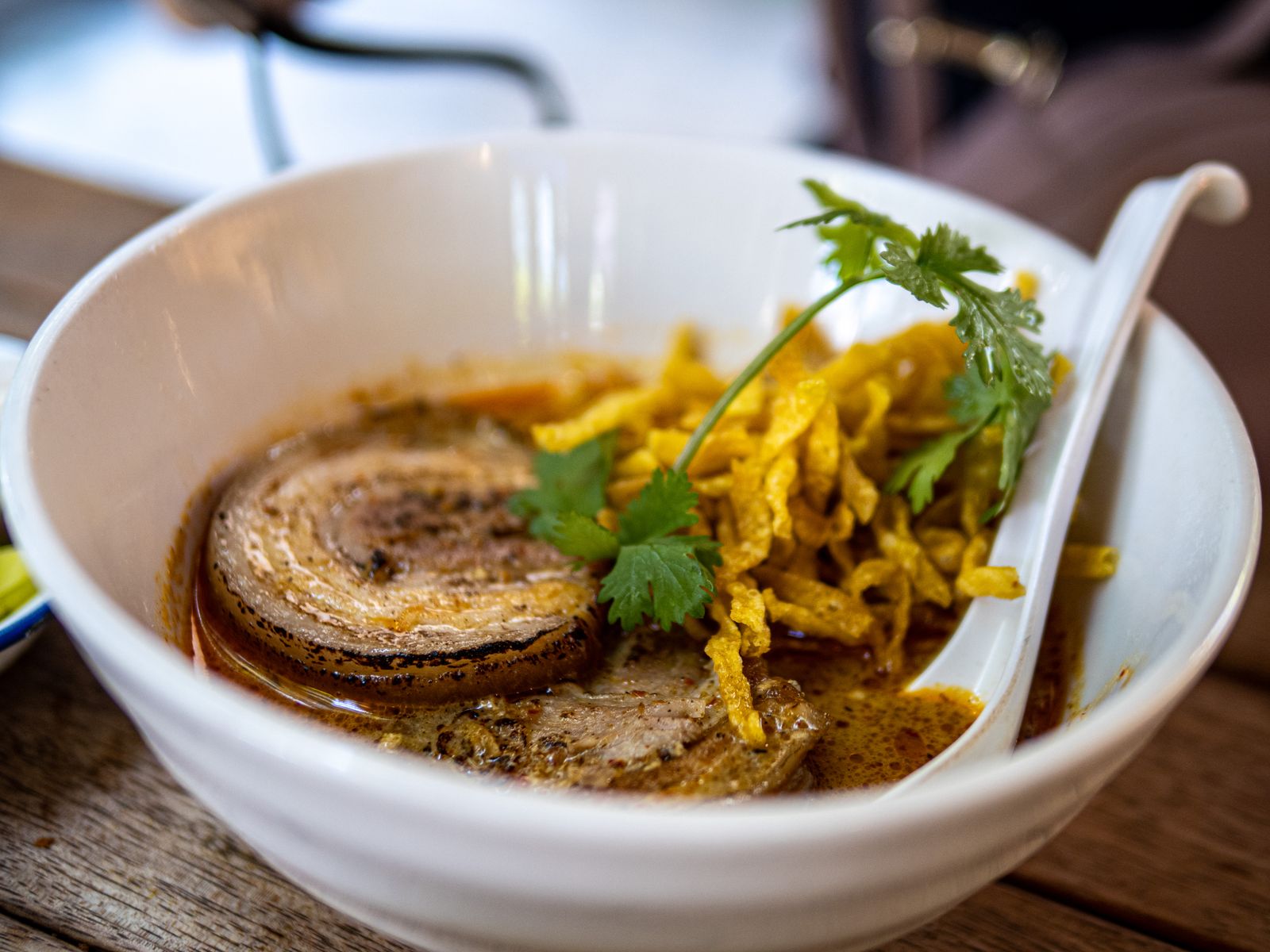
Khao soi is a curry noodle soup with a silky, deeply spiced broth, soft egg noodles underneath, and a crown of crispy fried noodles on top that slowly dissolve into the broth as you eat — a built-in textural countdown. On the side: pickled mustard greens, raw shallots, lime, and chile oil. These are not garnishes. They’re the controls. Taste the broth first, understand what you’re working with, then tune it. Chicken is the classic; beef and pork versions exist and are worth ordering if you see them.
The version in Chiang Mai is richer and more complex than anything that gets exported — less sweet, more layered, with a spice depth that takes a few spoonfuls to fully read. If your only reference is khao soi from abroad, this will reset your baseline permanently.
Nam Prik Noom & Nam Prik Ong: Northern Thai Chile Dips
Order these first. Everything else makes more sense after you’ve had them.
Nam prik noom is charred green chiles pounded with garlic into a mash that looks like it’ll destroy you and then delivers a slow, mellow burn instead. The smokiness is the point — it’s the flavour of something that spent real time over fire. Nam prik ong is minced pork with tomatoes, dried chiles, and shrimp paste, and it tastes like a version of Bolognese that grew up in the right country. Rich, savoury, deeply familiar in a way you can’t immediately explain.
Eat both with sticky rice and kab moo — pork cracklings — and you’ll understand within three bites why this combination has been on Chiang Mai tables for centuries. The crunch of the crackling, the softness of the rice, the smoke of the dip. It’s a complete system.
Gaeng Hung Lay: Chiang Mai’s Slow-Cooked Pork Belly Curry
This is the dish I tell people about when they ask what surprised me most about Northern Thai food.
Gaeng hung lay is a pork belly curry — slow-cooked with ginger, pickled garlic, tamarind, warm spices, and peanuts — that contains no coconut milk and somehow achieves a depth and richness that most coconut-based curries are working toward. The tamarind brings acidity. The pickled garlic brings a fermented complexity. The pork belly, given enough time, collapses into the sauce until the fat and the broth are indistinguishable. It’s sweet and tangy and savoury all in the same spoonful and it’s one of those dishes that genuinely has no equivalent anywhere else in Thai cooking.
If you eat one thing in Chiang Mai that you didn’t already know about, make it this.
Sai Ua: Chiang Mai’s Herb-Packed Lanna Sausage
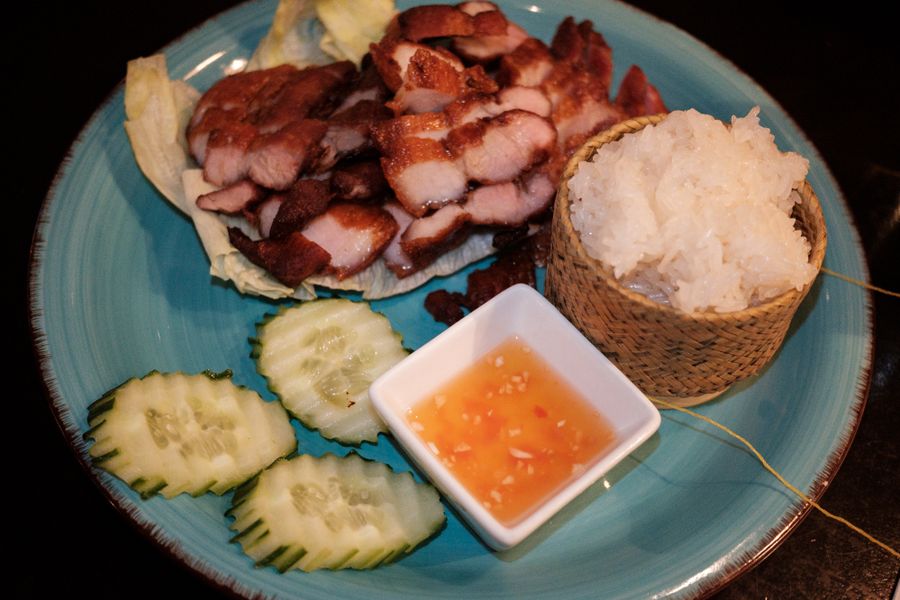
Coarsely minced pork loaded with lemongrass, makrut lime leaf, galangal, and chiles, grilled until the outside catches and the herbs inside start to perfume the smoke. Sliced diagonally, served with sticky rice, cucumber, and fresh herbs. Every component is doing something. Nothing is there by accident.
Market stalls will often vacuum-seal links if you ask — worth getting an extra portion for later, especially if you’re heading to night markets where you’ll want something in hand while you walk.
Kanom Jeen Nam Ngiao: Northern Thai Tomato Noodle Soup
Soft rice noodles in a broth built from tomatoes, dried chiles, and pork that manages to be simultaneously bright, acidic, spicy, and deeply savoury. Some versions add cubes of congealed blood; all versions benefit from full herb assembly at the table. This dish doesn’t get the same tourist attention as khao soi, which means the version you’ll find in local shophouses is almost certainly better than anything being made for visitors. Order it, add everything on the table, and wonder why nobody told you about it sooner.
Kaeng Khanun: Northern Thai Young Jackfruit Curry
Young jackfruit braised in a chile-herb broth with no coconut and usually some pork, cooked until it reaches a texture somewhere between artichoke and slow-cooked eggplant — fibrous enough to have substance, soft enough to absorb everything around it. It was the spiciest dish at my table the day I tried it. It was also the one I kept reaching back into. No coconut, serious heat, and a depth that rewards eating slowly.
Gai Neung: Lanna-Style Herbed Steamed Chicken
The dish you order when the rest of the table is trying to end you. Chicken steamed with aromatic herbs until tender, served in a light savoury broth that tastes clean and intentional rather than simply mild. It’s not a consolation prize — it’s a palate reset, and a well-made one earns its place on the table alongside everything else.
Laab in Chiang Mai: Cooked vs Raw — What You Need to Know
Northern laab is not the dish you know from central Thai menus. This is not a light herb salad with toasted rice powder and lime. This is something older and stranger and more serious.
Laab dib — raw laab — can include bile. Intentionally. The bitterness is the flavour, not a flaw, balanced by a herb and spice mix that goes deeper than anything in the cooked version. I had raw buffalo laab with bile at Laab Ton Koi and it was the most challenging thing I ate in Chiang Mai: aggressively bitter, powerfully herbal, and fascinating in the way that only dishes with real conviction behind them can be. The fresh herbs and cabbage on the side aren’t optional. They’re the antidote, and you’ll need them.
If raw isn’t your move — and that’s a completely legitimate position — the cooked pork laab is spicy, aromatic, topped with fried shallots that crackle on contact, and delivers the Northern profile without the bitterness. It’s excellent. It’s also a fundamentally different dish, and worth knowing the difference before you sit down.
One note: raw meat and blood carry health risks. If you’re immune-compromised or your stomach is unpredictable, stick to cooked.
Luu: Chiang Mai’s Traditional Cold Pork Blood Soup
Crimson, chilled, seasoned with herbs and spices and crunchy bits, and genuinely more refreshing than any description of it prepares you for. I went in expecting to tolerate it. I came out surprised. The heat is real — this is not a delicate dish — but the cold temperature does something unexpected to the whole experience. The herb basket earns its keep again.
Chiang Mai Street Food & Snacks: Sweets and Drinks Worth Trying
Bamboo worms — saltier and crunchier than you expect, more expensive than they look, better than they have any right to be. Get them with lemongrass, garlic, and chiles if the stall has them that way.
Tong muan — delicate rolled wafers with pandan and, if you find the right stall, edible flowers that feel like showing off in the best possible way. Pair with Thai tea. Don’t eat them dry standing up — they deserve better than that.
Khao lam — sticky rice slow-roasted inside bamboo, smoky and sweet, sold in markets in the morning. Buy it before 10am or it’ll be gone.
Thai iced tea, Northern style — foamier, creamier, colder, and inexplicably better than the version served everywhere else in Thailand. Whether that’s because of the recipe, the milk ratio, or the simple fact that cold sweet tea after a spicy meal achieves temporary perfection — I stopped caring about the reason after the third one.
Watch: Chiang Mai Street Food Before You Go
If you want a visual sense of the markets, pace and dishes before you arrive, this Chiang Mai food video is a useful preview. Watch for the way meals are built around shared plates, herbs, dipping sauces and rice rather than one single main dish.
Best Restaurants for Northern Thai Food in Chiang Mai
The Tourism Authority of Thailand lists dozens of Chiang Mai restaurants but these are the three worth building your schedule around.
Huen Jai Yong — A stilted wooden house with gallery space, craft stalls, and mat seating that makes the meal feel like an event rather than just dinner. We ordered the nam prik duo, gaeng hung lay, kaeng khanun, and gai neung, ate until we couldn’t, and started planning a return before we’d finished the table. It’s that kind of place. Perfect introduction to what to eat in Chiang Mai for first-time visitors.
Laab Ton Koi — Arrive before opening or don’t bother. This is where I had the raw buffalo laab with bile — intense, bitter, herbal, and completely uninterested in making concessions for people who aren’t sure they want it. Very local, very affordable, no performance for tourists whatsoever. Opens early mornings only.
Laab Lak Pun — The better entry point if Laab Ton Koi sounds like too much. Cooked pork laab with fried shallots, the cold pork blood soup if you’re testing the waters, and a room full of locals who are there because the food is genuinely good and not because a guidebook sent them. More forgiving hours than Laab Ton Koi.
Frequently Asked Questions: What to Eat in Chiang Mai
What food is Chiang Mai famous for, and what to eat in Chiang Mai first? Chiang Mai is famous for khao soi, sai ua, gaeng hung lay, nam prik noom, nam prik ong, kanom jeen nam ngiao, kaeng khanun and Northern Thai laab. Khao soi gets the headlines, but the dips, curries and sticky rice culture are what make Lanna food feel different from Bangkok food.
What should I eat first in Chiang Mai when deciding what to eat in Chiang Mai? Start with khao soi because it gives you the easiest entry point into Northern Thai flavour. After that, order sai ua, gaeng hung lay, nam prik noom with sticky rice and kab moo, then kanom jeen nam ngiao if you want a more local noodle dish.
Is Northern Thai food very spicy? Yes, at local spots that aren’t adjusting for visitors. Use mai phet if you need to, eat from the herb basket between bites, and don’t assume the kitchen’s default is calibrated to your baseline.
How much does food cost in Chiang Mai? Simple bowls and snacks often land around 40-80 THB. A shared Northern Thai meal at a sit-down restaurant is usually closer to 150-350 THB per person before drinks, depending on how many dishes you order.
What should I eat beyond khao soi? Gaeng hung lay first, then sai ua, then the nam prik duo with kab moo. After that: kanom jeen nam ngiao, kaeng khanun, and whichever laab variant matches your appetite for adventure.
How do I eat sticky rice? Roll a small ball, press a thumb-dimple, use it to scoop. Thirty seconds of practice and it’s instinctive. Start with the nam prik dips so you understand why the technique exists.
Is raw laab safe? There’s real risk with raw meat. If you’re unsure, order cooked. If you’re going for it, go somewhere with a reputation and a queue because freshness matters here more than almost anywhere else.
Which dishes skip coconut milk? Most of them. Gaeng hung lay, kaeng khanun, nam ngiao, all the nam prik dips. The absence of coconut is one of the defining characteristics of Lanna cooking: not a limitation, a choice.
Are there vegetarian options? Yes, with caveats. Sticky rice with nam prik noom (verify the shrimp paste), herb salads, khao lam, tofu substitutions in some curry dishes. Always check the paste because shrimp paste is common and not always flagged on the menu. For a broader look at plant-based eating across the region, see our Southeast Asia vegetarian food guide.
Where should first-time visitors eat Northern Thai food? Start with Huen Jai Yong for a broad sit-down Lanna meal. Save Laab Ton Koi or Laab Lak Pun for a separate lunch when you specifically want laab, blood soup or the more adventurous end of Chiang Mai eating.
Plan the Rest of Your Thailand Food Route
Chiang Mai is only one branch of Thai food. To turn this into a proper Thailand food route, use these next:
- Thai curry types guide for understanding curry pastes, coconut milk and regional curry styles.
- Thai street food beyond pad thai for dishes that connect Bangkok and Chiang Mai street eating.
- Bangkok food guide for the central Thai contrast and city eating.
- Bangkok street food guide for capital-city market eating.
- Best night market food in Southeast Asia for market-first eating across the region.
- Best breakfasts in Southeast Asia if you want morning market dishes beyond Thailand.
About This Guide
Written by Álvaro M Llerena, a food writer and travel guide author with 10+ years of eating experience across Southeast Asia, specializing in Northern Thai cuisine. This what to eat in Chiang Mai guide comes from multiple research visits to the city, meals at documented restaurants and markets, and conversations with local food experts. The goal: help you eat like a local rather than like a tourist.
Chiang Mai Food Guide: The Short Version
Chiang Mai is one of Asia’s great eating cities and most people only scratch the surface. The hits — khao soi, gaeng hung lay, sai ua — are genuinely excellent and will keep most people more than happy. But the further you push — into the laab, the dips, the dishes that don’t have English names on the menu — the more the city reveals itself as something special rather than just somewhere good.
Order the things you recognise. Then order the thing you can’t quite identify. The herb basket will handle whatever comes next.