
Mexico City rewards a neighborhood-by-neighborhood plan. Historic sights, museums, markets, parks, taquerías, and evening neighborhoods sit across a vast city where travel time matters. This guide groups the best things to do into practical days, explains what needs advance booking, and shows where food stops fit naturally along the route.

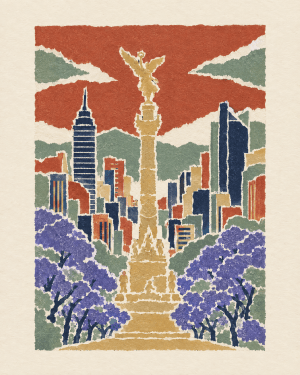 CDMX
Mexico / Mexico City / Things to do · 11 min read
Too large and too layered to see in a week.
Twenty-one million people at 2,250 metres, built directly on top of Tenochtitlán. This is what actually rewards the time.
Jump to what you came for
CDMXMexico City at a glance
Twenty-one million people at 2,250 metres
The best things to do in Mexico City are to visit Teotihuacán early, explore Chapultepec and the Anthropology Museum, spend time in Coyoacán and the historic centre, and experience Roma, Xochimilco and lucha libre. Allow at least four days; a week gives the city room to make sense.
Lonely Planet named Mexico City one of its top destinations for 2026, and they're right for the wrong reasons. The murals, the museums, the food — all of that is true. But what the guide descriptions miss is the specific feeling of being in a city of 21 million people that operates at its own frequency: the smell of marigolds and copal on a November morning in Coyoacán, the way Roma Norte transforms between afternoon and midnight, the existential scale of Teotihuacán at 7am before the tour buses arrive. Mexico City is not a city you can summarize. You can only tell people what to prioritize.
This is that list. Built around what actually rewards your time, not what photographs well.
The city at street level


When to go
Terracotta = best months (mild, dry). June–September is the rainy season — still warm, with short afternoon showers.
Where to base yourself
| Base | Best For | Vibe |
|---|---|---|
| Roma Norte & Condesa | Cafés, restaurants, nightlife | Shifts from relaxed lunch to full nightlife by 10pm; art nouveau streets and Parque México |
| Coyoacán | Frida Kahlo Museum, markets, slower pace | Village-within-the-city; plazas where locals actually sit |
| Centro Histórico | Architecture, museums, Aztec history | Built on top of Tenochtitlán; Templo Mayor, Palacio de Bellas Artes, Zócalo murals |
CDMXTeotihuacán: go early or do not go
Eight in the morning, on a weekday

The ancient city of Teotihuacán — "the place where men become gods" in Nahuatl — sits roughly 50 kilometers northeast of Mexico City and draws a million visitors a year. The scale of the Pyramid of the Sun, the largest structure in the pre-Columbian Americas, still stuns people who thought they knew what to expect. The Avenue of the Dead stretches for kilometers, lined with temples and platforms that were built by a civilization whose name we don't even know.
Go at 8am when the site opens, on a weekday if possible, before the largest tour groups arrive. Climbing the pyramids and other platforms is prohibited; use the plazas and Avenue of the Dead for the principal views. Allow four hours, bring water and wear comfortable shoes because the exposed site becomes hot quickly. Check the official INAH hours and admission before travelling.
The site is accessible by public bus from the Terminal Central del Norte or by Uber/taxi (roughly 45 minutes). Don't pay tour bus prices for what is a perfectly easy independent trip.
CDMXChapultepec Park: the city’s living room
866 hectares, and the best museum in the Americas

Bosque de Chapultepec is the largest urban park in Latin America — 866 hectares of forest, lakes, museums, and the city zoo, in the middle of Mexico City. It's where residents go on Sundays: families on paddle boats, teenagers on dates, food vendors everywhere, roller skaters circling the fountain. Come on a Sunday morning for the full social experience.
Inside the park: the Museo Nacional de Antropología (National Museum of Anthropology) is one of the most important museums in the world, full stop. The Aztec Sun Stone alone justifies the visit, but the collection spans the full breadth of Mesoamerican civilization — Olmec, Maya, Zapotec, Toltec, Aztec — across fourteen permanent exhibition rooms. Budget a full morning or afternoon. The English audio guide is worth getting.
The Castillo de Chapultepec on the hill above the park was an imperial palace under Maximilian I and then a military academy — a strange and beautiful building with Tiffany-stained-glass windows and views over the entire city that make the climb up the hill worth it regardless of what's inside.
CDMXFrida Kahlo Museum and Coyoacán
Book ahead, then stay for the afternoon

La Casa Azul — the Blue House where Frida Kahlo was born, lived, and died — is in Coyoacán, a village-within-the-city neighborhood that maintains a slower pace and a genuine local identity despite its fame. The museum is excellent and intimate, holding Kahlo's personal belongings, her studio, her wheelchair, and a significant collection of her work within the actual rooms where she made it.
Book tickets in advance — the museum has timed entry and sells out on weekends, sometimes days ahead. Go on a weekday morning for the most manageable crowd.
After the museum, spend the afternoon in Coyoacán properly: the Jardín Centenario and Jardín Hidalgo, two adjacent plazas where locals genuinely sit rather than posing for photos, a coffee at one of the cafés around the square, and a proper market lunch at Mercado de Coyoacán, which has some of the best midday food in the city — tlayudas, memelas, and a section of vendors selling nothing but tostadas with a dozen different toppings.
CDMXThe historic centre: layers on layers
Built directly on the Aztec capital
The Centro Histórico is built directly on top of the Aztec capital of Tenochtitlán, which the Spanish razed in 1521 and then used as a foundation — literally. The Museo del Templo Mayor sits beside the cathedral, excavated from under a colonial-era building in the late 1970s, revealing the Great Temple of the Aztec empire. The displays are extraordinary and the archaeology is still ongoing.
The Palacio de Bellas Artes — a stunning Beaux-Arts building with an Art Nouveau exterior and murals inside by Diego Rivera, José Clemente Orozco, and David Alfaro Siqueiros — is worth the visit for the building alone even if you don't catch a performance. Rivera's "Man at the Crossroads," the mural commissioned and then famously destroyed by Rockefeller Center, was recreated here in 1934.
Diego Rivera's murals in the Palacio Nacional, directly on the Zócalo, are the other anchor: a sweeping visual history of Mexico from pre-Hispanic civilization to the 20th century, painted across a full wall of the government palace and free to enter with a passport and a willingness to wait in the security line.
 CDMX
Roma Norte and Condesa
Afternoon into evening, without changing neighbourhood
Roma Norte and Condesa


Roma Norte and La Condesa are the two adjacent neighborhoods that hold Mexico City's most concentrated café, restaurant, and bar scene. Spend an afternoon walking between them: the art nouveau architecture on Álvaro Obregón, the large park (Parque México) at the center of Condesa where residents walk dogs and have coffee, the independent bookshops and galleries along Roma's tree-lined streets.
The specific Mexico City pleasure of this area is how it shifts between hours. At 2pm it's lunch, relaxed and civilian. At 6pm it's aperitivo, people appearing on terraces. By 10pm it's a different city: bars full, music from competing sound systems, the specific energy of a capital city that treats Thursday night like a Saturday. Plan your evening accordingly.
CDMXXochimilco: the floating gardens
The tourist version is pleasant; the local one is better
Xochimilco, three ways


The chinampas of Xochimilco — ancient floating gardens built by the Aztecs in a lake system south of the city — are where Mexico City goes on weekend afternoons to drink beer on colorful wooden boats (trajineras) while vendors paddle alongside selling food, drinks, and flowers. It's loud, cheerful, and completely unlike any other experience in Mexico.
The tourist version is pleasant. The local version is better: hire a trajinera on a Sunday afternoon rather than a tourist holiday, bring your own food and drinks (vastly cheaper than buying from the boats), and let the afternoon drift. The marimba bands paddling up alongside are either charming or maddening depending on your mood and can be waved off politely.
CDMXLucha libre: one evening, no discussion
Go once, and buy the cheap seats

Mexican wrestling — Lucha Libre — takes place at the Arena México in Doctores on Tuesday and Friday evenings and at Arena Coliseo in the Centro on Tuesdays and Sundays. The experience is genuinely theatrical: elaborate masks, multi-generational rivalries, crowd participation that's organized in a specific way you'll pick up within the first ten minutes, and the physical spectacle of athletes who are meaningfully more skilled than the format suggests.
Go once. It's one of those experiences that sounds like a tourist cliché and turns out to be genuinely entertaining, partly because the audience around you is entirely invested in the proceedings in a way that's infectious.
Budget seats are the right call — better atmosphere than the ringside premium sections.
CDMXDía de Muertos in Mexico City
If the dates allow any flexibility at all

If your dates allow any flexibility, plan around Día de Muertos (Day of the Dead, October 31 - November 2). The Mexico City celebration has become one of the most significant in the country since the government began organizing a major parade in 2016 (inspired partly by the Bond film Spectre, which invented the idea of a massive Day of the Dead parade in Mexico City and then the city decided to make it real). The parade runs through the historic center and draws enormous crowds; the cemetery visits in Mixquic (a village absorbed by the city's southern expansion) and the neighborhood ofrendas (altars) placed in public spaces and building lobbies throughout the city are more intimate and often more moving.
Chapultepec Park and the surrounding cultural institutions organize special programming. The city smells of marigolds for a week solid. It's genuinely one of the more remarkable things that happens in any major city in the world.
CDMXMarkets beyond the obvious
Flowers, and a small organic one
The Mercado Jamaica, the city's main flower market, is worth visiting at any hour for the scale of the flower trade alone — towers of marigolds (cempasúchil), the flowers central to Día de Muertos offerings, take over the market in October. The food section has excellent menudo (beef tripe soup) early in the morning, the correct hangover cure per universal CDMX consensus.
Mercado El 100 is a smaller, curated organic market in Condesa that runs on weekends — higher prices, verified local and organic producers, excellent coffee from Oaxacan and Chiapan roasters, prepared food from vendors who take ingredients seriously. Not the authentic chaos of a traditional market, but a useful Saturday morning option if you're based in Condesa or Roma.
CDMXA few honest trade-offs
Weather, safety, and the metro
What to know before you commit
Weather
Mexico City's weather is genuinely pleasant year-round — it sits at 2,250 meters altitude, which means even summer (technically the "rainy season," June-September) stays mild. The rains come in the afternoon, last an hour, and then stop. The best months for most visitors are October-November (Día de Muertos in late October-early November is an extraordinary cultural experience if you time it right) and February-May before the rains.
Safety
Safety is real but manageable. The tourist neighborhoods — Roma, Condesa, Polanco, Centro Histórico, Coyoacán — are generally fine with the same common-sense practices you'd apply in any major city. Don't take street taxis (use Uber or authorized taxi stands). Keep your phone in your pocket in crowded areas. Don't let anyone worry you out of visiting: Mexico City rewards the people who actually go.
Getting Around
The metro is excellent, cheap, and fast. Use it. The occasional overcrowding on major lines during rush hour is a minor inconvenience compared to the cost and traffic of taxis across a city of this size.
CDMXHow many days do you have
Both plans work; the city scales
Three days, or a week
3 days
Roma Norte, Condesa, Coyoacán, and the Centro Histórico — a coherent experience without rushing across the whole map. Spend a full afternoon-into-evening in Roma/Condesa, a morning at the Frida Kahlo Museum and Coyoacán's plazas and markets, and a half-day covering Templo Mayor, Palacio de Bellas Artes, and the Zócalo murals in the Centro.
1 week
Everything in the 3-day plan, plus Xochimilco's floating gardens on a Sunday afternoon, a Lucha Libre evening at Arena México, a full morning at Chapultepec Park and the Museo Nacional de Antropología, and a full day at Teotihuacán (go at 8am). Neither plan is too much or too little — the city scales to whatever time you give it.
CDMXThe bottom line
Too large and too layered to see in a week
Mexico City is too large and too layered to see in a short trip. The right approach is to pick a neighborhood and know it deeply, rather than rushing across the whole map. Three days in Roma Norte, Condesa, Coyoacán, and the Centro gives you a coherent experience. A week lets you add Xochimilco, Lucha Libre, a full Chapultepec morning, and a day at Teotihuacán. Neither is too much or too little — the city scales to whatever time you give it.
Go early to the pyramids. Get lost in Roma Norte at night. Eat the comida corrida at the fonda next door to wherever you're staying. That's the version of Mexico City worth having.
Before you go
How many days do you need in Mexico City?
Three days covers Roma Norte, Condesa, Coyoacán and the Centro Histórico without rushing. A week adds Xochimilco on a Sunday, a lucha libre evening, a full morning at Chapultepec and the Museo Nacional de Antropología, and a day at Teotihuacán.
What is the best time of year to visit?
October and November, which includes Día de Muertos, or February to May before the rains. June to September is the rainy season — still warm, with short afternoon showers rather than washouts.
Is Mexico City safe for visitors?
Manageable with normal big-city practice. Roma, Condesa, Polanco, the Centro Histórico and Coyoacán are generally fine. Do not take street taxis — use Uber or an authorised taxi stand — and keep your phone in your pocket in crowds.
When should you go to Teotihuacán?
At 8am when the site opens, on a weekday. The coaches arrive mid-morning and the site is exposed, so the heat and the crowds build together. It is reachable by public bus from Terminal Norte.
Do you need to book the Frida Kahlo Museum in advance?
Yes. La Casa Azul uses timed entry and regularly sells out, so book before you travel rather than turning up.
How do you get around Mexico City?
The metro — it is cheap, fast and extensive. Rush-hour crowding on the main lines is a minor cost against taxi fares and traffic in a city this size.
Sources
First-hand time in Roma Norte, Coyoacán, the Centro Histórico and Xochimilco · UNESCO — Historic Centre of Mexico City and Xochimilco · UNESCO — Pre-Hispanic City of Teotihuacan · UNESCO — traditional Mexican cuisine · SECTUR — Mexico’s tourism ministry · Mexico City’s official tourism portal · UK FCDO — Mexico travel advice · US State Department — travel advisories · Smartraveller — Australian government advice · CDC — Travelers’ Health · CIA World Factbook
We will tell you whether we can help and send a written quote before any paid work begins.
Frequently asked questions
How many days do you need in Mexico City?
Four days is a useful minimum for the historic center, major museums, two or three neighborhoods and a focused food itinerary. Add time for Teotihuacán or a slower pace.
Which Mexico City attractions need advance booking?
Reserve limited-capacity museums, special exhibitions and popular tours. Parks, markets and most neighborhood walks can remain flexible.
What is the best way to plan each day?
Group activities by neighborhood because the city is large and traffic changes travel times. Keep one major reservation per half-day and place food stops along the same route.