Rome’s luxury hotels differ most in location, building style, service, and the kind of trip they suit. This guide compares four standout stays near the historic center, Spanish Steps, and quieter residential areas, with clear tradeoffs around views, space, dining, and access. Use it to decide which experience justifies the rate before you book.

Italy / Rome / Where to stay · 12 min read
History is not an amenity. In Rome, four hotels prove it.
What you are actually paying for at the Hassler, the de Russie, Portrait Roma and the Sofitel — and the one question that decides the room.
Luxury Hotels in Rome: How to Choose
Four properties, four different propositions — and none of them is wrong for everyone.
Luxury hotels in Rome reward people who understand that history is not an amenity. The Hassler has been at the top of the Spanish Steps since 1893. The de Russie's garden is more beautiful than most of the city's public parks. These things don't require explanation in a press release because they don't require justification — they simply are what they are, and the price reflects it.
This is a guide to the properties that earn their position rather than the ones that occupy it by default of address.
Choose by what you want Rome to feel like
The address — Hassler
Top of the Spanish Steps, formal, ceremonial, with a Michelin star on the sixth floor.
The garden — Hotel de Russie
A terraced courtyard backing onto Villa Borghese, and the best first-trip answer.
The suite hotel — Portrait Roma
Fourteen suites run by the Ferragamo family, for occasions rather than itineraries.
The sensible number — Sofitel Villa Borghese
Genuine five-star service, a rooftop, and a rate worth comparing.
Rome, on the other side of the door
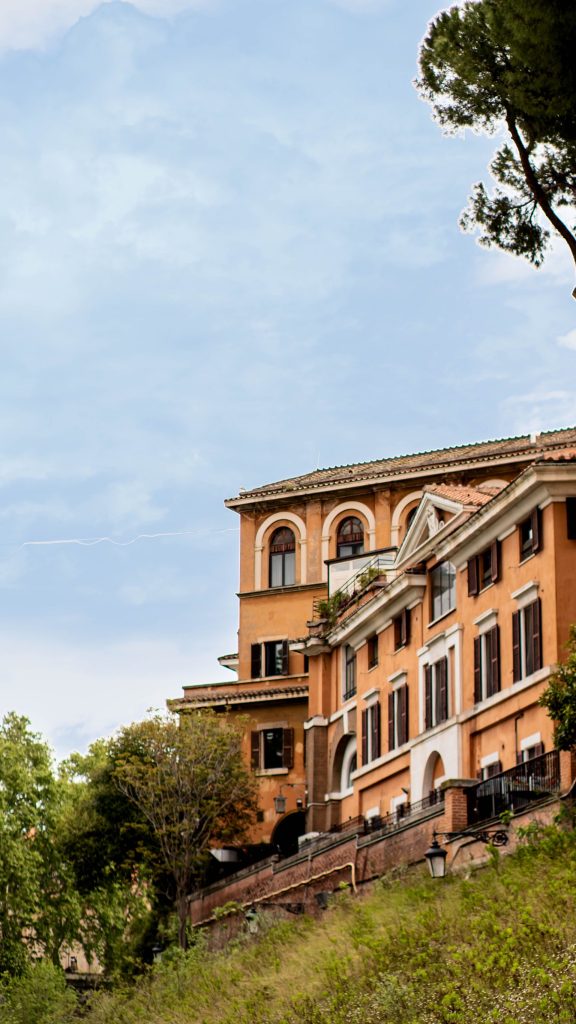 The streets these four open onto
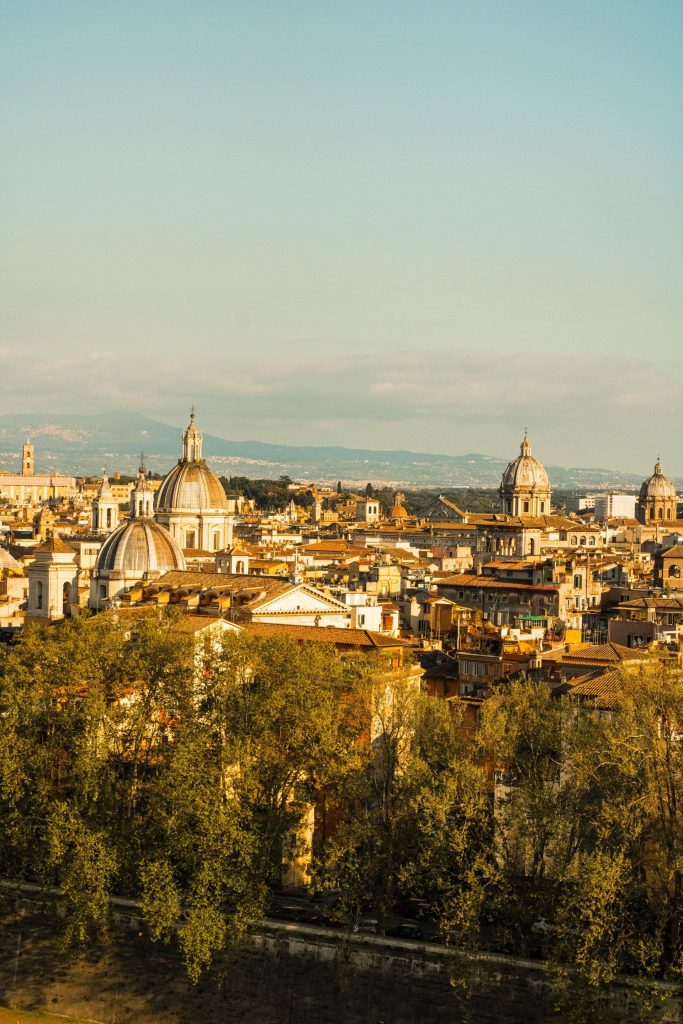 The light that makes the walk worth it
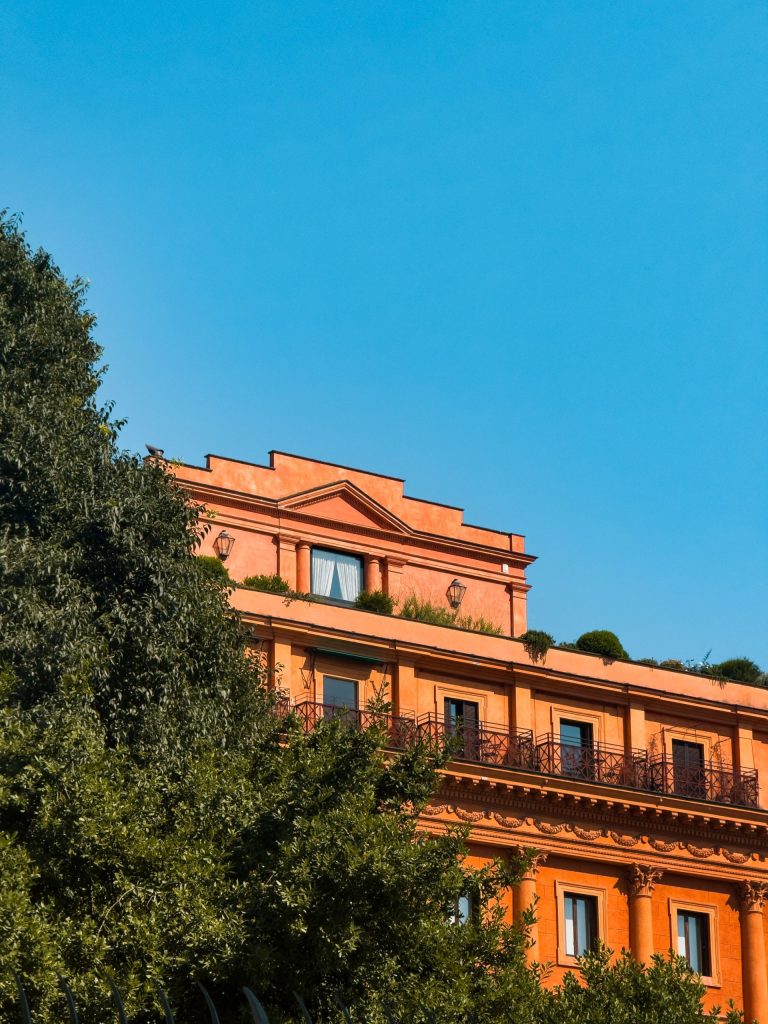 And the detail you only see on foot
Hotel Hassler: The Address That Came First
At the top of the Spanish Steps since 1893, and still the most famous door in Rome.
The Hassler sits at the very top of the Spanish Steps, which means that from certain rooms you look directly out over 135 steps of baroque staircase descending to a piazza that Keats died next to and Audrey Hepburn ran up in a film that most of your guests will have seen. This is the context you're paying for alongside the Egyptian cotton and the Limoges porcelain and the trompe l'oeil frescoes.
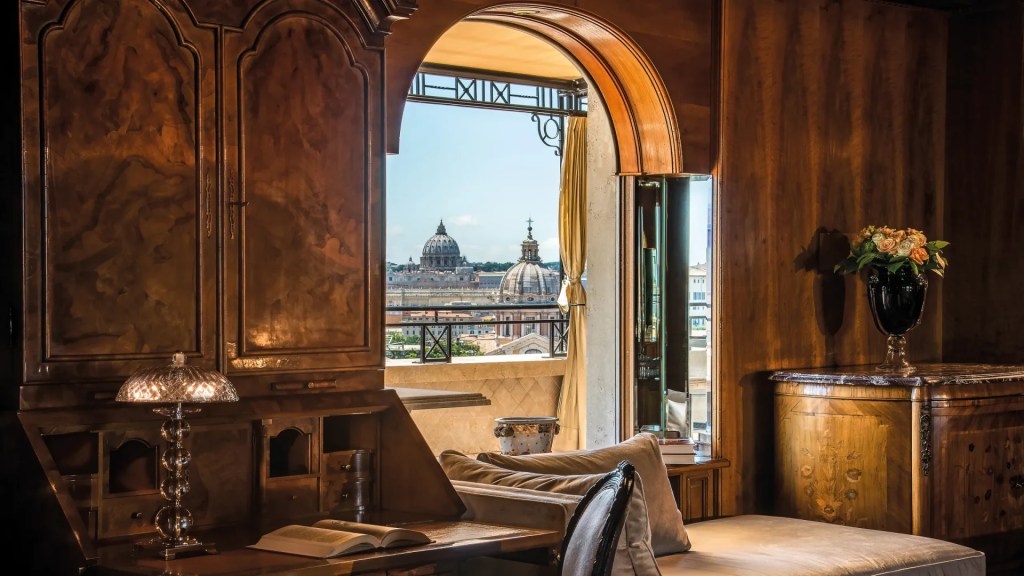
In practice: 82 rooms and suites, family-run by the Wirth family, Michelin-starred Imàgo restaurant on the sixth floor with a panoramic terrace view over Rome's rooftops and St Peter's dome. Gwyneth Paltrow and Tom Cruise have both stayed here, which is either an endorsement or irrelevant depending on your perspective.
The seventh-floor terrace bar — Social at Seven in summer — is one of the more beautiful places in the city to watch sunset, and is worth knowing about even if you're staying elsewhere. Rooms start at rates that reflect the location premium; suites start considerably higher.
The honest note: the atmosphere is formal and quiet. The Hassler is the right choice for couples wanting a genuinely ceremonial experience of Rome, and less right for anyone with children under approximately twelve who don't own their own tuxedos.
What the address actually buys you day to day is timing. The Spanish Steps are among the most photographed objects in Europe and by eleven in the morning the staircase is a slow-moving crowd; at seven, stepping out of the Hassler’s door, it is almost empty and the light comes up Via dei Condotti in a way that is genuinely worth setting an alarm for. Staying at the top means you get the piazza twice a day in a state most visitors never see it in, and it means every walk home is uphill through the one part of Rome that never stops being a set piece.
The Hassler, and the 135 steps at its door
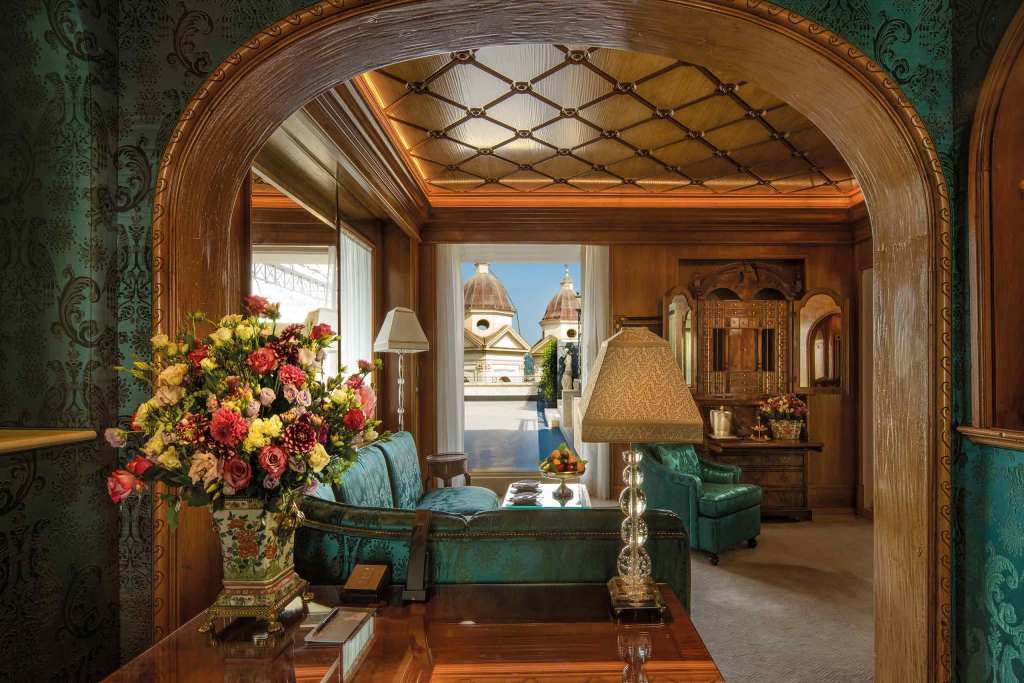 The San Pietro suite
 The hotel from the piazza

Hotel de Russie: The Garden That Changes Everything
A Rocco Forte palazzo by Piazza del Popolo, and the courtyard people still describe years later.
The de Russie is a Rocco Forte property near Piazza del Popolo — slightly removed from the immediate Spanish Steps prestige cluster, but with one specific advantage that I would argue makes it the better choice for most travelers who can afford either: the terraced garden.
The courtyard and garden at the de Russie feel like an extension of the Villa Borghese park that sits immediately behind the hotel, which is not a coincidence — the property backs against the Borghese gardens. Dining in the courtyard in the early evening, when the orange blossom is doing its thing and the light comes through at a specific angle, is the kind of experience that is very hard to describe without becoming the person at the dinner party who won't stop talking about Rome.
120 rooms and suites in an historic palazzo, modernized with streamlined interiors in pastel tones, mosaic-tile bathrooms. Full-service spa. The guest history includes VIPs across several generations of entertainment, politics, and creative industries who chose discretion over publicity. Rates equivalent to the Hassler; book direct for potential upgrades.
If I had to pick between the two for someone visiting Rome for the first time who wants one properly memorable hotel stay: the de Russie, for the garden.
Piazza del Popolo is a quietly better base than its reputation suggests. Via del Babuino runs from the piazza down to the Spanish Steps in about eight minutes of galleries and antique dealers; the Flaminio metro stop is at the north gate, which matters more than it sounds when you are coming in from Fiumicino with luggage. And the park behind the hotel is the reason the neighborhood breathes — Villa Borghese is the closest central Rome gets to being able to walk somewhere green without a plan.
The garden, and the park behind it
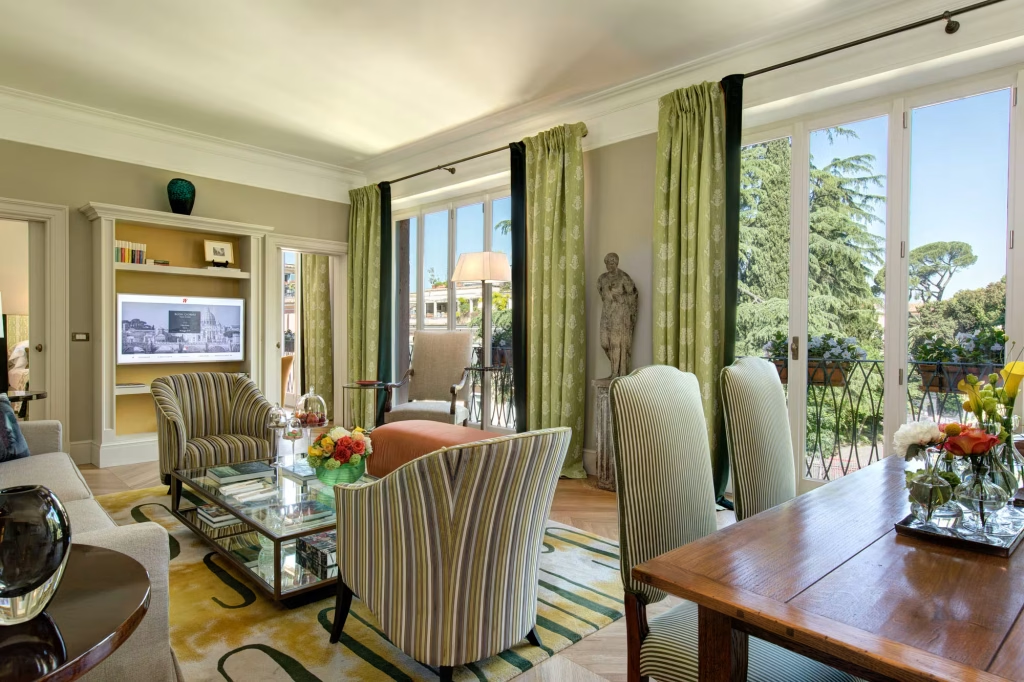 The Valadier suite


Portrait Roma: The Boutique Case
Fourteen suites on Via dei Condotti, closer to a private apartment building than a hotel.
The Portrait Roma on Via dei Condotti, a short walk from the Spanish Steps, makes a different kind of argument for why you should stay here: it's smaller (14 suites), it feels like a private apartment building more than a hotel, and the service is organized around personalization in the way that a property of 14 suites can achieve and an 82-room property cannot.
Run by the Ferragamo family (the fashion house), the building is a 19th-century palazzo with individually designed suites, a terrace with direct Spanish Steps view, and the specific quiet that comes from a building where the management knows every guest's name before they arrive. For honeymooners, anniversaries, or anyone for whom personal attention matters more than a famous address, Portrait Roma is the answer.
Via dei Condotti itself is the practical caveat. It is Rome’s luxury shopping street, which means the pavement below the Portrait is busy from mid-morning until the shutters come down, and it means the immediate surroundings skew commercial rather than residential. The building absorbs almost all of it — fourteen suites in a 19th-century palazzo is a quiet arrangement by definition — but if the idea of the trip is waking up on a sleepy back lane, the de Russie’s side of the centro delivers that better.
Fourteen suites and one terrace
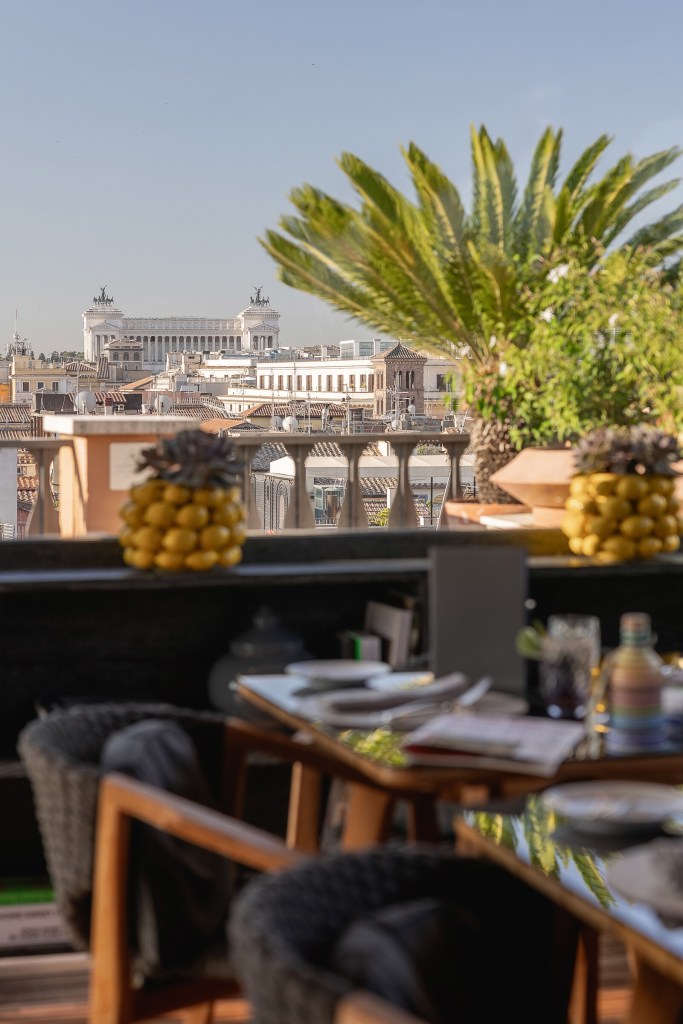 Breakfast on the terrace

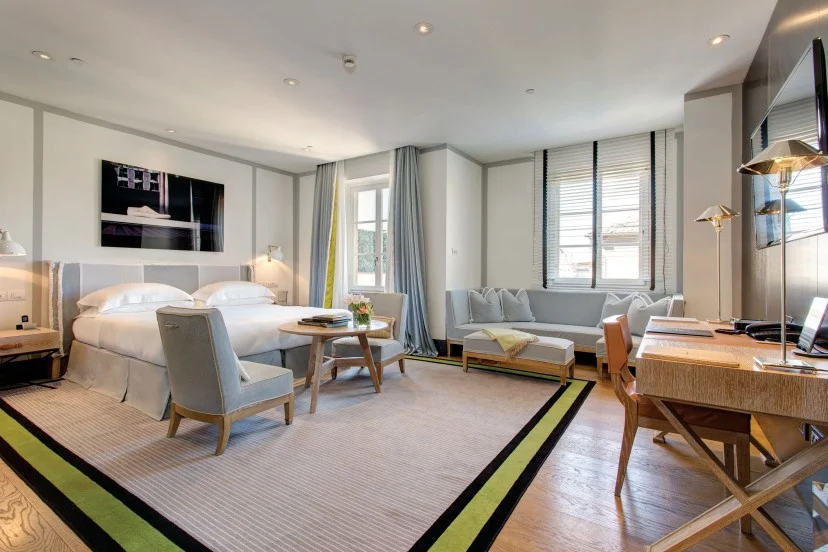 And the suite itself
Sofitel Roma Villa Borghese: Value in the Category
No historic pedigree, a slightly lower number, and a rooftop that does most of the persuading.
The Sofitel Roma Villa Borghese on Via Lombardia doesn't have the historic pedigree of the Hassler or the de Russie, but it operates at a slightly lower price point within the same luxury category and receives consistently excellent reviews for service quality. The terrace restaurant has rooftop Borghese views. The rooms are large by Roman standards. The hotel lists a fitness room, with personal trainers and yoga instructors available on request.
It's the choice for someone who wants genuine five-star service and amenities in a prime central location and doesn't specifically need to say they stayed at the Hassler.
The Via Lombardia version
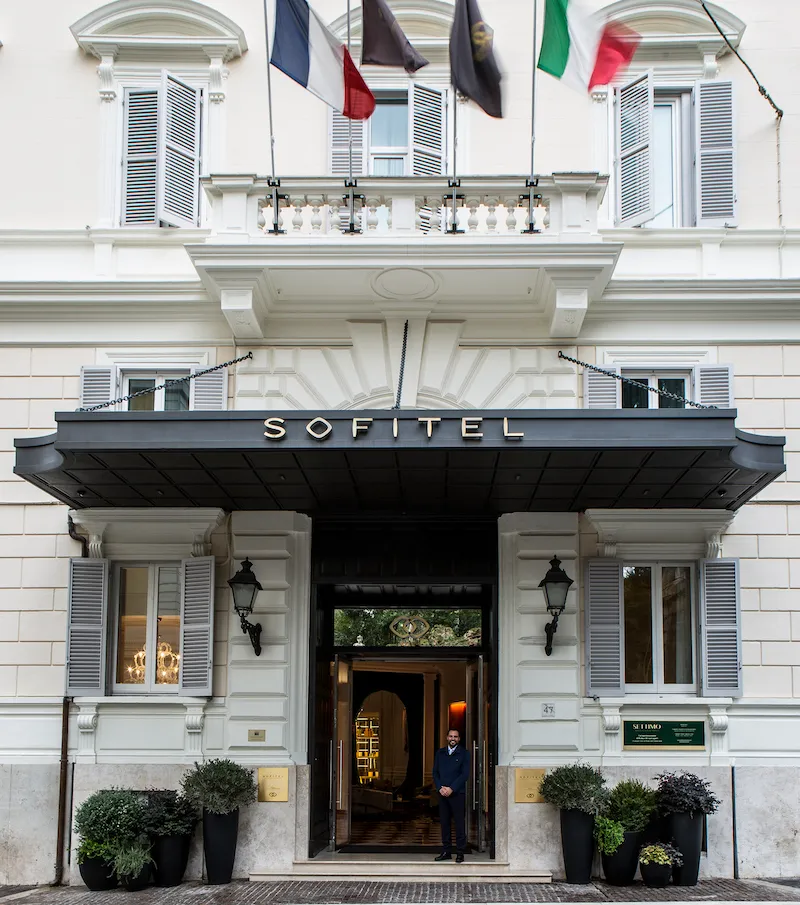 The entrance
 A room, larger than Roman standards suggest
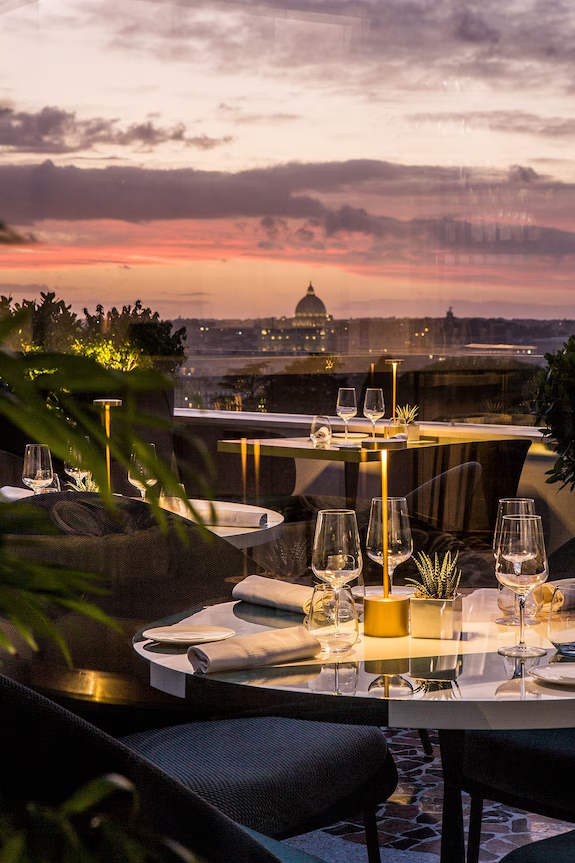 And the terrace restaurant
What All Four Have in Common
They use Rome rather than sit in it — which is the whole test.
The best luxury hotels in Rome do something that distinguishes them from equivalent international five-star product: they use Rome. The Hassler's view is Rome. The de Russie's garden is Rome absorbed into a hotel courtyard. Portrait Roma is a Rome palazzo, not a hotel that happens to be in Rome.
The generic international luxury property that could be anywhere — the chain flagship with marble lobbies and uniformly excellent service that provides no specific sense of place — exists in Rome too. It's not what any of the above are, and the distinction matters when you're spending this much on a bed.
The Four, Side by Side
Where each one is, how big it is, and the reason to pick it.
All four, sortable
| Hotel | Where | Size | The reason to pick it | Tier |
|---|---|---|---|---|
| Hotel Hassler | Top of the Spanish Steps | 82 rooms & suites | The address, and Imàgo upstairs | €€€€ |
| Hotel de Russie | Piazza del Popolo | 120 rooms and suites | The terraced garden against Villa Borghese | €€€€ |
| Portrait Roma | Via dei Condotti | 14 suites | Private-apartment scale and a Steps-view terrace | €€€€ |
| Sofitel Villa Borghese | Via Lombardia | Five-star, larger rooms | Rooftop Borghese views for meaningfully less | €€€ |
Booking Luxury Hotels in Rome
None of these upgrades is offered automatically, and all three decide the room.
Book as far ahead as possible, particularly for the Hassler, de Russie, and Portrait Roma. These properties are genuinely small relative to the demand for them during peak season (April-June, September-October). Last-minute availability at peak times means either a less desirable room or a significantly higher rate for whatever's left.
Ask about room position when booking. At the Hassler, upper-floor rooms facing the Steps have the view; lower-floor rooms facing the street do not. At the de Russie, garden-view rooms are specifically worth the request. At Portrait Roma, ask which suite category includes the outdoor space and view you want. None of these upsells are automatic — you have to ask.
Dining within the property is one of the legitimate advantages of staying at the Hassler, whose Imàgo restaurant has one Michelin star, or the de Russie, with its courtyard restaurant. The distance between your room and a very good meal being approximately zero is not a trivial benefit after a long day of Roman sightseeing.
Three questions to ask when you book
Which floor, and facing what?
At the Hassler the Steps view is upper-floor only — ask for the room by name.
Garden or not?
At the de Russie a garden view is a specific request, not a default.
Terrace suite or standard?
At Portrait Roma confirm the view and outdoor space for your exact suite category.
One honest note about what this tier does and does not fix. It does not fix August, when Rome runs at thirty-five degrees and the only sane schedule is early mornings and late evenings; what it does buy is a genuinely cool room and somewhere shaded to disappear to at two in the afternoon, which in this city is not a small thing. It does not fix distance either — the centro storico is walkable and the traffic is not, so the concierge’s car is a convenience rather than a shortcut. What it reliably buys is position, quiet, and the ability to go back to the room between things instead of enduring the whole day in one push.
What Rome Does Better Than Any Other Luxury Destination
The walk between the hotel and dinner carries something no equivalent property elsewhere can supply.
The specific pleasure of a luxury hotel in Rome that no equivalent property in Paris or New York or Tokyo can replicate: stepping out the door directly into a city where the street you're on has been in continuous use for two thousand years. The de Russie's immediate neighborhood includes a temple to the Egyptian goddess Isis converted to a church in the 9th century. The Hassler looks directly at a staircase that appears in Henry James. Portrait Roma is on a street where Raphael once had a studio.
This is not merely context. It changes the quality of being there — the walk between the hotel and dinner carries a weight that the equivalent walk in a more recent city doesn't. Luxury travel in Rome is specifically the combination of extremely high-quality accommodation and an extremely high-quality city around it, in a ratio that you cannot get anywhere else.
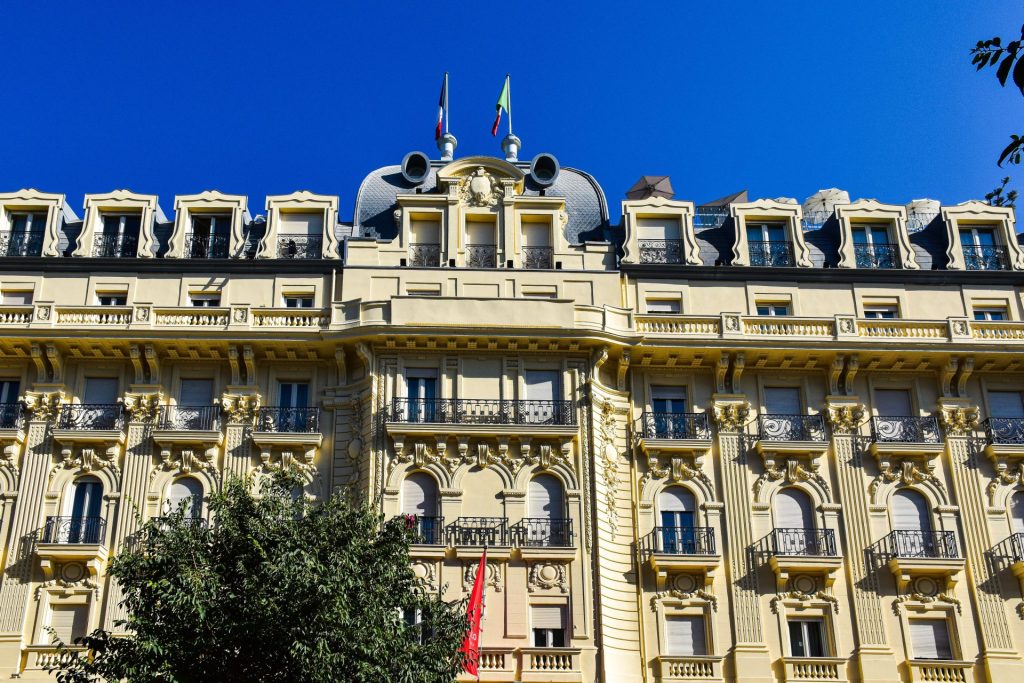 The city the hotel is borrowing from.
Best Luxury Hotels in Rome by Travel Style
A short, honest mapping of person to property.
A short, honest user-mapping:
Hassler: for people who want the most famous address in Rome, a formal experience of luxury, and the Michelin-starred Imàgo restaurant at their disposal. The Spanish Steps view is genuinely extraordinary. The atmosphere is seriously elegant.
Hotel de Russie: for people who want comparable quality with a better garden, slightly more relaxed atmosphere, and a neighborhood (Piazza del Popolo/Via del Babuino) that feels more connected to the city's daily rhythm than the Spanish Steps tourist circuit.
Portrait Roma: for couples on a specific occasion, honeymooners, anyone for whom scale and intimacy matter more than having the most recognizable hotel name. The Ferragamo family's approach to hospitality is personal in a way that larger properties genuinely cannot be.
Sofitel Roma Villa Borghese: for anyone who wants genuine five-star accommodation at slightly more accessible pricing within this tier, with excellent rooftop views and solid service without the premium attached to historic brand reputation.
All four are the right choice for someone. None of them is wrong. The question is which version of Rome you're actually there to have.
When to Book and What It Actually Costs
There is no single dependable nightly rate — only a dated quote.
Match the hotel to the trip
Hassler — The famous address
For the ceremonial version of Rome, a formal atmosphere, and Imàgo at your disposal. The Steps view is real and it is the reason to be here.
De Russie — First proper trip
Comparable quality, a better garden, a looser atmosphere, and a neighborhood that feels more like a place people live.
Portrait Roma — Occasions
Honeymoons and anniversaries. Scale and intimacy over recognition; the Ferragamo eye is on every one of the fourteen suites.
Sofitel — Sensible money
Genuine five-star service at a slightly more accessible number, with the rooftop doing the heavy lifting.
Families — A caveat
The Hassler is the least suited to children under about twelve. The de Russie and the Sofitel absorb them far more gracefully.
Anyone — The common thread
All four use Rome rather than sit in it. That is the whole test, and it is what the generic international five-star fails.
Luxury hotels in Rome price each date and room category differently. Spring and autumn are popular sightseeing periods, and Easter, major events and holiday dates can tighten availability. Compare your actual dates: there is no reliable fixed percentage by which one season is cheaper than another.
Compare the hotel’s direct offer with other booking channels using the same room category, breakfast, cancellation deadline and total charges. Ask about any benefits, but treat an upgrade as unconfirmed unless it is included in writing.
For Hassler and de Russie, start checking when your dates are set. Six to eight weeks is a planning prompt, not a guarantee of availability; a specific view or suite may need substantially more notice.
The portrait Roma's 14-suite scale means it sells out faster than the larger properties during peak periods. Booking two to three months ahead for spring and autumn travel is reasonable; for summer, book earlier.
The booking calendar
Apr–Jun, Sep–Oct — Peak — and the best weather
Popular sightseeing months. Check availability early, particularly for a specific suite or view.
6–8 weeks — Hassler & de Russie
A planning prompt, not an availability guarantee. Check earlier for a specific room.
2–3 months — Portrait Roma
Fourteen suites go first. For summer or a holiday week, stretch it further.
Holy Week · Easter · major events — Book far earlier
Or accept whatever is left, at whatever it costs.
The Bottom Line
All four earn the price. Two of them earn something slightly more.
The Hassler for the Spanish Steps address, the formal atmosphere, and the specific sense of being in a Rome institution that predates most living ideas of what a luxury hotel is. The de Russie for the garden, the slightly less formal atmosphere, and what I think is marginally the better daily-life experience for most people. Portrait Roma for honeymooners and anyone who values scale and personal attention over address recognition. The Sofitel for value within the category without sacrificing what the category actually needs to deliver.
All four earn the price they charge. The Hassler and de Russie earn something slightly more — the sense of staying somewhere that will be here in another hundred years and will have looked approximately like this the whole time.
Ask for the total stay price, including city tax and any breakfast or extra-bed charges.
Get the room category, view and any terrace confirmed in writing.
Check restaurant opening days and reserve a special dinner separately.
Keep a flexible cancellation option until flights and plans are settled.
Before you go
Which luxury hotels in Rome are best for a first visit?
Hotel de Russie suits travelers who want a garden retreat near Piazza del Popolo; Hassler suits those prioritizing the Spanish Steps. Choose the location and atmosphere you will enjoy returning to between sightseeing stops.
Which hotel is best for a honeymoon in Rome?
Portrait Roma is the intimate option in this shortlist, with fourteen suites. Compare the specific suite’s terrace, outlook and layout rather than assuming every room has the same view.
How much do luxury hotels in Rome cost?
There is no single dependable nightly rate. Dates, room category, occupancy, meals and cancellation terms change the total. Use the comparison table to shortlist, then request a dated quote including taxes and any supplements.
Is breakfast included at these Rome hotels?
Breakfast depends on the rate package. Check it explicitly alongside city tax, transfers and any dining credit before comparing two offers.
Should I book a luxury hotel in Rome directly?
Compare direct and third-party offers on identical terms. A direct reservation can simplify specific room requests, but a better price or upgrade is not guaranteed.
What should families or travelers with limited mobility check?
Ask about connecting rooms, maximum occupancy, lift access, steps at the entrance and the route to nearby sights. Confirm accessibility for the exact room and itinerary before paying a non-refundable deposit.
Keep going

Sources
Checked against official and institutional sources · UK FCDO Italy travel advice · US State Dept Italy · ENIT: Italia.it · Turismo Roma (City of Rome) · UNESCO: Historic Centre of Rome · CoopCulture: Colosseum and Forum tickets · Aeroporti di Roma · ATAC Rome public transport · MICHELIN Guide Rome · Musei in Comune Roma
We will tell you whether we can help and send a written quote before any paid work begins.