

Hungary / Budapest / Travel guide · 17 min read
Budapest is two cities on one river, and the river is the stage.
Which bath to choose, how the ruin bars actually work after dark, and the wine nobody is talking about yet.
Jump to what you came for
How Budapest Is Structured: The Crucial Geography
Three to four days covers it: one for the baths, one for the hill, one for District VII.
Two writers I know who covered European cities professionally for almost a decade lived in Budapest for two and a half years. I asked them which city in Europe they'd go back to if they could only pick one, expecting them to say something photogenic and obvious. They both said Budapest immediately, without thinking about it. "It's the ruin bars," one of them said. "No — it's the baths," the other one said. "It's both," the first one said. "It's the fact that you can have both in the same city."
Budapest is the city that keeps surprising people who should have been surprised years ago. The thermal baths. The ruin bars. The Art Nouveau architecture. The Hungarian wine that genuinely doesn't need the international reputation it doesn't have. The Christmas market at Vörösmarty Square, which is one of the finest in Europe. The fact that it costs roughly half what an equivalent quality of experience costs in Vienna, which is forty minutes away by train.
Here's how to be in it.
Budapest is two cities on one river. Buda, on the west bank, is hilly and residential, and holds the Castle District and the Ottoman baths built into the hillside. Pest, on the east bank, is flat, and holds the Parliament, the Jewish Quarter and the ruin bars. Three to four days covers it properly: one for the thermal baths, one for Castle Hill and the Danube, one for District VII and Hungarian wine.
This Budapest travel guide covers which bath to choose, how the ruin bars actually work after dark, what to eat beyond goulash, the wine nobody is talking about yet, and what the city costs in forint. Best months are April to May and September to October. The currency is the Hungarian forint, not the euro.
Budapest is two cities separated by the Danube and united by bridges. Buda is on the western bank — hilly, residential, the Castle District on the hill above, the old Ottoman baths built into the hillside, the Fisherman's Bastion with its neo-Romanesque towers and view over Pest.
Pest is flat, eastern, where most of the city's daily life operates: the Parliament building on the riverbank, the Grand Boulevard (Nagykörút) and Small Boulevard (Kiskörút) defining concentric circles outward, the Jewish Quarter in District VII with its ruin bars, the Central Market Hall, the coffee houses, the restaurants.
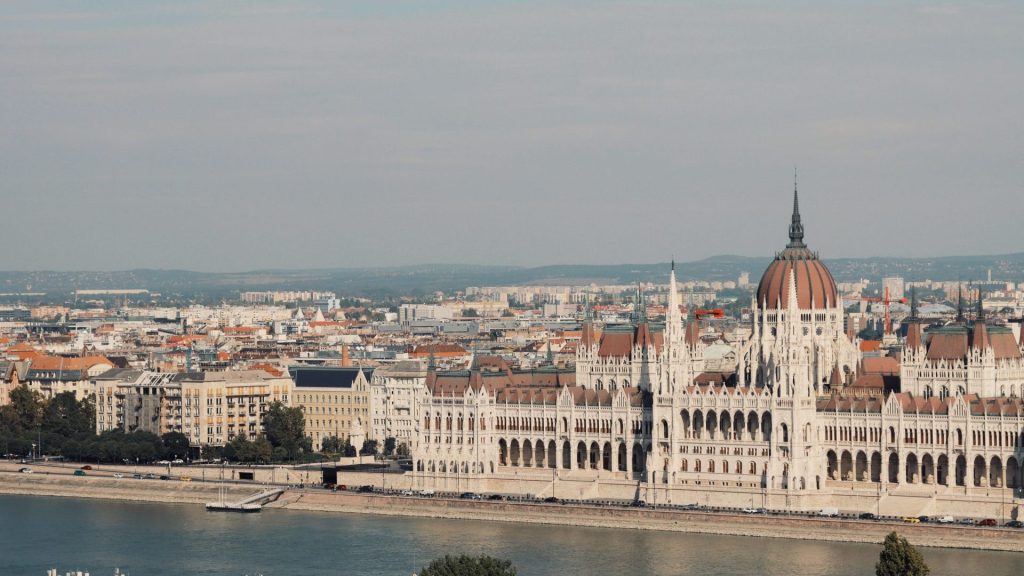
The Danube between them is the stage set. The Parliament lit up at night, reflected in the river, from a boat or from Buda's Castle Hill, is specifically one of the more extraordinary views available in any European capital. Do this at least once.
Two cities, one river
Buda — west bank, hilly, residential
The Castle District on the hill, the Ottoman baths built into the hillside, Matthias Church and the Fisherman's Bastion. Quieter, older, and where the view back across the river comes from.
Pest — east bank, flat, daily life
Parliament on the embankment, the Grand and Small Boulevards in concentric rings, District VII and its ruin bars, the Central Market Hall, the coffee houses. Where you will actually spend your evenings.
The river, which is the stage
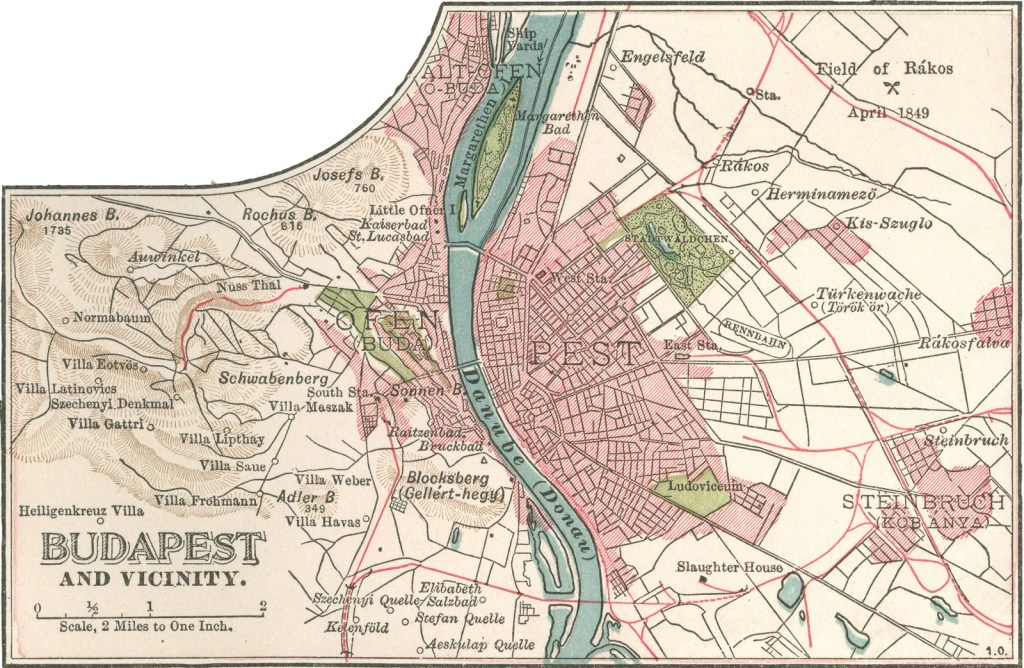 The city as it was drawn

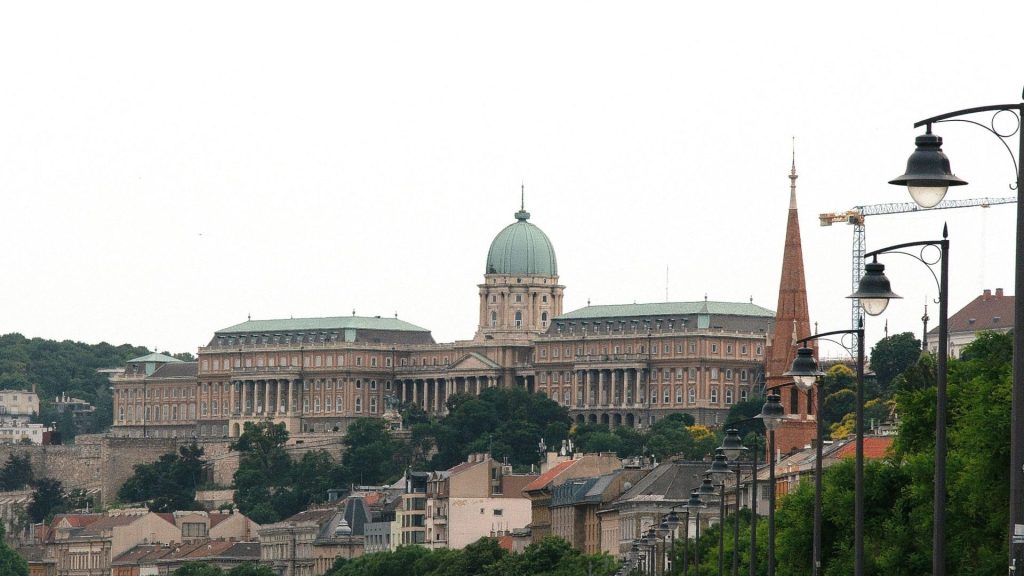 And Buda, which is where the view comes from
The Thermal Baths: Which One, Actually
Eighteen public baths, and the choice between them is not about the water.
Budapest has eighteen public thermal bath complexes. They exist because the city sits on a geological formation that pushes thermally heated spring water to the surface — the Ottomans who occupied the city for 150 years from 1541 built the first baths, and the subsequent Austro-Hungarian empire added the grand belle époque and Art Nouveau versions. They are not a tourist gimmick. Locals use them.
Széchenyi is the largest and the most famous — a neon-yellow neo-baroque building in City Park with eighteen pools, including outdoor pools at 38°C, and the specific aesthetic of dozens of people playing chess on floating boards while steam rises around them on a cold day. Arrive early morning to beat the tour groups. Bring flip flops; the marble floors are unforgiving.
Gellért is the more architecturally spectacular option — an Art Nouveau building with a stunning mosaic indoor pool and the specific atmosphere of a 1918 public building that hasn't been significantly modernized. Reports of a renovation have been circulating since 2024; verify current operational status before booking. When it's working correctly, Gellért is the most beautiful bath in the city.
The Sparty — a spa party at Széchenyi on Saturday evenings (22:00-04:00, DJs, lights, the thermal pools at night) — is exactly as strange and specific as it sounds and is genuinely worth doing once. Book tickets online in advance.
Rudas is the Ottoman-era bath near the Danube, built in 1566, with an original Turkish dome above the central pool. Smaller, older, less famous than Széchenyi. Better for people who want the history rather than the event.
Practicalities that decide whether a bath visit is good or merely wet. Bring flip flops, a towel and a swimming cap if you intend to use a lap pool — all three are rentable at inflated prices and all three are trivial to pack. Lockers are operated by wristband and are genuinely secure. Most complexes run a cabin option for a few hundred forint more, which buys you somewhere to change that is not a bench. And the outdoor pools are the ones to prioritize in winter: thirty-eight degrees of water under freezing air is the entire point, and the indoor halls, however beautiful, cannot reproduce it.
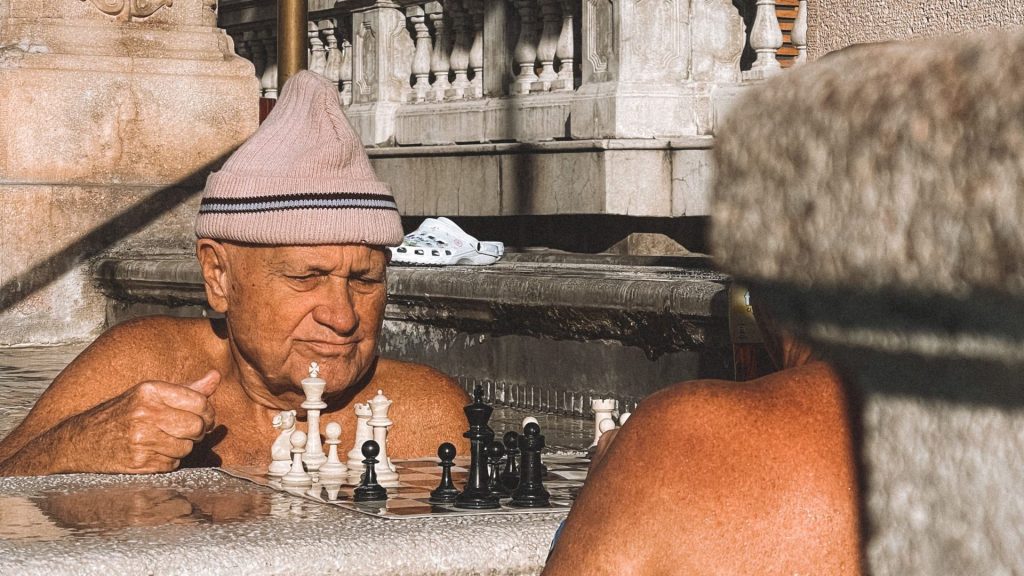 Chess on the water at Széchenyi, which runs all year
Budapest, the short list
The Ruin Bars: The Reality vs the Reputation
Bars built into derelict District VII buildings, and one organised scam worth knowing about.
The ruin bars of District VII — bars built in the formerly abandoned buildings and courtyards of Budapest's Jewish Quarter — are a cultural phenomenon that is genuinely unlike anything in the rest of Europe. Szimpla Kert on Kazinczy utca is the original: a converted factory courtyard with dozens of mismatched rooms, each decorated with a different collection of repurposed objects, live music, flea market on Sunday mornings, a dozen bars operating simultaneously. It's exactly as chaotic and atmospheric as described and has been consistently worth visiting since it opened in 2002.
What the ruin bar reputation doesn't include: the "friendly girl" scam, which specifically targets tourists in and around District VII. A person (often a woman, sometimes working with a group) befriends you outside or near a bar, suggests continuing elsewhere, and the bill at the recommended venue arrives at 100 times normal pricing. It's sophisticated, it's consistent, and it's specifically noted by every serious Budapest guide. Stick to well-reviewed venues. If anyone you've just met suggests moving to a bar you don't know, decline. Ask the price of drinks before ordering anywhere unfamiliar.
Instant–Fogas is the largest multi-room complex in the district — multiple bars, dance floors, DJs across different musical styles simultaneously. For people who want nightclub scale within the ruin bar aesthetic.
Anker't is calmer, conversation-friendly, a garden bar rather than a dance venue.
The ruin bars work best treated as a district rather than a destination. The courtyards of District VII sit within a few hundred meters of each other, which means the correct approach is to walk in without a plan, look through two or three doorways, and stop where the room sounds right. Szimpla is the one everyone photographs and is still genuinely worth an hour; it is also the busiest by a wide margin after about ten at night. The quieter courtyards one street over are where the people who live here actually drink.
Castle Hill: The View That Earns the Climb
Walk up early, ride down later, and the terraces are empty before nine.
The Castle District on the Buda side — accessible by funicular from the Chain Bridge, or by a 20-minute walk up the hill — holds Buda Castle, Matthias Church, and the Fisherman's Bastion: a neo-Romanesque terrace built in 1902 specifically to provide views over the Danube and Pest. The view from here — Parliament building directly across the river, the city sprawling in both directions, the bridges — is the definitive Budapest view. Go at dawn before the day-tour groups arrive, or in the evening when the Parliament lights up.
The funicular (Budavári Sikló) runs from Clark Ádám Square at the Chain Bridge; check the current fare before traveling. Take it up, walk down through the Castle District lanes.
The Parliament: See It from the Water
The third-largest parliament building in the world, and it was designed to be seen from the river.
The Hungarian Parliament building on the Pest bank of the Danube is one of the largest parliament buildings in the world — neo-Gothic, symmetrical, 96 meters tall (the number reflects the year of Hungary's millennial anniversary), with a dome that echoes St Stephen's Basilica across the city. The interior tour is available and well-organized. The best view is from the river or from the Buda side, particularly at night when the external lighting turns the building a specific warm gold that photographs as impossibly dramatic and also actually looks like that.
A Danube river cruise in the evening is the standard approach and works exactly as advertised — an hour on the water showing the lit-up Parliament, Chain Bridge, Castle Hill, and the bridges. Budget tours run from €15-20.

The Food: Underrated, Hearty, Worth Knowing
One of Europe's most underrated cuisines, and Váci utca is where it goes wrong.
Hungarian cuisine is one of Europe's most comforting and least internationally known. A few things worth seeking out specifically:
Goulash (gulyás in Hungarian) is a beef soup, not a stew — significantly thinner than what most international restaurants serve as "goulash." Paprika-rich, deeply flavored, served with a bread roll. The benchmark dish for understanding what Hungarian food actually is.
Chicken paprikash (csirkepaprikás) — chicken slow-cooked in paprika sauce with sour cream, served with egg noodle dumplings (nokedli). The dish that defines Hungarian comfort food.
Lángos: deep-fried flatbread, sold at market stalls and street vendors, topped with sour cream and grated cheese. The Great Market Hall on the Pest riverside has a famous lángos counter. Eat one. It's the food equivalent of the ruin bars — specific to here, better than it has any right to be.
Avoid restaurants along Váci utca, the central commercial pedestrian street — tourist pricing for mediocre food, universally flagged as the trap. Walk one block in any direction for half the price and meaningfully better cooking.
What to actually order
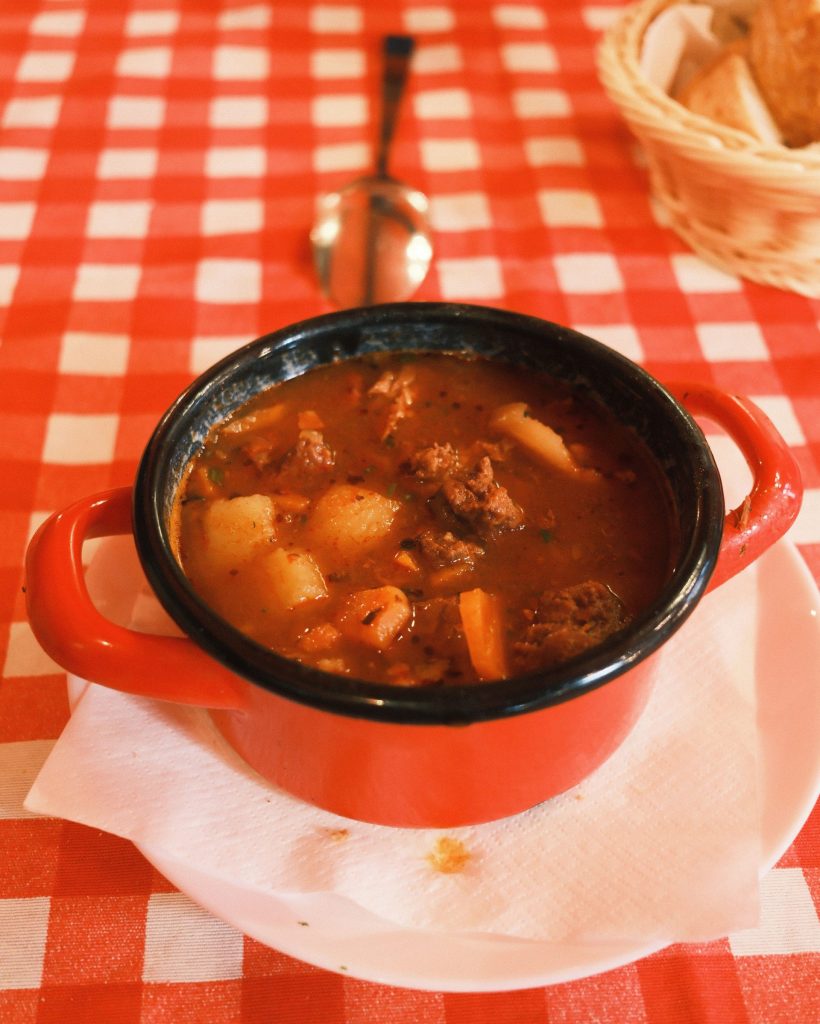 Gulyás, which is a soup and not a stew

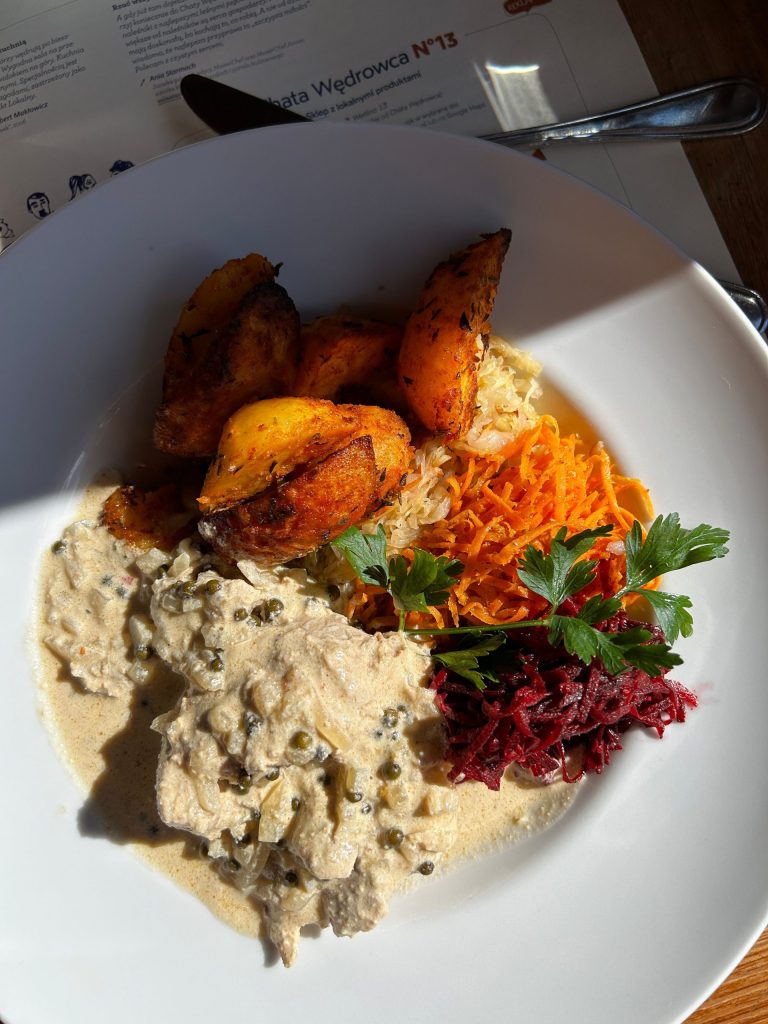 And the plate it all arrives on
When to Go
Spring and autumn are the sweet spots. Winter is the one people underrate.
Spring (April-May) and autumn (September-October) are the sweet spots — comfortable temperature, reasonable crowds, the city feeling like it belongs to residents. Summer fills with festival energy (Sziget Festival in August is one of Europe's largest and genuinely worth timing a trip around) and is busier and warmer. Winter is specifically underrated: the Christmas market at Vörösmarty Square is one of the finest in Europe, the baths feel exactly right in cold weather, and prices drop significantly.
Note for non-EU travelers: the EU's ETIAS travel authorization system is not yet in operation, and as of October 2026 the European Union has not announced a start date — it says it will give several months' notice. When it begins, the application fee is €20. Check the official ETIAS site before traveling.
When to go
The city at street level
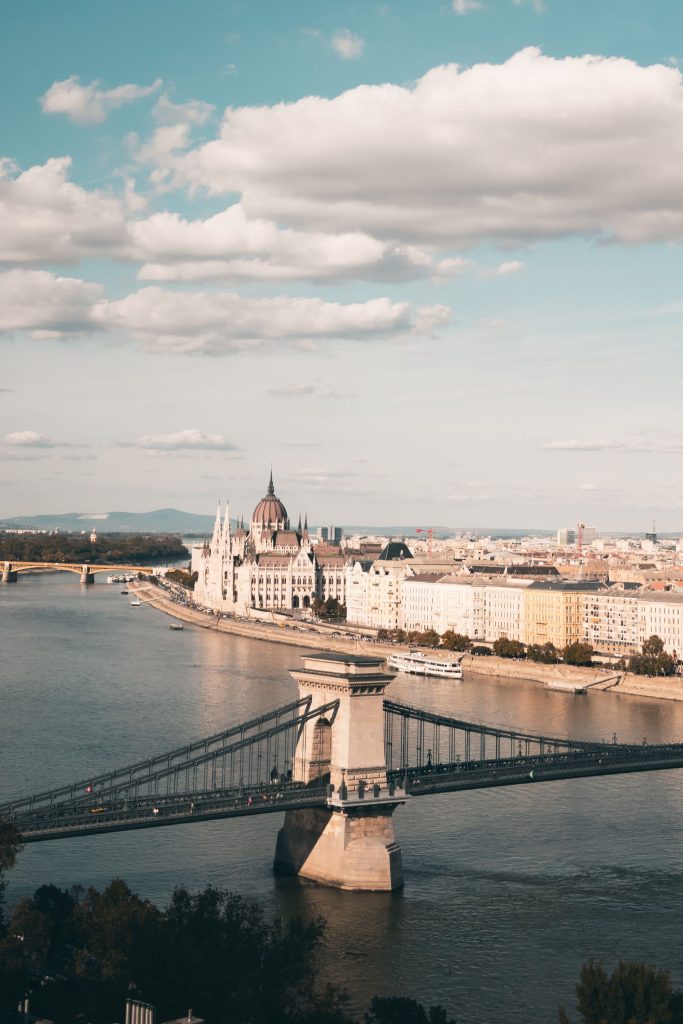 The Chain Bridge and Parliament from the embankment
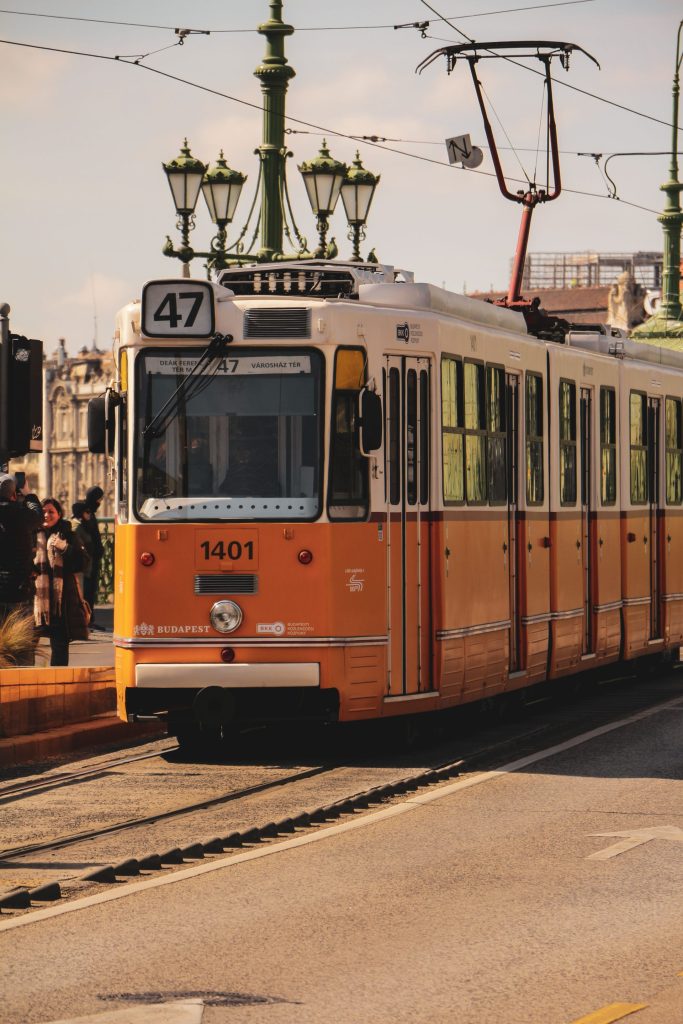 The number 47 tram, which is a sightseeing route at fare price

Hungarian Wine: The Best Thing Nobody Is Talking About
Tokaj, Eger and a volcano, at prices that have not caught up yet.
Hungarian wine has been on the periphery of international wine attention for decades, partly because Soviet-era production collapsed quality, and partly because the major Hungarian wine regions (Tokaj, Eger, Somló, Villány) have English-language coverage that doesn't reflect the quality of what's actually in the bottle.
Tokaj aszú — Hungary's legendary sweet wine, made from botrytis-affected grapes in the northeastern Tokaj region — is one of the world's great sweet wines, and in Budapest you can drink it at restaurant prices that are a fraction of what the equivalent quality commands internationally. Order a glass or a half-bottle.
Egri Bikavér ("Bull's Blood of Eger"), the Eger reds, and the whites from Somló are all worth exploring at the wine bars of the 7th district and in the better restaurants. Hungarian natural wine has also developed a serious following in the last five years — ask at the wine bars for what's being made locally with minimal intervention.
Three regions worth drinking
Tokaj — the famous one, northeast Hungary
One of the world's great sweet wines, drunk here at restaurant prices rather than auction ones. Order a glass or a half-bottle and see what the fuss is.
Eger — the reds, northern Hungary
Egri Bikáver, Bull's Blood, and the rest of the Eger reds. The everyday counterweight to all that sweetness.
Somló and the natural wave
Mineral whites from an extinct volcano, plus a serious low-intervention scene that has grown up in District VII in the last five years.

Which Bath, Actually
Each bath, where it is, what it is, and the hour to go.
Every bath, sortable
| Bath | Where | What it is | Go for | Best time |
|---|---|---|---|---|
| Széchenyi | City Park, Pest | 18 pools · outdoor 38°C | The famous one, chess on the water | Early morning |
| Gellért | Buda, Danube side | Art Nouveau, mosaic indoor pool | The most beautiful, when it is open | Check status first |
| Rudas | Buda, by the river | Ottoman, built 1566 | The history rather than the event | Quiet weekday |
| Sparty | Széchenyi, Saturdays | 22:00–04:00, DJs, lights | Exactly as strange as it sounds | Book online ahead |
Practical Budapest
Forint not euro, one ticket for everything, and the honest cost of a day at the baths.
Currency: Hungarian forint (HUF). Budapest is not on the euro. ATMs are plentiful; Wise or Revolut cards reduce exchange fees significantly. Budget hotels run an estimated €60–120 a night, mid-range €120–200, luxury €200+ — indicative figures, not published rates.
The Budapest Card bundles unlimited public transport with free or discounted entry to a list of attractions, and is now sold through BKK, the city transport authority, rather than the tourism office — do the math before buying it; whether it saves money depends on your itinerary.
ETIAS: the EU's travel authorization system for non-EU passport holders is not in operation yet. As of October 2026 no start date has been announced, and the EU says it will give several months' notice; the fee will be €20 and the permitted stay up to 90 days. Hungary is in the Schengen area, so Schengen rules apply in the meantime.
Public transport is excellent and cheap. Metro, tram, and bus all run on the same ticket. The tram along the Danube riverbank (Tram 2 on the Pest side) is itself an experience worth taking — it runs past the Parliament and along the river in a way that no other perspective gives you for the price of a ticket.
A sit-down dinner with wine in a neighborhood restaurant runs an estimated €25–35 a head, a glass of good Tokaj a few euros, and an evening Danube cruise €15–20. None of those are remarkable individually. Stacked across four days they are what people mean when they say the city is half the price of its neighbours.
The Bottom Line, Actually
The city rewards coming back, which is the thing people say about it most.
I keep coming back to what those two writers said: it's the baths and the ruin bars and the fact that you can have both in the same city. That's an understatement. It's that, plus the Parliament lit up at night from across the river, plus a glass of Tokaj aszú with a local cheese plate, plus a Sunday morning walking Buda Castle Hill before the tour groups, plus goulash in a neighborhood étterem that's been feeding the same street for forty years, all of it for half the price of doing equivalent things in Vienna.
Budapest is the city that rewards coming back. First visit: the obvious things done properly. Second visit: Bonfim-equivalent neighborhoods and wine. Third visit: you're already planning the fourth.
Before you go
How many days do you need in Budapest?
Three full days is the honest minimum and four is better. One day for the Pest side — Parliament, the Jewish Quarter, the Great Market Hall. One for Buda — Castle Hill, Fisherman's Bastion, a bath in the afternoon. One for District VII and Hungarian wine, which is the part most itineraries skip. A fourth day buys you a second bath and a slower pace, which is what the city is actually for.
Which Budapest thermal bath should you choose?
Széchenyi if you want the famous one and the outdoor pools — it is the largest complex, in City Park on the Pest side. Gellért for the Art Nouveau architecture and the mosaic indoor pool. Rudas for the Ottoman-era dome, built in 1566, and the panoramic rooftop pool over the Danube. If you only do one, do Széchenyi early on a weekday; if you want the architecture to be the point, do Gellért.
How much does entry to Széchenyi Baths cost in 2026?
A day ticket with a locker is 13,200 Ft Monday to Thursday, 14,800 Ft on Friday and at the weekend, and 15,800 Ft in peak periods. The "Good morning" ticket, if you are through the door before 9am, is 10,500 Ft on weekdays and 11,800 Ft at the weekend. That is roughly €29–43 at the European Central Bank's reference rate of 365 Ft to the euro on 9 October 2026. Figures from Széchenyi's official 2026 price list, checked in October 2026 — the baths publish their own rates and change them, so check before you go.
What are Széchenyi's opening hours?
Monday to Thursday 07:00–20:00, Friday 07:00–22:00, Saturday and Sunday 08:00–20:00, per the bath's official site in October 2026. Individual services inside the complex — massages, the Private Spa, the Palm House — keep their own hours, and the Saturday-night Sparty is a separately ticketed event that runs long after the baths close.
Do you need a visa or ETIAS to visit Hungary?
Hungary is in the Schengen area, so the Schengen rules apply. As of October 2026 ETIAS is and the European Union has not announced a start date — its official site says it will give several months' notice before launch. When it does start, visa-exempt travellers will pay a €20 application fee and may stay up to 90 days. Earlier reports of a fixed late-2026 launch have not been confirmed by the EU, so check the official ETIAS site rather than a secondary source before you book.
Keep going


Sources
Checked 2026 against the baths' own price list, the city tourism board, the EU entry-requirements site and the European Central Bank · Széchenyi Thermal Bath · Gellért Thermal Bath · Budapest Info, the official tourism board · The EU ETIAS information site · European Central Bank reference rates · BKK, Budapest transport · Szimpla Kert · Visit Hungary · Time Out Budapest · FCDO Hungary travel advice
We will tell you whether we can help and send a written quote before any paid work begins.