This Siem Reap food guide covers fish amok, breakfast noodles, markets and Khmer restaurants, with ideas for fitting memorable meals around your Angkor temple visits.
The best meal in Siem Reap starts at 6am on a plastic stool outside the Old Market, a bowl of nom banh chok in front of you, a pile of fresh herbs you’re still working out how to layer, and a tuk-tuk driver eating the same thing two stools to your left. The town is still waking up. The tourist market sellers haven’t set up. The coffee is dark and sweet in a glass of condensed milk.
This is the hour when Cambodian food is most itself — unhurried, local, built for the people who live here rather than the people who flew in to see Angkor Wat. You will spend three days being told to eat fish amok. You will find it at fifty different restaurants. Most of those restaurants will serve you a cold, sweet version that has nothing to do with the real dish. Here is how to find the ones that do it right — and what else Cambodia actually cooks.
In Short
- Fish amok at a proper Khmer restaurant, not a tourist buffet, is the meal you came for
- The breakfast hour (5–9am) is when Cambodian food is at its most honest
- Pub Street is a different city — eat on the roads behind it instead
- The training restaurants (Marum, Tree Alliance network) are some of the best value in Southeast Asia
In this guide
Siem Reap Food Guide: Know This First
Siem Reap’s food scene runs on a split economy. On one side: the cluster of restaurants, bars, and buffet operations centred on Pub Street and the Old Market that exist almost entirely to serve first-time Southeast Asia visitors — affordable, inoffensive, covering every option from Khmer “local” platters to Thai curries to banana pancakes. On the other: the food that Cambodians actually eat, which is available at the same markets and at many of the same price points, requires marginally more effort to find, and is significantly better.
Khmer cooking is not well understood internationally. It is gentler than Thai food, less pungent than Vietnamese, and less sweet than what you’ll find in Bali — but it is not bland; it is built on kroeung, the Cambodian spice paste of lemongrass, galangal, turmeric, kaffir lime, and garlic that forms the base of most cooked dishes, and on fermented fish paste (prahok), which is to Cambodian cooking what fish sauce is to Thai. If you’ve been eating pad thai for a week and arrive expecting something similar, you’ll need to recalibrate: Cambodian food is earthier, more aromatic, and more herb-forward than any of its neighbours.
The practical context: Siem Reap is the temple town. Most visitors are here for Angkor Wat and are spending two or three days. The food scene has organised itself around this — there are training restaurants, fine dining options, and excellent market eating, all within a compact central area. You don’t need a car or a full week to eat well here. You need to know which hour and which road.
Fish Amok — The Dish That Defines Cambodian Cooking
Verdict: Fish amok is Cambodia’s answer to “what should I eat here” — a steamed coconut fish curry served in a banana leaf, and the version you’ll find at a proper Khmer restaurant bears no resemblance to what tourist buffets serve. This is the dish to order first and to order well.
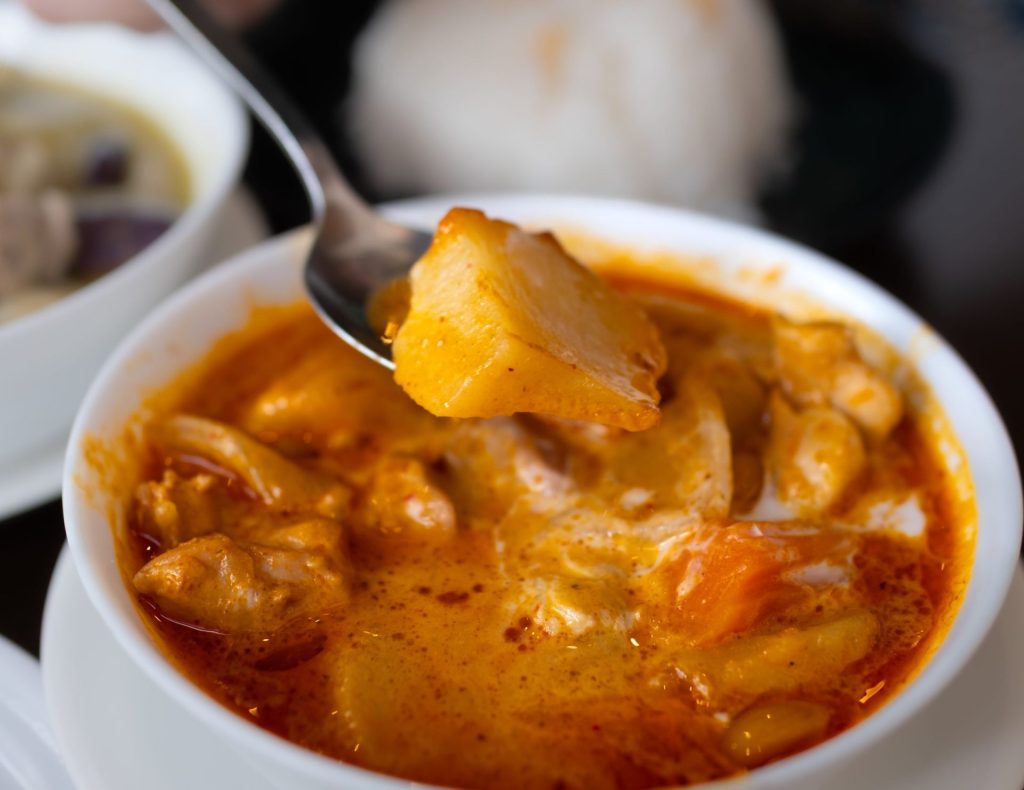
What it is: Fish amok (nom amok trey) is a steamed coconut milk fish curry, traditionally steamed in a banana leaf cup with lemongrass, galangal, kaffir lime, and kroeung — the Cambodian spice paste that is the foundation of the country’s cooking. The texture is somewhere between a savory custard and a thick curry; the fish is suspended in the coconut mixture rather than floating in sauce. It is a slow-cooked dish — properly made, it takes time and attention.
What it’s like: At a good restaurant, the banana leaf arrives at the table still steaming, the surface set like a savory coconut custard, the fish beneath tender and perfumed with galangal and turmeric. It is not hot-spicy — the heat is all aromatics, not chilli — and it arrives with jasmine rice and a small dish of fresh herbs. The galangal gives it a cool, camphorous note; the kaffir lime leaf gives fragrance; the coconut milk provides the body.
At a tourist buffet, the same dish arrives cold, watery, and tasting of nothing, served in a banana leaf that has been sitting under a heat lamp since the lunch service. The gap between the two versions is total.
How to do it: Order fish amok at Marum (the NGO training restaurant on the road near Taphul) or The Sugar Palm (Street 27, the benchmark for traditional Khmer in Siem Reap). Both do the dish properly and both take reservations. Budget $$ for either. If you want the most traditional version, The Sugar Palm makes its kroeung by hand and sources its coconut milk fresh — call ahead to confirm availability during slower season.
The catch: Amok is listed at every restaurant in town, but quality ranges from excellent to inedible. The banana leaf presentation is not a quality signal — every restaurant uses it. The smell of fresh kroeung paste is: if the dish arrives smelling of aromatic herbs and lemongrass, the kitchen ground the paste themselves. If it smells primarily of coconut milk, they didn’t.
The Sugar Palm
Street 27, opposite Pannasastra University, Siem Reap.
When: The restaurant lists dinner Tuesday–Sunday, from 5:30pm with last orders at 9:30pm, closed Monday. Confirm holiday changes and the current menu directly.
The Breakfast That Belongs to Cambodia
Verdict: The two Khmer breakfasts worth knowing — nom banh chok (rice noodles with fish-based green curry sauce and fresh herbs) and bai sach chrouk (pork and rice with pickled vegetables) — are eaten before 8am and cost under $2. This is how Cambodia eats before the temples open, and it is the most honest version of the food here.
What it is: Nom banh chok is fresh rice noodles topped with a fish-and-lemongrass green curry sauce, eaten at room temperature with a forest of fresh herbs — banana blossom, cucumber, bean sprouts — that you layer on yourself. The sauce is not the colour of Thai green curry; it is paler, more delicate, made with lemongrass and fermented fish rather than green chilli. Bai sach chrouk is thinly sliced pork, marinated in garlic and coconut milk and grilled over charcoal, served over jasmine rice with a clear ginger broth and pickled vegetables. Both are complete meals. Both cost about $1.50.
What it’s like: Breakfast in Siem Reap is a street affair. Vendors set up around 5am with the day’s nom banh chok already made — the noodles fermented and pressed, the sauce cooked from the previous evening — and the pork for bai sach chrouk already marinating over the coals. You sit on a plastic stool beside the morning temple crowd — monks in saffron robes, market workers between shifts, tuk-tuk drivers refuelling — eat fast, and leave before 8am.
The flavours are mild by Southeast Asian standards, but the freshness of the herbs on a good nom banh chok is the point: on a full tray, there are ten different herbs available, and you build the bowl yourself.
How to do it: Walk any market edge at 6am and you’ll find both dishes. Psah Leu (the Old Market) has the densest cluster of breakfast vendors, concentrated on the market’s outer perimeter and the lanes running behind it. Budget $1–2 per person. Point and use fingers to indicate quantity — no Khmer is required for this transaction. Arrive before 8am or most vendors will be sold out and moved on.
The catch: These are breakfast dishes — available from 5am to 9am, then gone. This is not a 10am option, and no amount of requesting will produce them later in the day. Set your alarm the night before if this is important to you.
Psah Leu (Old Market) Breakfast Row Psah Leu / Old Market, Siem Reap town centre · Street food market · $ Order: Nom banh chok ($1–1.50) or bai sach chrouk ($1.50–2); point at the largest queue When: 5am–9am; earlier is better Where: Psah Leu (Old Market), Siem Reap — main market building and surrounding streets Link: No dedicated URL; locate on Google Maps as “Psah Leu Old Market Siem Reap” Check: Needs confirming (operating hours and vendor locations change seasonally)
The Night Market Circuit
Verdict: After sunset, the food moves to the markets. Psah Leu transforms, the lanes around the Old Market fill with charcoal smoke and the smell of Khmer BBQ, and a food environment that has nothing to do with the tourist circuit operates within 50 metres of it. This is the best version of Siem Reap eating after dark — if you go on foot and eat at stalls rather than restaurants facing the street.
What it is: The night market circuit is a series of overlapping food environments operating from roughly 6pm to 10pm: open-air market stalls, Khmer BBQ (sach ko ang — marinated grilled meats served with dipping sauces), fresh sugarcane juice presses, and vendors selling lok lak (stir-fried beef with pepper sauce and a fried egg) from portable woks. All of it is concentrated within a 10-minute walk of the Old Market bridge, along lanes that run parallel to Pub Street but face away from it entirely.
What it’s like: At 7pm, the smoke from charcoal grills thickens the air around the Old Market. Street food tables appear between souvenir stalls. A bowl of kuy teav (rice noodle soup) materialises from behind a cart that was selling fruit juice an hour earlier. It is not organised or particularly clean — the trays are wet, the plastic tables are crowded, the lanes are narrow with foot traffic — but the sach ko ang here, marinated in fish sauce, garlic, and palm sugar and grilled over live charcoal, is some of the best meat in the city.
The sugarcane juice, pressed in front of you and poured over ice, costs $0.50 and is the correct drink for a Siem Reap evening.
How to do it: Walk from the Old Market along the riverside past the night market entrance and continue down the lane running parallel to Pub Street. This is where the food is densest and least tourist-oriented. Budget $2–5 for a street dinner — a plate of sach ko ang, a bowl of kuy teav, and a sugarcane juice. Carry small bills; most vendors don’t make change from $20.
The catch: Pub Street is 50 metres from the best night market stalls. The two populations barely overlap but the geography forces you through the tourist corridor to get to the local one. Stay on the lane parallel to Pub Street, not the street itself — the street itself is for someone else’s trip.
Skip it. Pub Street restaurants are designed for people who’ve never eaten Southeast Asian food before. The food is expensive by Siem Reap standards, the kitchens are tired, and the menu is a greatest-hits cover band of pan-Asian dishes — everything from pad thai to spring rolls to pasta. Walk through Pub Street to get somewhere else.
The Training Restaurants Worth Your Money
Verdict: Siem Reap has the highest concentration of NGO-run training restaurants in Southeast Asia — they exist to train former street youth in hospitality — and the food at the best ones is as good as any restaurant in the city. Marum is the best of them, and it is genuinely one of the best restaurants in Cambodia.
What it is: Marum is run by the Tree Alliance network, a group of NGOs that operate social enterprise restaurants across Southeast Asia; the Siem Reap location is in a colonial-era wooden house with an open garden, and the menu is Khmer-inflected — not a tourist version of the food, but dishes the kitchen team grew up eating, refined for a restaurant setting by cooks who understand what the food is supposed to taste like. The model is simple: guests pay market prices for genuinely good food, and the revenue funds the training program. The food has to be good for the model to work.
What it’s like: Dinner at Marum is the nicest version of eating in Siem Reap — a colonial wooden house with lantern light in the garden, the smell of tamarind and coconut drifting from the open kitchen, and service from students who are clearly being trained but doing it well. The amok is excellent — the coconut milk set properly, the fish beneath fragrant and not overcooked.
The beef lok lak with Kampot pepper is the dish to order: the beef is tender, the egg is fried to order, and the Kampot pepper — a Cambodian pepper from the southern province of the same name, which has a distinct citrus fragrance unlike any other pepper — is used generously. The mango sticky rice at the end is as good as anywhere in the region.
How to do it: Confirm Marum’s current operating status, address and reservation channel through the TREE Alliance listing before planning a visit. Older guides contain conflicting addresses and booking links. If you cannot confirm service, choose a restaurant that can accept your reservation directly.
The catch: These are training restaurants, not professional kitchens. Service can be uneven — a student in their second week will occasionally bring you the wrong dish or forget a sauce — and wait times are sometimes longer than a comparable non-training restaurant. This is the point: the mission is the training, the food is the method. If that arrangement makes you impatient, The Sugar Palm is the alternative.
Marum Restaurant
Training restaurant associated with the TREE Alliance network. Its current service details were not confirmed for this update; verify directly before making a journey or booking.
Cuisine Wat Damnak — When Cambodia Gets Ambitious
Verdict: Cuisine Wat Damnak is the best restaurant in Cambodia. A fixed tasting menu that treats Khmer ingredients as seriously as any fine dining kitchen in Asia. If you have one meal in Siem Reap that isn’t a street stall or a training restaurant, it should be this.
What it is: Cuisine Wat Damnak (French chef Joannès Rivière, open since 2011) is a fixed tasting menu restaurant that changes weekly based on what the kitchen team finds at the market. It draws on Cambodian culinary history — fermented fish paste, palm sugar, wild herbs, river fish — and presents them in the vocabulary of contemporary fine dining without losing the essential character of the ingredients. There are two menu options per service of five to six courses, with a vegetarian alternative available. The wine list is short but considered.
What it’s like: The space is a converted Cambodian house, calm and low-lit, without the colonial grandeur that other Siem Reap fine dining operations perform. The cooking is technically precise — the sauces are clean and concentrated, the presentations spare — but the flavors are unmistakably Cambodian: fermented, earthy, herb-forward, with the quiet intensity that kroeung gives everything it touches. A course of river fish with wild herbs and kroeung paste reads as a refined translation of what the market vendors do by instinct, except with thirty more hours of kitchen work behind it. Not showy. Just very good.
How to do it: Book at cuisinewatdamnak.com at least a week in advance — ideally two weeks during November to March. Dinner only, Tuesday to Sunday; closed Monday. Two tasting menu options run approximately $35–45 per person (confirm current pricing on site before booking — the menu and price change). BYO is not permitted. The wine list is the wine list. Note: the menu changes weekly, so you will not know exactly what you’re eating until you arrive. This is the correct approach to a market-driven tasting menu.
The catch: Significant dietary modifications are difficult here — the menu is set, the kitchen plans it in advance, and a request to remove a primary ingredient from a course may mean removing the course. If you have serious dietary restrictions, contact the restaurant when booking and explain fully; they can sometimes accommodate with advance notice. Do not arrive and announce restrictions at the table.
Cuisine Wat Damnak Wat Damnak area, Siem Reap · Contemporary Khmer / fine dining · $$$–$$$$ Order: Tasting menu (menu changes weekly; approximately $35–45 per person for 5–6 courses) When: Dinner only, Tuesday–Sunday; closed Monday; confirm current hours on site Where: Near Wat Damnak, Siem Reap (confirm current address on site) Link: Reservations and current menu at cuisinewatdamnak.com Confirm the current address, opening hours and menu before visiting.
If You Only Have One Meal
Fish amok at The Sugar Palm on Street 27. It’s not the most ambitious meal in Siem Reap, and it’s not the most historically important — that case could be made for nom banh chok at a Psah Leu breakfast stall. But it is the most honest: a dish that existed before tourism arrived in Cambodia and will exist after it recedes, prepared at a restaurant that understands what the dish is supposed to be.
The Sugar Palm’s version is close to how a family kitchen makes it — the kroeung paste ground by hand, the coconut milk from a fresh coconut, the banana leaf cup from the garden behind the kitchen. Order it with jasmine rice and lok lak on the side. Two people, under $20. This is where to start.
At a Glance
| Where | What for | Price | When |
|---|---|---|---|
| The Sugar Palm (Street 27) | Fish amok, the benchmark version | $$ | Lunch and dinner |
| Psah Leu breakfast row | Nom banh chok and bai sach chrouk | $ | 5–9am only — gone by mid-morning |
| Night market circuit | Khmer BBQ, kuy teav, grilled skewers | $ | 6–10pm; skip Pub Street itself |
| Marum | NGO training restaurant, Khmer fine casual | $$$ | Dinner; book ahead Nov–Mar |
| Cuisine Wat Damnak | Six-course contemporary Khmer tasting menu | $35–45 pp | Dinner Tue–Sun; book 1–2 weeks ahead |
Practical
Getting there: Use Siem Reap Angkor International Airport (SAI) for current flight planning. Do not use transfer advice written for the former REP airport. Check the airport’s official transport information for the shuttle and taxi options, and allow a separate transfer into town before making a restaurant reservation.
Getting around: Tuk-tuk (negotiate a day rate; $15–20 covers most temple and town circuits) or bicycle ($3–5/day from most guesthouses). The central restaurant and market area is compact and walkable in 20 minutes; the outer districts require transport.
Currency: Cambodia uses US dollars broadly for restaurant and market transactions above about $1. Cambodian Riel (KHR) is used for very small change — 4,000 KHR ≈ $1. Carry small USD bills ($1, $5); a $50 bill at a street stall creates a problem.
Eating hours: Breakfast 5am–9am (street stalls only); lunch 11am–2pm; dinner 5pm–9pm at restaurants; night market 6pm–10pm.
Language: Khmer script is not widely romanised on menus at street level, but most restaurant menus in Siem Reap include English. At street stalls, point and use fingers for quantity; a smile covers the rest.
Best season: November to March is dry season and cooler (mid-20s°C). June to October is rainy season — accommodation prices drop significantly and the landscape is green, but outdoor evening eating is less comfortable and some roads to outer districts flood.
Entry requirements: Check the official Cambodian e-Visa portal for your nationality, visa category, fees and permitted entry points before travelling. Requirements depend on your passport and purpose of visit.
FAQ
Is the street food in Siem Reap safe to eat?
Street food in Siem Reap carries the same general risk profile as street food anywhere in Southeast Asia — which is to say that it is generally fine if you choose the right stalls. The indicators are the same globally: high turnover (food that moves fast doesn’t sit), cooked to order in front of you, and popular with the local population rather than tourists. The nom banh chok stalls at the Old Market, the bai sach chrouk grills, and the night market satay vendors all meet these criteria.
What to be cautious about: ice at street stalls (not always made with filtered water, though Siem Reap has improved significantly in recent years), pre-prepared salads that have been sitting, and the buffet operations on Pub Street, where food is prepared hours in advance and maintained at uncertain temperatures. Carry oral rehydration sachets as a precaution. Most visitors eat street food for three days in Siem Reap without incident.
What’s the difference between Cambodian and Thai food?
The comparison is inevitable given geographic proximity, but the two cuisines operate on different principles. Thai food is built on balance — the interplay of sour, sweet, salty, bitter, and spicy in every dish — and uses fresh chilli heat aggressively. Cambodian food is built on aromatics first: kroeung, the Cambodian spice paste, provides the flavour base for most cooked dishes, and the result is earthier, more fermented-forward, and gentler in heat than comparable Thai dishes.
Prahok (fermented fish paste) is the umami foundation of Cambodian cooking in the way that fish sauce is for Thai — but prahok is stronger, more pungent, and more characterful. The practical result: if you’re arriving from Thailand expecting a spicier version of what you’ve been eating, recalibrate. Cambodian food rewards patience and attention rather than immediate intensity.
Is Cuisine Wat Damnak worth the price?
Yes, with a specific caveat. At $35–45 per person for a six-course tasting menu in a converted Cambodian house, Cuisine Wat Damnak is exceptional value by any international fine dining standard — comparable food in Bangkok or Singapore would cost two to three times as much. The caveat: this is not the place if you need a menu in advance, significant dietary flexibility, or the ability to choose individual dishes. The menu changes weekly, it is fixed, and serious modifications are difficult.
If you can eat broadly and are willing to surrender control to the kitchen, it is the best meal available in Cambodia. The chicken rice at a Siem Reap buffet is also “authentic” in a technical sense; this is a different category of experience entirely.
When should I eat in Cambodia — is there a meal worth waking up early for?
Yes: breakfast, without question. The 5am–9am window is when Cambodian food is most itself and most honest. Nom banh chok at a Psah Leu stall is made fresh every morning, eaten at room temperature with herbs you layer yourself, and costs $1.50. Bai sach chrouk — pork marinated in garlic and coconut milk, grilled over charcoal before the temples open — is one of the finest breakfasts in Southeast Asia for under $2. Neither dish is available after 9am at street level. The temple crowd eats breakfast first and the stalls are gone by the time the tourist restaurants open.
Set your alarm, go to the Old Market, eat what the person next to you is eating. The afternoon noodles and the dinner fish amok will still be there when you’ve done the temples.
Is Pub Street ever worth eating at?
Functionally, no. Pub Street and its immediate surrounds are designed for visitors who want affordable, recognisable, broadly pan-Asian food in a safe, air-conditioned, English-menu environment. That’s a legitimate need — not everyone arrives in Siem Reap wanting to navigate a street market at 6am — but the food is uniformly uninspiring: watery lok lak, overpriced Angkor beer, amok from a container that’s been reheated twice. The exception is if you’ve been out late and need something to eat at midnight in a lit environment — in which case Pub Street is genuinely one of the only options. During normal eating hours, the thirty-second walk behind Pub Street puts you in a different city.
What should I know about tipping in Cambodian restaurants?
Cambodia does not have a strong tipping culture at street stall level — rounding up to the nearest dollar is sufficient and appreciated, but a large tip at a $2 breakfast stall would be unusual. At sit-down restaurants like The Sugar Palm or Marum, 10% is the appropriate and expected addition, and most menus will not include service charge automatically. At Cuisine Wat Damnak, 10–15% is appropriate. At tourist-facing restaurants on Pub Street, check whether a service charge is already included (it often is, at 5–10%, printed in small type).
For tuk-tuk drivers who accompany you to dinner spots: agree the fare before departure, tip separately if they waited for you. The training restaurants (Marum and the Tree Alliance network) are a case where a generous tip directly supports the mission — the students benefit from understanding that good service has tangible value.
Bottom Line
Siem Reap is primarily a temple town, and its food scene knows this — it has organised itself around visitors who have three days and want to cover the cultural basics. What it has built, partly by accident, is a food environment that rewards anyone willing to step slightly off the main road: a serious fine dining restaurant at a price that would be considered budget in London, a cluster of NGO training restaurants that are genuinely excellent, and a street food breakfast culture that is one of the most pleasurable eating experiences in Southeast Asia.
The mistake is to treat it as a simplified version of Thai or Vietnamese food. Cambodian cooking has its own logic — fermented, aromatic, herb-forward, built for a climate and a set of ingredients that are specific to this part of the Mekong basin. Fish amok is not a coconut curry. Nom banh chok is not a Thai noodle soup. Prahok is not fish sauce. If you come to Siem Reap with that distinction already established, you will eat very well. If you come expecting pad thai with a different flag, you’ll spend three days eating pad thai.
One last thing: eat breakfast before the temples. Order nom banh chok at 6am, drink the dark sweet coffee, and arrive at the east gate of Angkor Wat with the morning light on the stone and no one between you and it yet. The food and the temples reward the same thing: showing up early, paying attention, and not looking for the shortcut.
Sources
- The Sugar Palm official site: thesugarpalm.com
- Marum Restaurant / Tree Alliance: restaurantmarum.com
- Cuisine Wat Damnak official site: cuisinewatdamnak.com
- Lonely Planet Cambodia (current edition)
- The Guardian travel coverage of Siem Reap
- Tourism Cambodia / Ministry of Tourism: tourismcambodia.com
- Cambodia e-Visa portal: evisa.gov.kh
Explore more regional dishes in our best food cities in Asia guide, and compare hawker traditions in the Penang food guide.
We will tell you whether we can help and send a written quote before any paid work begins.