

 LIMA
Latin America / Peru / City guide · 11 min read
Most itineraries give Lima three hours.
The best things to do in Lima deserve more than an airport stop: Barranco, the Miraflores coast, Museo Larco, Huaca Pucllana and the historic centre. This three-day plan leaves room for meals and traffic.
Things to Do in Lima: The Short Answer
For three days, combine Barranco and Miraflores, give the historic centre its own half-day, and choose a museum-and-archaeology day. Check museum closures, reserve the right Huaca Pucllana route and leave generous transfer time.
LIMABeyond the airport stopover
Eleven million people, and almost nobody stops
Lima grew too fast and too large to be conventionally beautiful. The grey Pacific sky, the concrete sprawl of the working districts, the traffic grinding along the Panamericana — none of it photographs the way Cusco does, and that is most of the reason the city gets treated as an airport with restaurants attached.
The Lima that survives in the middle of all that concrete


But in the neighbourhoods where things actually happen, Lima holds one of the most sophisticated cultural and culinary environments in South America. Our Lima food guide covers the restaurants — two of them have been voted the best in the world. This guide is what you do when you are not eating.

Three days is the number. One for Barranco and the clifftop, one for the historic centre and the Larco, one loose day for whatever the first two made you curious about. Below is the shape that works.
How a Lima day actually runs
The structural rule: one major thing per half-day, and never two that are more than twenty minutes apart. Lima traffic eats itineraries.
LIMABarranco, on foot
Even if you only have one day
If you are spending more than two days in Lima, base yourself in Barranco. If you are spending fewer than two days, spend them in Barranco anyway. The bohemian district south of Miraflores is where Lima’s artists, musicians and independent restaurants have concentrated for decades — colonial buildings in that specific faded yellow-and-blue palette, cafés and galleries and wine bars in the streets below the cliff.
The Puente de los Suspiros, the Bridge of Sighs, sits at the bottom of a flight of steps off the main street: a wooden footbridge over a ravine running down towards the sea, surrounded by flowering trees. It is the most photographed corner of the neighbourhood and one of the very few landmarks of that kind that is genuinely pleasant to stand on rather than only to photograph. The legend says a wish made while crossing without breathing comes true. The walk justifies itself either way.
MAC Lima is our current contemporary-art option in Barranco. Use the museum’s own programme to check what is on, ticket arrangements and any exceptional closures. Do not build a day around an older museum listing without confirming that it still operates.
LIMAMiraflores and the coast
A practical base with hotels and coastal walks

Miraflores is where most visitors stay and where most of the well-known restaurants are. It is well-serviced and a little removed from the cultural energy of Barranco — which is not a criticism. As a base it is excellent, particularly the area around Parque Kennedy and the coastal cliff walk.
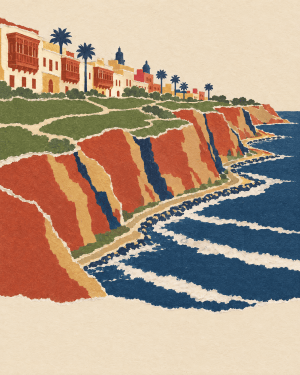
The Malecón is the cliff-edge promenade above the Pacific: several kilometres of path, gardens maintained between the walkway and the drop, paragliders launching on weekend afternoons, and a sequence of viewpoints that finally make Lima’s coastal geography legible. Walk it at sunset at least once, in either direction.
Larcomar, the mall built directly into the cliff face at the end of Miraflores, is worth knowing about for the geography rather than the shopping. Restaurants and bars face the Pacific from inside the cliff. Eat dinner there once; the view earns the tourist-zone pricing, and it is the single easiest way to understand how this city sits on its coast.
LIMAHuaca Pucllana, a pyramid mid-city
Compare daytime and evening tour routes

In the middle of residential Miraflores, surrounded by apartment buildings and restaurants, sits a pre-Inca ceremonial complex dating to roughly 200–700 AD. Huaca Pucllana was built by the Lima culture from handmade adobe bricks stacked vertically in a distinctive pattern often described as shelved books — a technique that, as it turns out, survives earthquakes far better than solid walls do.
PROMPERÚ lists separate daytime and evening visits to Huaca Pucllana. The evening route requires a reservation and does not include the same areas as the daytime route. Check current opening days, entry times and restrictions before booking; a restaurant reservation is separate from archaeological-site admission.
The restaurant beside the ruins — also called Huaca Pucllana — serves upscale contemporary Peruvian food with the lit site directly in view through glass walls. It is the kind of setting that sounds invented until you are sitting in it eating ceviche beside a pyramid.
LIMAMuseo Larco
Tens of thousands of objects, and you can see almost all of them
Museo Larco, in Pueblo Libre, a separate road journey from Miraflores, holds the most important private collection of pre-Columbian art in the world: tens of thousands of Moche, Nazca, Chimú and Inca ceramics, textiles and gold objects, assembled by Rafael Larco Hoyle in the mid-twentieth century and displayed in an eighteenth-century vice-regal mansion surrounded by gardens.
The distinctive thing about it is the storehouse at the back, where thousands of artefacts sit on open shelves in climate-controlled rooms, organised by type and all of it visible. Most archaeological museums show you a curated two per cent and warehouse the rest. This one shows you the warehouse, and the sheer density reorganises how you think about the cultures that produced it.
The erotic pottery gallery gets mentioned in every guide, with reason: a separate room of Moche ceramic representations of sexual acts, from roughly 200–700 AD, numerous and explicit enough to genuinely startle. Its real value is corrective. It makes it obvious that these were cultures with a complete rather than a sanitised relationship to the body, which is not the impression most museum displays leave.
What the colonial centre actually looks like


 LIMA
The city centre
Plan a separate half-day for the historic centre

Cercado de Lima requires a road journey from Miraflores, with timing dependent on traffic that most visitors never make, mostly because it asks for more navigation and awareness than the polished corridors of Barranco. That is a mistake: the historic centre holds the most significant Spanish colonial architecture in the city.
Plaza Mayor is the colonial heart. The Cathedral of Lima — begun in 1535, with Francisco Pizarro’s tomb inside — has an interior of ornate carved choir stalls that is worth the entry on its own. The Archbishop’s Palace sits alongside it, and any guard-changing ceremony should be checked against the current official arrangements.

The Convento de San Francisco and its catacombs are the strangest hour available in Lima. An underground ossuary holding the remains of something like seventy thousand people, arranged in geometric patterns — it served as the city’s main burial ground until 1808. Take the guided tour; the history is what makes it land, and almost everyone comes out more affected than they expected to be.
Plan the historic centre in daylight, check current access and arrange your return transport. Crowds, demonstrations and restrictions can change the experience; no district is risk-free.
LIMAParagliding off the Miraflores cliffs
Check the operator, location and weather conditions

A tandem paragliding flight can offer a different view of the coast, but operation depends on wind and other conditions. Confirm the exact launch location, pilot credentials, passenger requirements, insurance and cancellation terms with the operator. Get a current quote rather than relying on a fixed price in an older guide.
Keep a flight as a flexible option rather than a guaranteed appointment. Ask how weather cancellations are handled and whether transport, photos and any fees are included. Choose another coastal activity if conditions are unsuitable.
LIMAWhere to eat and drink
Purple corn, and the grape brandy nobody agrees about
The national beer is Cuzqueña, a perfectly respectable lager. More interesting is chicha morada CHEE-cha mo-RA-da: a non-alcoholic drink of boiled purple corn with pineapple, quince, spices and lime, served cold and sweet, in a purple so saturated it is unmistakable on a table from across a room. It is on every traditional restaurant menu and worth ordering deliberately rather than defaulting to a soft drink.
Pisco is the national spirit, a grape brandy and the base of the Pisco Sour: pisco, lime, syrup, egg white, a few drops of bitters. Whether pisco is Peruvian or Chilean is a real diplomatic dispute between the two countries that this guide is not going to settle. What can be said is that the Peruvian version, poured at a Barranco bar into a glass that came out of the freezer, is among the better pre-dinner drinks available on this continent.
LIMAOutdoors under Lima's grey sky
Coastal cloud changes the mood of the city
Lima’s coastal setting can bring long periods of low cloud, mist and drizzle, often called garúa. This changes the atmosphere of a clifftop walk, but it is not a reason to skip the museums, archaeology or neighbourhoods. Check a current forecast rather than treating a seasonal description as a promise for your dates.
The warmer part of the year generally offers more sunshine, but cloud and temperatures vary. Carry a light layer and sun protection, and plan indoor and outdoor options. Do not assume the city is always grey, never hot or guaranteed cheaper in a particular month.
 LIMA
Practical tips
Traffic, safety, and what to pack
The traffic is worse than the map thinks. Budget significantly more time for any taxi or ride-app journey than the estimate suggests, particularly in the morning and evening peaks. This is the single most common way a Lima day falls apart: two things booked an hour apart on opposite sides of the city.
Use a ride app rather than hailing. It fixes the price and removes the negotiation, and in a city this large you want the driver working from a route rather than from a description.
Use current local advice. Keep valuables discreet, avoid displaying phones beside traffic and use reputable transport. Read current Peru safety advice before travel and ask your accommodation about the specific route you intend to walk.
Pack for your actual forecast. A light layer can help on a cloudy coastal evening, while sun protection is useful even when the sky looks muted. Comfortable footwear matters for the promenade, steps and archaeological visits.
Entry and transport. Check current requirements and domestic routes on PROMPERÚ, the official tourism body, before committing to a Cusco connection — most people fly on from here and the schedules shift.
Lima between the sights


A three-day itinerary, and what to book
Day one: Barranco and Miraflores
Start with a neighbourhood walk, choose MAC Lima if its programme interests you, and have lunch nearby. Continue to the Miraflores promenade when the weather suits. Among the things to do in Lima, this is an easy combination to shorten if you arrive tired. Avoid making a weather-dependent flight the fixed centrepiece of an arrival day.
Day two: the historic centre
Give the centre its own half-day. Choose the cathedral, a convent visit or a guided architecture walk rather than booking every interior. Check entry arrangements and leave time for the return journey. Put lunch near the places you are visiting, and keep an indoor alternative if access changes.
Day three: archaeology and Museo Larco
Book a suitable Huaca Pucllana tour and plan a separate transfer to Pueblo Libre for Museo Larco. If that feels rushed, choose one and leave the other for a longer stay. Museo Larco currently lists daily opening from 9am to 7pm, with reduced hours on certain holidays. Check the visitor entrance, tickets and any gallery notices before departure.
What to reserve and what to leave flexible
Reserve a specific guided tour, a restaurant you particularly want and any transport with a fixed pickup. Leave walks and cafés flexible. Save booking confirmations offline, including the address and meeting point. Grouping things to do in Lima by district helps more than trying to predict one universal taxi time.
Budget and accessibility
Build the day’s budget from tickets, transfers, meals and optional guiding. Ask what a quoted tour includes and whether a missed connection or weather cancellation is refundable. For steps, uneven ground or reduced mobility, contact the venue about the actual visitor route. A nearby map pin does not tell you whether the entrance is accessible or whether the walk follows a steep staircase.
If you are continuing to Cusco, use our Machu Picchu travel guide to plan ticket and rail arrangements separately. Do not squeeze city sightseeing into a short airport connection: check your airline’s reporting time, baggage needs and the full return transfer first.
LIMAIf you only have an afternoon
The honest single answer
Not the museum. Not the ruins. Walk Barranco from the bridge down towards the sea, take the clifftop path north as the light goes, and watch the paragliders come down. It costs nothing, it takes three hours, and it is the version of this city that makes people book a second trip.
LIMAHow to combine them
Three days, and it repays every one of them
Give Lima three days. Barranco in the morning and again in the evening. Miraflores for the Malecón at sunset. Museo Larco on a weekday afternoon. Huaca Pucllana lit up at night, ideally seen through a restaurant window with a plate in front of you.
The food guide takes care of the eating, and in this city that is a substantial part of the argument. This guide covers the rest of it. Lima rewards attention, and it has been quietly rewarding it for a very long time while everybody else changed planes.
Before you go
How many days do you need in Lima?
Three days allow a useful first visit: Barranco and Miraflores, the historic centre, and a museum or archaeology day. Two days works if you narrow the selection and allow for traffic.
What are the best things to do in Lima on a first visit?
Start with Barranco, the Miraflores promenade, Museo Larco and Huaca Pucllana. Add the historic centre if your schedule allows, grouping stops by district.
Can I visit Huaca Pucllana at night?
Evening visits have separate opening days, reservation requirements and a more limited route. Check current official information; restaurant access is separate from site admission.
Is MAC Lima open every day?
MAC Lima normally opens Tuesday to Sunday and closes on Mondays. Check its current exhibitions and any exceptional closure before travelling.
Can I rely on a fixed taxi time across Lima?
No. Traffic and the exact addresses matter. Check the live route, leave a buffer and avoid booking activities close together in distant districts.
Can beginners paraglide in Lima?
Some operators offer tandem flights, subject to their passenger requirements and suitable conditions. Confirm credentials, insurance, launch location, current price and cancellation terms before booking.
Keep going
Sources
Practical information reviewed 15 October 2026. Recheck official opening times, ticket conditions and transport before booking.
Huaca Pucllana · Larco Museum · Convento de San Francisco · Lima Cathedral · Plaza Mayor · Barranco · Miraflores · PROMPERÚ
We will tell you whether we can help and send a written quote before any paid work begins.